SUMMARY
Should have Estonia boycotted this year’s Venice Art Biennale? After sitting out the art world’s pre-eminent international event in 2022 and 2024, Russia is back in its national pavilion in the Giardini and once again taking part in the Venice Biennale – the world’s oldest, founded in 1895 – for the first time since launching its full-scale invasion of Ukraine. And there appears to be little anyone can do about it: “the Biennale leadership allows it to happen and the Italian government throws up its hands”, as Maria-Kristiina Soomre, arts adviser at the Estonian Ministry of Culture, observed at the ceremonial pre-opening in early May.
Whenever a major international cultural event unfolds alongside a large-scale war, the question of moral responsibility inevitably surfaces – for states and for individuals alike. The Venice Biennale, so often likened to the Olympic Games, may be founded on “openness, dialogue, and the rejection of exclusion and censorship in art and culture” (critics have called this a fiction of neutrality), but that hardly makes it an ideology-free apolitical zone. It is a publicly funded enterprise structured around national representation. Artists not invited to the curated main exhibition – that is, the overwhelming majority – must compete for places in national pavilions financed by their respective countries.
Estonia has officially participated in the Venice Biennale as an independent state since 1997. Before the Second World War, it had no pavilion. Under Soviet occupation, Estonians had no state to represent and, diplomatically speaking, no voice. By contrast, the Russian Pavilion opened in the Giardini in 1914. Finland’s – having narrowly slipped from the Soviet orbit – followed only in 1956. For comparison, the British Pavilion opened in 1909, Germany’s also in 1909 (rebuilt in 1938), France’s in 1912 and the US Pavilion in 1930 – part of the 29 permanent pavilions in total. During the Biennale, one can wander through the Giardini, the Arsenale and the historic heart of Venice as if traversing a miniature psychogeographical atlas: as a nation, you are either seated at the table or served up on the menu.
This year Estonia is at the table for the 15th time, with Merike Estna’s immersive, site-specific monumental painting project “The House of Leaking Sky”, addressing motherhood and, at least thematically, resolutely apolitical. Russia, too, is at the table with (the disquietingly similar title) “The Tree Rooted in the Sky”, involving 38 artists. In total, 100 countries are represented this year – a figure that has grown steadily with each edition. Israel, for example, has participated since 1950, while Palestinians have no national pavilion: under Biennale rules, only sovereign states officially recognised by Italy qualify.
If one follows the media coverage to date, it is clear that geopolitics has eclipsed art in Venice this year. Even should an individual career catch a favourable wind at the Biennale, it will remain shadowed by the question of whom exactly the protesters in Venice’s labyrinthine streets were addressing, and how openly allegiances were displayed – in oversized banners, hastily made placards, fishnet-patterned scarves or blue-and-yellow garters. For the multinational audience, there are effectively two lightning rods this year: Russia, which has been killing Ukrainians daily since 2022, and Israel, who has (as many feel, perhaps over)reacted in Gaza in response to Hamas’s 2023 terror attacks.
In effect, it was because of these two states – or rather the storm provoked by calls for their exclusion – that the Biennale jury collectively resigned before the opening. Tasked with selecting the best exhibition at the outset, the jury stated that it could not in good conscience consider pavilions from states led by individuals against whom the International Criminal Court in The Hague has issued arrest warrants. In lieu of a jury decision, a public vote will now run until the close of the Biennale to determine the audience’s favourite pavilion and main exhibition.
What, then, of the question whether Estonia should have boycotted the Biennale? One might counter by asking who would have benefited and what would have changed. Even if Estonia had withdrawn in March, the Russian Pavilion in the Giardini would still have opened in May.
There was, however, one point on which Estonia diverged from countries such as Latvia or Finland. Some states opted not to send serving politicians at all, limiting official presence to civil servants. Estonia, by contrast, inaugurated its pavilion with a congratulatory speech by the Minister of Culture. The Estonian art community’s collective protest has so far remained largely symbolic as well: at the pre-opening, participants joined a march initiated by Latvian colleagues, carrying placards parodying the Biennale logo with the slogan “Death in Venice – Russia, go home!” Following the jury’s resignation, 30 national pavilions, including Estonia’s, along with most artists in the main exhibition, withdrew from participation in the public vote – effectively signalling from the outset that they did not wish to compete in November for the prize affectionately dubbed the Visitors’ Lion. Indeed, the process must not allow serious circumstances to lapse into farce.
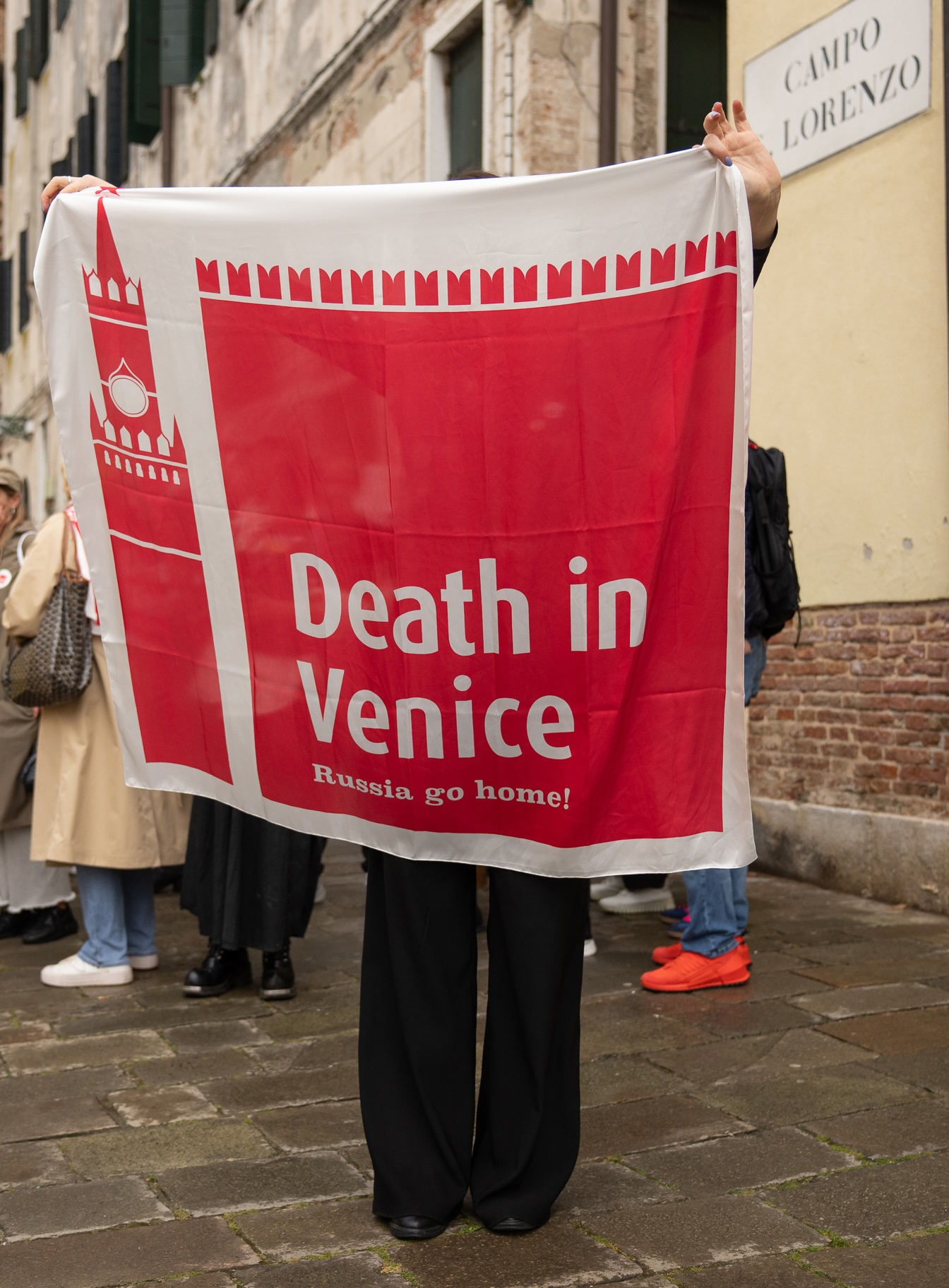
with Ukrainian cultural workers
Campaign material design: Krišs Salmanis