SUMMARY
First installation day. We’ve got the keys, a plan and a fairly calm mood. Me, Liisa-Lota, Daria and Marto are in our corner, painting walls. It feels strange – we’ve already talked all these things through so many times in meetings that it’s almost weird to watch the exhibition actually being built, physically, for real. The discussions were so detailed that you start to wonder what’s left to realise at all.
Liisa-Lota and I are squatting between the shelves at the Depo DIY store, talking about motherhood. Whether we want it, etc. Neither of us does right now. We buy sandwich supplies for 20 hungry installers and a basketful of colourful tapes. At the moment we’re waiting for someone to find us 50 T-shirts in the right colours, and in the meantime we talk like old friends.
We met a couple of years ago through the Estonian Young Contemporary Art Association (ENKKL) and have always been friendly, but creating something together, and actually making it, brings people into the same space very quickly and builds trust. One day I was sitting in the office of the Contemporary Art Museum of Estonia (EKKM) when Johanna – whom I’d spoken to maybe once before, if that – walked in and asked if I was in a relationship. Then she quizzed me for another 10 or 15 minutes about love and relationships. Later I had a long drive with Sonja, picking things up around the city and putting up posters, talking the whole time like we were longtime girlfriends. The association isn’t a circle of friends, but it feels like many of its members are potential friends.
One hour until the opening. It’s five o’clock. A Klassikaraadio reporter is there, interviewing people who weren’t supposed to give interviews. The people who were supposed to give interviews have disappeared. Tights are being pulled on, dress zips pulled up, a deep breath taken. At the same time, guests start arriving.
At the opening, wet snow blows horizontally straight into my face. With a trembling hand, I try to hold a Centre Party green umbrella over the head of a Reform Party culture minister while she thanks the curator of our exhibition. A few months earlier, at an exhibition meeting, phrases like “no to a curator, yes to a designer” and “fate is the curator of our lives” were being thrown around. That little detail wouldn’t occur to me now if I didn’t notice Mia Maria’s face under the umbrella, smirking at the culture minister from deep inside her fur coat.
ENKKL is not an institution. Though we love institutions. We have an official name, an obscure acronym, a website and a temporary internal division of labour. We send out a monthly bulletin to members and newsletter subscribers. Other art institutions want to collaborate with us – like EKKM and the Estonian Artists’ Association – and those collaborations are covered by third institutions, such as Estonian Public Broadcasting and Müürileht. We accept new members through an application process. And we don’t accept everyone – only those who receive the most votes at the general assembly.
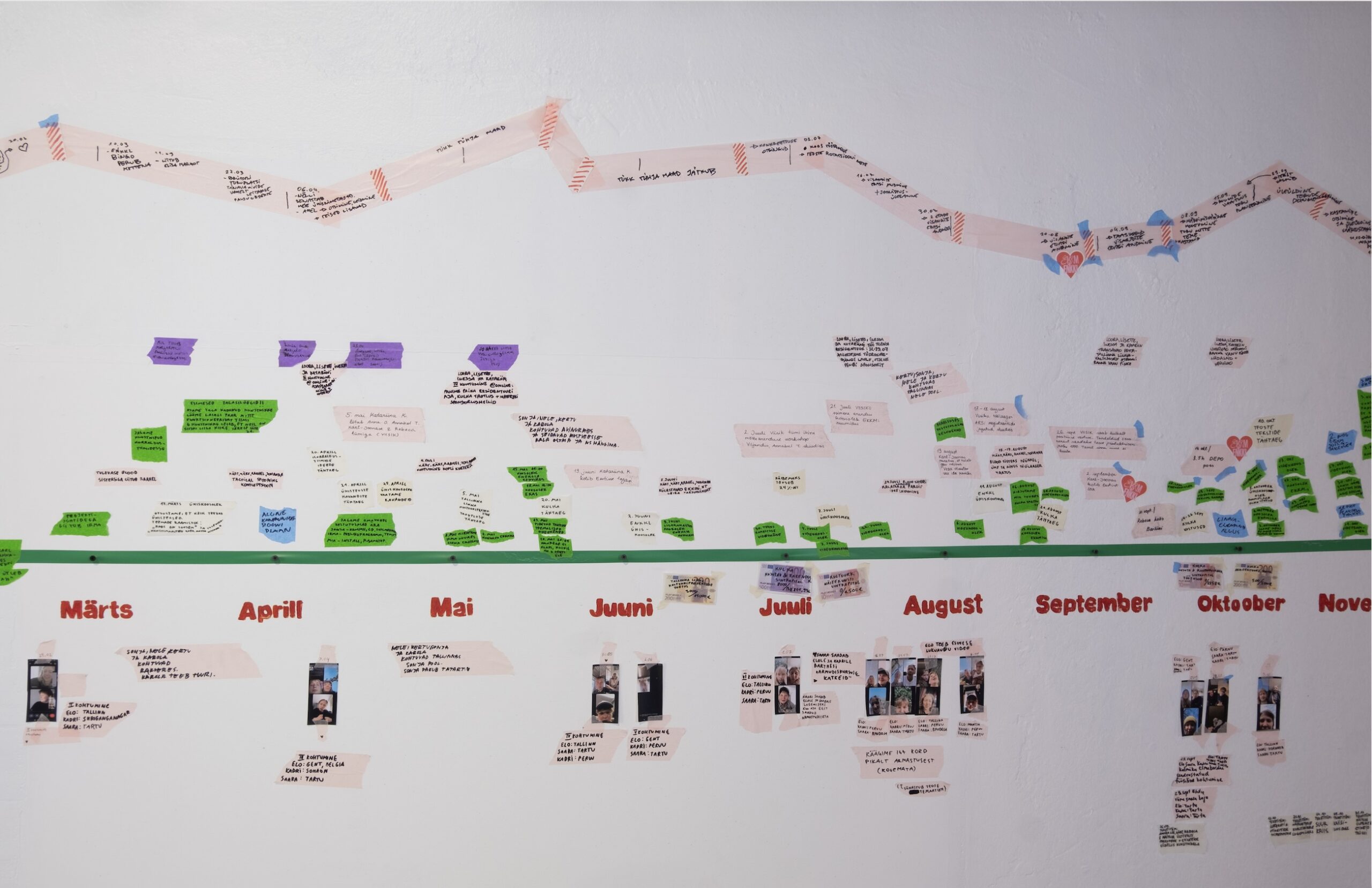
One evening, Margaret and I started talking at the Estonian Academy of Arts (EKA) about what ENKKL actually is. We had started working on the exhibition a year and a half before. EKKM had offered the association a temporary takeover of their building at the end of 2025. During the first meetings, it became clear which members wanted to and were able to take part. Since there were more than 30 participants, it quickly became obvious that instead of individual works we’d make group pieces, with the groups formed by draw.
Alongside the groups for artworks, groups also formed around organisational tasks. Every artist in the exhibition had to choose an additional role: who’s responsible for installation, who for communication, who puts together the public programme, who writes the wall texts, who acts as project manager, and who puts up posters in bars the night before the opening (it turned out this would definitely be one of the project managers). And that’s how we started moving very slowly, because with a group this large, slowness is inevitable.
I thought a lot about how many compromises we were making, and how many interesting angles this kind of collaboration might smooth away. Does shared responsibility dilute individual responsibility? I don’t really think it does – at least not judging by the exhibition “Together, We’re Warmer”. Watching my fellow exhibitors during the process, it really feels like everyone is taking it seriously. For all of us, this is personal, and we’re doing it together.
So Margaret and I sat there at EKA trying to figure out what this thing actually was. Who are these people? It’s not a collective. It’s not a group of friends. It’s not a school. Though yes, many members went to the same schools, mainly EKA. And yes, there are friends among the members – lifelong friends, groups of friends, even couples. I’ve known some members for nearly 20 years; with others, I’ve never even spoken. About half the association wasn’t involved in the exhibition at all, and that wasn’t a problem. Not everyone has to want to do things together.
But is there something we all want? Are we even here for the same reason? And is ENKKL a joke? A very long-running joke? A joke that’s starting to get old? Will the last drop of sarcasm soon be washed out of our white T-shirts that say “I love institutions”?
When I applied to join ENKKL three years ago, I did it completely seriously. It was a bleak early spring, I was stuck, and I wanted people around me. People who didn’t necessarily think about the same things, or in the same way as I did, who might be looking for something else, but who were at least thinking and searching. Together, we really are warmer.”Just imagine, all of this was created by only a couple of people,” says a luminary sat at the next table. I take a deep breath to calm my irritation. Not a couple of people but dozens of co-creators! I’m tired of the art and theatre worlds’ constant pursuit of the “real” author or creator. Who is the true director, whose idea did it all really come from? As if the creator were simply the one who first plucked the initial idea out of thin air – and, more importantly, put it into words. Even when a collective morphs into an institution and takes over another institution, there’s no escaping that burden.