SUMMARY
Rebeka Vaino’s solo exhibition “As I Was Moving Ahead Occasionally I Saw Brief Glimpses of Beauty” at Castellan House Gallery brings together works created over the past five years in Paris, London and various locations in Estonia. Vaino studied painting at the Estonian Academy of Arts (2015–2019), continued her studies at the Berlin University of the Arts (2017–2018) and completed a master’s degree in fine art at Goldsmiths, University of London, in early 2025. According to the exhibition’s press text, the artist explores “themes of memory, fragmentation, and embodied presence, examining experiences of trauma, depersonalisation, and confusion”.
Depersonalisation is a stark psychiatric concept that refers to an unusual perceptual experience described as a loss of self or a blurring of identity – as if a person were observing themselves from the outside. It is usually associated with high levels of stress. Since the artist has spent almost the entire past decade in unfamiliar cities, studying art, organising exhibitions and trying everywhere to quickly integrate into local English-, German- or French-speaking circles, one can assume that this process of adaptation has not been easy. Especially when, in one of these Old Europe metropolises, you have to explain that you come from Estonia, from Eastern Europe – a part of the world that, within living memory, did not even appear on classroom maps or in geography textbooks there.
The title of Vaino’s exhibition is a clear reference to art history: Jonas Mekas’s well-known experimental documentary “As I Was Moving Ahead Occasionally I Saw Brief Glimpses of Beauty” (2000). During his lifetime, Mekas was described as the godfather of American avant-garde cinema, and his uncensored documentation of American life makes his vast archive compelling material for future research, but beneath it all lay personal trauma. Mekas was not American by birth but an immigrant and war refugee from Eastern Europe. He fled Lithuania in 1944 as a young man and, after many hardships, reached the United States with his brother in 1949. Granted, the Russian army has not yet come to “liberate” Estonia from democracy and the free market. Yet its full-scale invasion of Ukraine has lasted more than four years and shows no sign of ending soon. In other words, what happened to Mekas and many other Eastern European war refugees in the 20th century could, in the worst case, once again become a painful reality despite the ideals of a free Europe. There is still anxiety in the air – a particular tension, an unspoken anticipation of catastrophe that has quietly become normal for Vaino’s generation. It was not long ago that young people’s futures darkened under Greta Thunberg’s warnings of climate crisis and the entire world briefly shut down during the Covid-19 pandemic. There has always been some new upheaval, some uncertainty about tomorrow. Or, as the title of one of Vaino’s performances puts it: “The world is spinning too fast, I need something to hold on to” (2024).
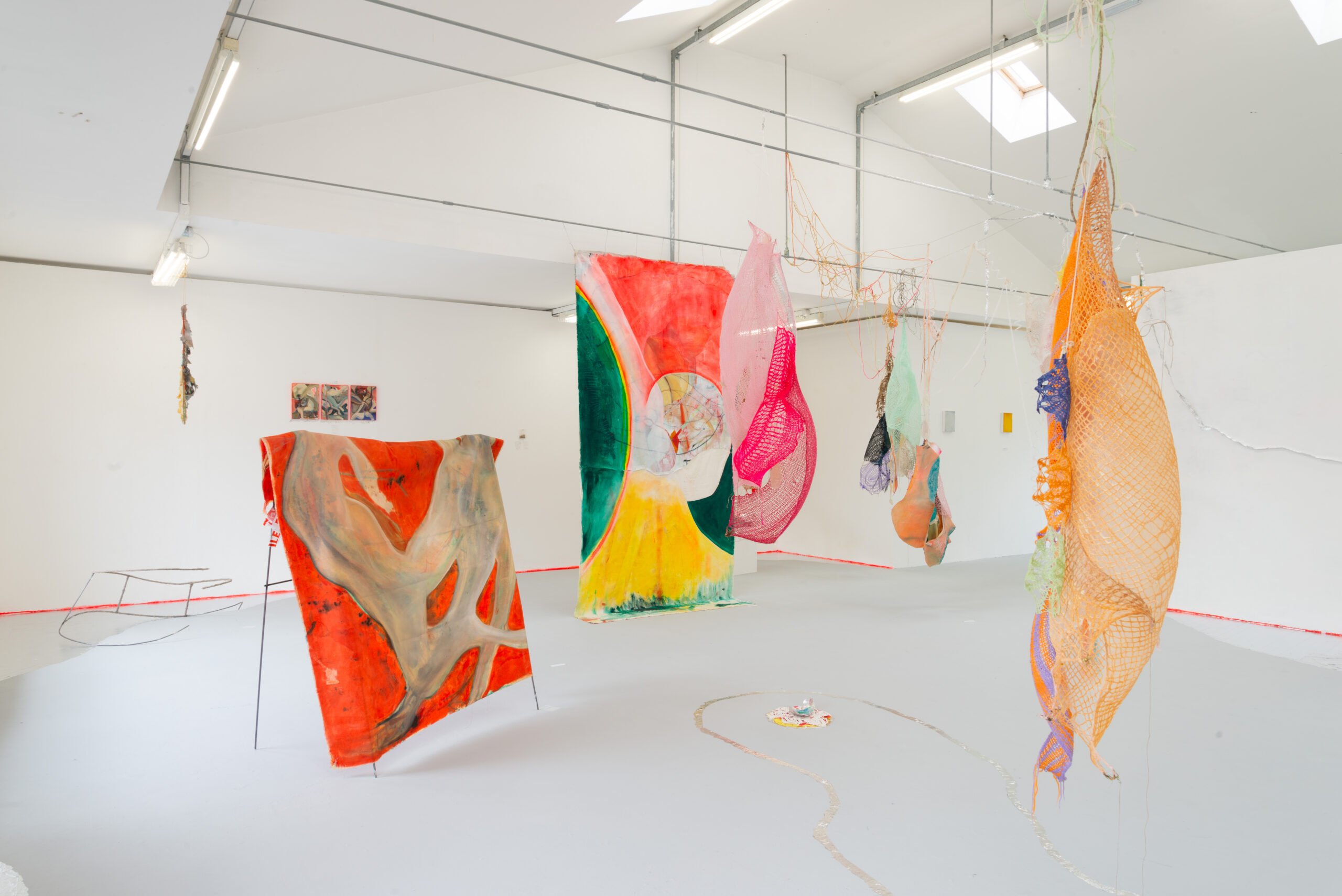
Exhibition view at the 2024 Goldsmiths University of London Fine Art
Master’s degree show
(Goldsmiths Campus, Studio B Barridale, 2nd floor)