SUMMARY
Arne Maasik has developed a clearly defined artistic profile. Photographs of the geometric landscapes of urban forms and, in contrast, images of undergrowth as a chaotic maze of untamed nature – this is how the architect-trained artist, who turns 55 this year, has made a visible mark on the Estonian art scene, attracting attention and receiving awards.
A technical strand in Maasik’s practice consists of sculptural assemblages in stainless steel, composed of ball bearings, pipe sections, rings, cylinders and other machine parts. These still lifes have appeared in exhibitions under various titles. The installation or assemblages present the raw substance of artistic material, onto which endless meanings and narratives can be grafted.
Naturally, this is a field where architecture, sculpture, and visual and performative art intersect. Maasik building his “steel city”, clad in a suit of tin foil – the image is strikingly photogenic and radiant. Reflected and refracted spotlights scatter shifting patches of light across the walls, adding an ephemeral play of illumination to the metal structure. The activity is exploratory and playful. Structure, pure geometry and monochrome – what we recognise from Maasik’s photographs – appear here as a way of stripping the image of excess information. They lead towards a quality that runs quite consistently through the artist’s work: intensity.
Maasik can be described as a practitioner of intense visual art. He uses the phrase “pure geometry” to articulate the flawless beauty of steel forms, but “pure” works here as a metaphor for the impeccable and the perfect. What emerges is an unmistakable experience of beauty and sublimity. Nearly a decade ago, Leonhard Lapin wrote of an “effect of sublimity” arising from the multilayered relationships of objects deconstructed through reflection and light. Lapin compared Maasik’s constructions to altars, to a Buddhist sacred figure before which one experiences elevation, rising above the everyday.
These new forms and objects also carry a poetic dimension. A pipe no longer channels oil, water or gas; a ball bearing no longer rotates, lubricated between steel components. They have become aesthetic objects in a utopian state of perfectionism, where order, purity and exactitude prevail. The associations with grand cathedrals and church spires are evident, as are echoes of classic science fiction cinema – there is much here that feels familiar.
As a photographer, Maasik is accustomed to exercising complete control over visual space – much like an architect – making sure that every form, plane, light source and reflection is precisely positioned. Everything is envisaged and staged. Each viewer defines the objects through their own path of movement and the time they choose to spend with them. Here, Maasik sustains a dialogue between the material and the immaterial. The reuse of metal objects and materials in the creation of sculpture and art is, of course, well established in art history. The list of sculptors working with recycled metal is long. The use of found objects and industrial waste materials was once a statement. It was a way of demonstrating how lifeless matter could acquire poetic and existential resonance and speak to viewers about themselves – and about civilisation more broadly.
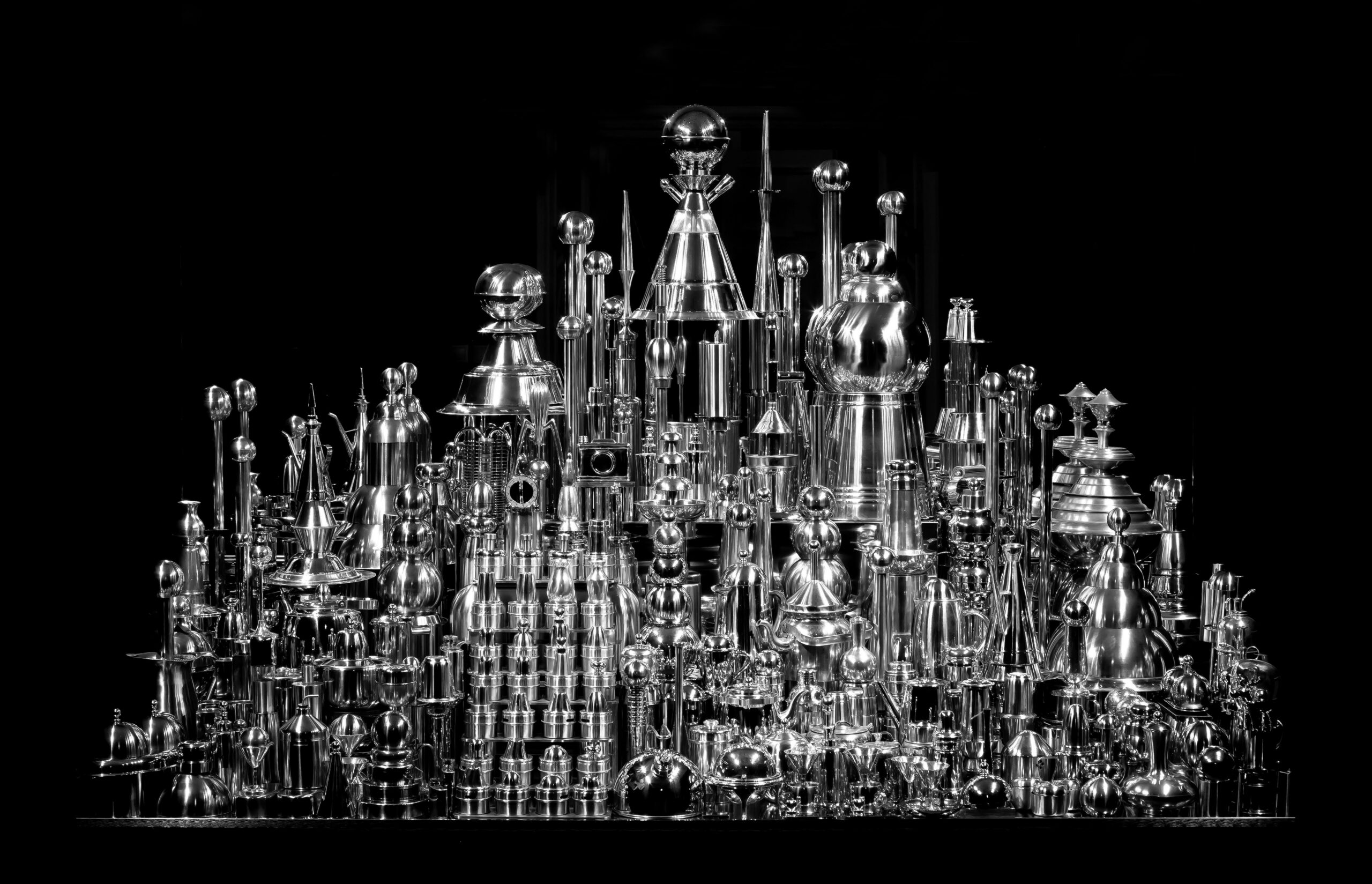
Still Life. Photo No. 3433
2017
Black-and-white photograph, 80 × 120 cm
Property of the artist