16. VI–5. XI 2023
Great Hall, Kumu Art Museum
Artists: Concordia Klar (1938–2004), Silvi Liiva (1941–2023), Marju Mutsu (1941–1980), Naima Neidre (b. 1943), Kaisa Puustak (b. 1945), Marje Taska (b. 1955), Vive Tolli (1928–2020), Aili Vint (b. 1941), Mare Vint (1942–2020) and Marje Üksine (b. 1945)
Curators: Maria Arusoo, Eha Komissarov, Eda Tuulberg
Brigit Arop (BA): Early this summer, an exhibition opened in the Great Hall of the Kumu Art Museum, presenting the combined body of work of ten women printmakers who were active during the latter half of the previous century. Viewers were invited to experience socialist society from the 1960s to the 1980s through the women’s eyes, engaging with themes such as the body, relationships, space, social roles, everyday life and the natural environment. How did the concept for this exhibition come about?
Eha Komissarov (EK): In the first year of the COVID-19 pandemic, Kumu lost virtually half of its foreign exhibitions. Faced with this challenge, we had to look more closely at how to make the best use of our own collections. Less than half of a museum’s collection is usually publicly displayed, so we decided to showcase more of ours while introducing new perspectives on the work within them.
During the pandemic’s first year, several of our most prominent women printmakers, including Vive Tolli and Mare Vint, passed away. It was then that I proposed the idea of an exhibition about women printmakers to Sirje Helme, the CEO of the Art Museum of Estonia. From the outset, we recognised the need to break away from the existing discourse on women printmakers and explore an entirely new approach.
Eda Tuulberg (ET): Examining collections is a basic practice at Kumu. Another enduring working principle has been to highlight and reassess the continuing relevance and significance of Soviet-era art. In recent years, there has also been a specific and deliberate focus on women artists. The exhibition of women printmakers emerged precisely at the intersection of these programmatic interests.
Maria Arusoo (MA): Reflecting on recent history from a contemporary standpoint is a major global trend, as it aids in recognising, highlighting and contextualising the work of a broader range of artists than before. Undertaking an exhibition of women printmakers at Kumu was a logical step, given the enduring relevance of the themes these women addressed.
BA: What approaches or perspectives did you agree upon when you first started the curation process?
ET: We didn’t start with a preconceived framework. We examined the work of not just the ten featured artists but of all local women printmakers from the late 1960s to the early 1980s in Kumu’s graphic art collection. Once we had our selection of artists, we broadened our exploration to include their studios and the collections of their heirs. Initially, we approached the material intuitively, fostering collaborative thinking and “listening” to what it communicated to three curators with diverse backgrounds.
EK: At the same time, from the outset, we were clear about the approaches we wanted to avoid. In the context of modernism, these authors were consistently labelled as printmaking innovators. Time and time again, discussions focused on new techniques and their refinement, forming a critique that was overwhelmingly technique-centric. We, however, opted to set aside this technical discourse.
While we acknowledged the artists’ technical prowess, our exhibition aimed to spotlight the content and substance of their work. We didn’t seek to show off our printmaking skills to the visitors but rather to present these artists as individuals whose work serves as a testament to a life lived.
MA: Despite being a newly formed team and my personally not having collaborated with Eha or Eda before, the initial phase of preparing the exhibition was characterised by mutual trust. As we talked, we realised that we had very similar principles for curating this exhibition. None of us wanted to create an exhibition that would force the artists into a preconceived concept. Instead, we knew from the start that we would allow the material to guide us.
We also determined early on that the show wouldn’t be a retrospective. Instead, we sought to interpret these works from a contemporary standpoint while being mindful of the artists’ historical context.
For instance, in the period from which most of these pieces come, the artists’ work was addressed through the concepts of femininity, decorativeness and beauty. I initially felt inclined to discard these terms and eliminate this vocabulary from the discourse. However, as the process unfolded, we decided to take these concepts metaphorically as vessels to be filled with new meaning – acknowledging that femininity extends beyond beauty, tenderness and brightness, decorativeness doesn’t necessarily carry a negative connotation, and beauty has its dark side. Thus, from the outset, we embraced a non-binary approach, avoiding simplistic categorisations and examining everything through layers and multiplicity.
EK: It was crucial for me to consider these artists’ relationship with feminism. In the 1990s, when feminism established itself in Estonia amidst other new rhetorics, it embraced a feminine discourse – specifically this narrative of “femininity”, “gentleness” and “beauty”, which had a unique history within the former Soviet Union, often incompatible with the Western experience.
Here, femininity was an approach to contesting the suppressed position of Soviet women that entailed asserting something society didn’t value – the feminine perspective. Estonian artists were virtually the only ones in the vast Soviet empire who engaged with feminine expression during the post-thaw period, an achievement that, unfortunately, has received insufficient attention. The arrival of activist and political feminism after Estonia regained independence pushed all that aside.
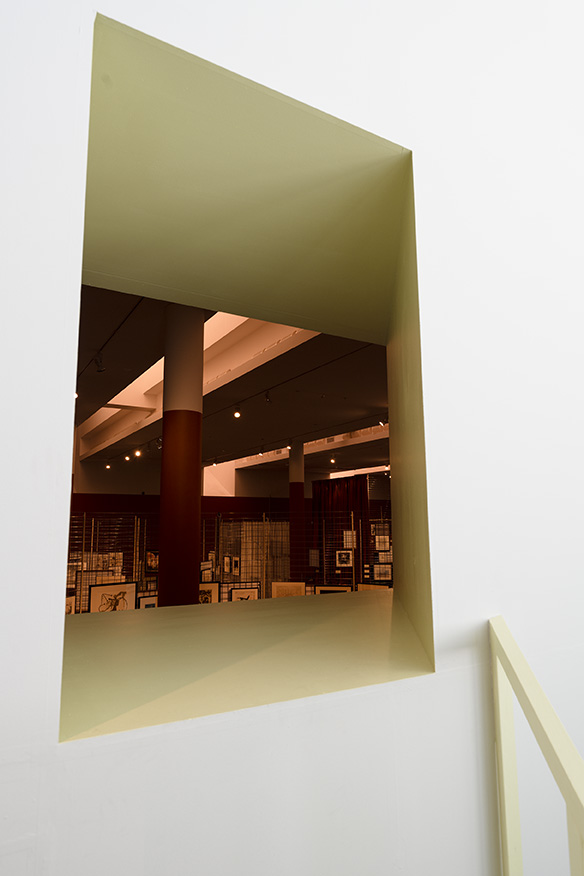
Exhibition view at the
Kumu Art Museum
Photo: Stanislav Stepashko
BA: How was the experience of collaborating, and how did it shape the methods employed in curating the exhibition?
MA: First, we got to know each other and sought to integrate our diverse backgrounds and knowledge. Given the considerable overlap of principles and the ways in which our methodologies complement each other, this was a smooth process. The difference in our thinking only became apparent as we began selecting the works. That was the moment we realised we had positioned the works in completely different linearities! It was also a fun moment – initially, there was confusion about how to proceed, but through discussion and multiple voices, we successfully developed a cohesive visual narrative.
ET: When it comes to the theoretical framework taking shape through our verbalisations of multivocality and camaraderie, the turning point for me was Maura Reilly’s “Curatorial Activism: Toward an Ethics of Curatorial Activism” (2018). Reilly reflects on the need to categorise exhibitions as those featuring women artists. She argues that such focuses are essential due to the persisting essentialism and inequality within societies.
Reilly suggests three different strategies for addressing the limitations of the canon of art history. The first involves adding new names to the existing canon, the second entails creating new and specific canons that run alongside the existing one, and the third, arguably the most transformative, is the relational strategy, which allows the establishment of new thematic dialogues.
From Reilly, we adopted the concept of polylogue, a term she herself borrowed from Griselda Pollock. With this concept, we aim to counter the homogenising, monological truth and to highlight through specific themes and premises the importance of dialogues and unexpected intersections. This approach, we hope, allowed us as curators to demonstrate the diversity of these artists.
MA: We also aimed to initiate dialogues through accompanying performances. Three performance artists were invited to engage with the exhibition’s themes: the concept of Keithy Kuuspu’s “Falling” (2021) aligned with the space and time highlighted in the exhibition, while Jette Loona Hermanis and Kaja Kann created new works based on and inspired by the pieces in the exhibition.
BA: Besides Reilly, what other writers guided the exhibition’s curation?
EK: I was lucky enough to get my hands on the Russian-language “Gender in Soviet Unofficial Art” (Гендер в ÑовеђÑком неофициальном иÑкуÑÑђве, 2021) by the Ukrainian art historian Olesya Avramenko. In the book, Avramenko meticulously examines the position of women artists in the Soviet Union from the era of Joseph Stalin to its eventual collapse.
ET: For me personally, a passage from Redi Koobak’s dissertation “Whirling Stories: Postsocialist Feminist Imaginaries and the Visual Arts” (2013) resonated with this exhibition. Koobak reveals that if feminism were a verb, for her, it would be whirling or dancing – a transformative activity that shakes you out of hierarchies, fostering new relationships with the world and others. These relationships are fresh, corporeal and characterised by the coexistence of different modes of perception. This might sound abstract, but it is precisely the sensibility I aimed to convey.
MA: In addition to these theoretical texts, it was equally crucial for me to read domestic fiction and poetry from the Soviet era. Exploring works by women authors in literature and film helped us to understand the lived experiences and choices women faced back then and the way creative women navigated their social reality. One work that especially left a lasting impression was Aino Pervik’s novel “Kaetud lauad”, that is ‘laid tables’ (Tallinn: Eesti Raamat, 1979). In addition to reading domestic literature, conducting interviews with the artists featured in our exhibition and documenting their insights was a crucial aspect of our approach.
BA: How did you approach different feminist curation methods?
MA: While the exhibition is curated from a feminist perspective, we opted not to label it as such explicitly. We recognised the artists’ conflict with feminism, particularly the hypocritical women’s emancipation of the Soviet era and, as Eha highlighted, the 1990s and the influx of Western feminism into Estonia.
Our approach was delicate and empathetic, steering clear of the “voice-giving” narrative. We tried to engage with the artists and their positions from a place of sensitivity, and we consciously embraced a non-hierarchical vocabulary, seeking new ways of understanding and rejecting the perpetuation of “great genius” narratives.
ET: Listening to the artists was a huge priority. In our many interviews with them, we discussed the position of women and women artists during that period while also exploring questions such as whether it is even fair to have an exhibition featuring only women artists. The interviews also allowed us to “test” the concepts and dilemmas we had been grappling with ourselves, ultimately leading us to let go of some of our own preconceptions.
EK: Letting go also meant breaking away from established ways of interpretation. The conventional discussion of women printmakers often revolves around specific categories, such as landscape and urbanism in the case of Mare Vint. However, in our exhibition, Vint was connected to broader themes like vulnerability and loneliness, which might have surprised, or even disappointed, those accustomed to putting these artists into boxes. No need to be discouraged, though! There’s room for your favourite keywords and new ideas!
BA: How did the exhibition’s design come about?
EK: Traditional museum displays often suffocate prints with passepartouts, heavy black frames and great white walls that absorb all the light and swallow up the work.
MA: … and that’s why the spatial design and dramaturgy were paramount for us. We wanted to encourage visitors to pause and truly engage with the works, fostering a dialogue, not just walking through the exhibition halls. The exhibition space and graphic design were infused with dialogicity, with designers Edith Karlson and Maria Luiga, along with graphic designer Brit Pavelson, finding organic ways to relate to the material, and many design motifs, such as birds and wire mesh, emerging directly from specific pieces in the exhibition.
ET: The design concept incorporated elements of transparency, hybridity, layering and dialogicity, as well as a somewhat labyrinthine quality.
MA: These choices came to us gradually and intuitively. On one hand, we engaged with motifs such as the mesh wire and transparency. On the other hand, the exhibition was designed to evoke a sense of reaching a dead end for the people who lived during the Soviet era. A sensation that suggests that, while the field of vision might seem unrestrained, ultimately, you will find yourself in a blind alley, with only grey birds in the sky to bear witness. Darkness, absurdity and humour emanate from these works.
BA: The decision to exhibit printing plates, sketches and the backs of works while keeping the exhibition space text-free seems significantly meaningful.
EK: Presenting the metal printing plates has become common practice. Given our desire to avoid a separate discussion on printmaking techniques, exposing these plates became a more subtle way of demonstrating the technical aspects of the work.
MA: Including sketches and printing plates reflected a deliberately non-hierarchical approach to the artwork. We sought a holistic presentation while also introducing elements of temporality. After all, printmaking is a time-consuming and physically demanding process that can affect the artist’s health. By demonstrating the challenges of working on harsh metal and mirrored forms, we encouraged viewers to ponder the challenges printmakers face. Not to mention the fact that the sculptural qualities of the printing plates are undeniably captivating in itself.
ET: For that reason, we opted not to include explanatory texts on the walls. The only textual elements were the wall text by the door and the book, which, unfortunately, is only available in Estonian. The “Archive Room” played an important role, providing a tangible connection to the time period without the need for additional background information about the works.
MA: Given the exhibition’s magnitude, I personally didn’t have a clear vision of how the space and choices would harmonise until it began to be installed. There were risks, but ultimately, all the elements came together successfully – a direct result, I believe, of the extensive and trusting discussions among all involved parties throughout the process.
Brigit Arop is an art worker, curator and writer primarily exploring women’s and queer experiences.