4. VI–18. IX 2016
9th Berlin Biennale (bb9) “The Present in Drag”
Curators: DIS (Lauren Boyle, Solomon Chase, Marco Roso, David Toro).
Marge Monko (M.M.): This interview was partly inspired by the 9th Berlin Biennale and the criticism it has received. Most of the works in the Biennale were in one way or another related to the post-internet discourse and at times invited quite sharp criticism. Interestingly, the critics mostly used the very same epithets to describe the works, such as “superficial”, “cynical”, “empty”, “dehumanising”, etc.
You were among the artists performing at the Biennale; what’s more, you’re one of the artists whose practice defines the post-internet discourse, as it were. How do you feel about the criticism?
Katja Novitskova (K.N.): To me, “post-internet” has become an empty word, used only in gossip or at art fairs. If someone said to me that they’re curating a post-internet exhibition, I wouldn’t take them seriously.
The DIS collective haven’t done that. Starting from 2009, they’ve built up a network of like-minded people who cooperate across the globe and publish artworks, texts and music in DIS Magazine and other platforms, such as DIS Images. Based on this coM.M.unity, ties between artists, musicians and thinkers developed naturally, and spread through environments like Tumblr.
All this happened before the great interest from the market and institutions. The market and large institutions allowed this community to achieve success and be recognised by the art world, at the same time defining “post-internet” as a new label. By that time, it had indeed become just a label: we ourselves (I and many of my colleagues) have stopped using it long since.
M.M.: An artist I know recently told me that, as a resident at a Dutch national art academy (Rijksakademie van beeldende kunsten – an up to two-year international residency prograM.M.e for young artists in Amsterdam – M.M.), she used to slightly look down on the Sandberg Institute types who worked on internet aesthetics. With self-irony, she went on to point out how the tables turn in life and someone’s work at some point becomes more significant than someone else’s.
In this connection, I’d like to ask you: how did you become an artist?
K.N.: In first grade, when my class teacher asked me what I wanted to be, I said, an artist. And after some trials and tribulations I succeeded.
The Rijksakademie is a good place, but sometimes it represents a conservative view of what art can be and what goes on in the world. For example, Dutch queens and princes attend the opening ceremonies there, which seems very strange to me: it’s 2016 – why does the monarchy even exist anymore? Why should I recognise it? The Netherlands has a very complicated colonial history, and it all creates a special environment there.
M.M.: You first came to the public eye with the 2010 publication of your “Post Internet Survival Guide”. It’s a 272-page book containing collaborations – visual work and texts – by more than forty artists and authors. Would you please say a few words about how it came to life?
K.N.: The “Post Internet Survival Guide” was my graduate thesis at the Sandberg Institute in Amsterdam. From 2008 to 2010, I studied in the graphic design department there, which was not an ordinary design school even back then: Daniel Van der Velden of Metahaven (a conceptual design studio in Amsterdam – M.M.) taught there, people like Åbäke (a transdisciplinary graphic design collective founded in London in 2000 – M.M.) organised workshops for us and so on. The emphasis was on the critical, conceptual and political potential of design.
While in Amsterdam, I communicated a lot with artists and graphic designers and at one point had to admit that I wasn’t going to be a good designer, as I’d rather do my own thing. I didn’t see a strong enough mystical charm in design, which seemed to be there in art. So I decided that although my final project should be a book it should be one where I study my visual and conceptual interests – a book as a study and an artistic object at the same time (it became part of the installation for my graduation exhibition).
Another very important factor was cooperating with people I thought of as like-minded or whose work sparked great creative interest in me. I thought about how the book would have a life of its own after I graduated and how the collaborations could be used in curating new exhibitions and projects. The result was clumsy in places and the curating problematic (for example, the percentage of men and women), but these were my first experiences and I’ve learned a lot since then.
M.M.: It seems to me that the popularity your works gained has been significantly helped by the images of the exhibition being circulated on the internet. I also first saw your work online: it was a photographic report of an exhibition by you and Timur Si-Qin at Bard College in 2012. Please tell us more about this show and the images of the installation.
K.N.: Our view was not that the images circulated on the internet would help us gain popularity but that those images would in fact be the most important output of our work – the logical conclusion of the production cycle of an artwork, which gives the work an independent online existence, making it part of the pattern of the rest of this visual flow.
For Timur and me, the exhibition at Bard College was the first to follow this principle. What was important for us was not the couple of dozen serious curators who would see the exhibition in real life, as it were, at one of the most expensive art schools in America (the Center for Curatorial Studies, Bard College); we made these works thinking about how thousands of young people would later look at the images of the exhibition on Tumblr.
This was definitely based on some kind of an idea of democracy and the democratic potential of social media. For we were also young, poor artists who had never had the opportunity to study at a school like Bard. Our curator Agatha Wara was the mastermind behind the whole thing. All the works were made using cheap materials (which we found in local shopping malls and ordered from print ad makers), and it felt very right in the context. My first collaboration with the DIS collective also grew out of this exhibition: they came and made a photo session with students at the exhibition.
M.M.: In several interviews, you’ve mentioned texts by Agatha Wara and Manuel DeLanda as a source of inspiration. How, if at all, does theory help you as an artist?
K.N.: I’m not a good writer, but I am highly sensitive to words and text. Writers help me find a verbal output for the concepts embedded in my work. In this respect, Agatha and I have had a very productive working relationship. Manuel DeLanda is a very special philosopher for me, and his profound theory of materialism is in fact based on an almost shamanistic sense of life. It feels very right.
Recently, I’ve also been collaborating with Nora N. Khan, who writes essays on topics such as the aesthetics of artificial superintelligence. And there are several other writers whose work I’ve been reading a lot recently: Benjamin Bratton, Janet Vertesi, Donna Haraway.
M.M.: Your work has touched on topics in fields such as biology, technology, astronomy and so on. What does your research process look like?
K.N.: My process is, broadly speaking, the visual scanning of the world, and grasping the images that emerge: I spend a lot of time on the Web. I’m fascinated with generating scientific images. Every dataset, every matrix of data that is generated in today’s world is at the same time a direct image of that world and/or the generator of the data. Accordingly, I think that our ideas about seeing, images and art history must change for us to understand this new world.
M.M.: You mostly use images found on the internet. Do you take your cue from these images and then place them in some conceptual framework? Or does the concept come first and then you find an image to represent it?
K.N.: I’d say that the work takes its cue from both the images on the internet and an idea I have. After having filtered out the images, I start thinking about what it all could mean. But it’s never possible to tell or explain 100 per cent, all the way through, what and why is going on.
When the work stands outside of language and linear logic, it feels like something new is coming to life. I’m happy when during the working process the thought crosses my mind: “I can’t believe I’m doing this!”
M.M.: Many of your works, for example, those in the exhibition at Bard College that we mentioned before, but also the more recent Dibond-based photo sculptures, borrow elements from the presentation formats used by the advertising industry. What is it in advertising that attracts you?
K.N.: The main idea was to use the formats that exist in the advertising industry (hoardings, support structures, fliers, cut-outs, flags, brochures, etc.) in the context of art. At the time of doing the Bard College exhibition, I didn’t have a studio; I just used my computer and a desk. When I realised that I had to make sculptures fast and relatively cheaply, the advertising industry seemed like the right place to materialise them.
Another thought was that, in today’s neoliberal society, every work of art is actually an advertisement for the artist and her world view, a signal vying for attention. It seemed exciting to explore all this.
M.M.: Please tell us a little about your installation “A DAY IN A LIFE with THINGS I REGRET BUYING” (2014) at the Kunsthalle Lissabon in 2015. It seems like a rather complicated and aesthetically unified installation. What was it inspired by and what are those ready-made objects that you’ve tuned up?
K.N.: In thinking about the world and observing myself, I realised that after the work with animal photos I had to address machines next: the “bodies” of machines and the relationship between the machine and the animal. That exhibition was an attempt to build this Jurassic park-like ecosystem with simple animated machines – how metal and plastic come to life.
I used these electronic baby swings available in shops, as they look very much like animals; I didn’t want to build robots myself or to have the machine aesthetic that would come with it. The simplicity of these baby swings, on the other hand, seemed fresh and relevant. It was also accompanied by the image of a machine that is not militaristic (like the Terminator), but one that can give birth, eat another machine and so on.
M.M.: Looking at your education, it all seems very smooth and logical: studying semiotics at the University of Tartu and then graphic design at the Sandberg Institute in Amsterdam.
Then again, I read in an interview for Frieze that before all this you were not admitted to the Estonian Academy of Art. Could the fact that you have a Russian last name and your native language is Russian have been a factor in this?
K.N.: I don’t really believe that my nationality was the main reason (Frieze misrepresented what I said). My leaning towards design came from the fact that I’d always been sensitive to typography and graphic layouts (both in books and on the Web), and it felt like the right area for engaging with the contemporary visual world while also making money, even though I had no practical experience in the area at the time. As I wanted to be admitted to graphic design, rather than the liberal arts department, at the time, the admission committee may have got the impression that I was not suitable for the design profession.
At the same time, having grown up in the Russian-speaking community, I knew that my options were limited in Estonia: because of my very Russian name, the fact that I wasn’t fluent in Estonian and the status that came with that. This was somehow a kind of general understanding, which I didn’t really think about in any focused way.
M.M.: Your educational background is multi-faceted, I’d even say ideal for an artist practising these days – semiotics and graphic design. To what extent has familiarity with cultural theory and design helped you in your artistic practice?
K.N.: After high school, my parents said I could study anything as long as I got a state funded place. I was admitted to the semiotics department along with my best friend from high school Anna, and so I went to Tartu. I think that this was the greatest gift in my life: semiotics made my thinking a lot more flexible and I got the chance to communicate with many highly educated people.
For example, I read books by Boris Groys in Russian already in my second year at university and, when finding myself in the art world, I discovered that there was this e-flux journal available online, where Boris Groys was also important.
M.M.: A few years after graduating from the Sandberg Institute, you were accepted into the two-year residency programme at the Rijksakademie in Amsterdam. I went there on an open doors day in 2013. It was quite surprising to see what a popular event it was – tickets were sold at the door and there were so many people that it was difficult to make one’s way around the corridors. The facilities available to the artists were impressive; for example, the various workshops focused on different materials. How did this residency influence your artistic practice?
K.N.: Yes, what I got from there was precisely the experience of making art in a studio and I learned to work with various synthetic materials (polyurethane resin and others).
M.M.: For several years now, you’ve been represented by Kraupa-Tuskany Zeidler in Berlin. The list of artists they work with is impressive: Daniel Keller, Slavs and Tatars, Guan Xiao and others. When visiting their gallery in Berlin for the first time a couple of years ago, I was surprised by the location – a third-floor office space in a commercial building. On the other hand, this nonchalant attitude gave the impression that the focus was elsewhere – on supporting the work of the artists and representing them at international fairs.
What’s important for cooperating smoothly with a gallery?
K.N.: Each gallery and each relationship between a gallery and an artist is special and difficult to generalise about. I don’t know what Kraupa-Tuskany Zeidler first saw in my work, but they were a great help to me.
They’re roughly the same age as I am, we understood each other at a conceptual level and their knowledge of art history helped me to contextualise my work in the art world. They had a long-term interest in the development of my work, and they helped with the production of the works, both financially and with advice.
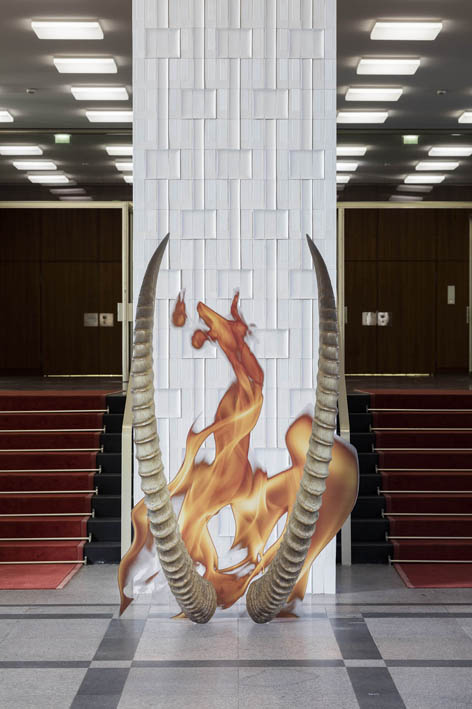
Katja Novitskova
Neolithic Potential
(fire worship, deer horns)
2016
digital print on PET G,
digital print on aluminum,
206x215x40 cm
Berlin biennale
installation view,
photo by Timo Ohler
Courtesy the artist and
Kraupa-Tuskany Zeidler
M.M.: How important is the presence of colleagues and like-minded people for you? For example, do you feel the need to share and discuss your ideas and to show others your work in progress?
K.N.: I don’t think I’d have amounted to anything without my friends who are active in art, or without the feedback from them. Actually, I don’t even know how to work on my own – many of my important decisions have been made as a result of conversations.
M.M.: As an artist, I know that creating new work requires space and time, but the art world, at the same time, is a machine in its own right, operating on the assumption that the artist is a perpetuum mobile, constantly putting out work and staying in the picture, as it were.
How do you cope with these expectations at a human level, how do you take care of yourself?
K.N.: I don’t cope with them particularly well, but that is a personal issue.
M.M.: In Estonia, they’ve started to show your work only quite recently, and largely thanks to Kati Ilves, a curator at the Kumu Art Museum. So, it even seems like a logical continuation that the collaborative project that you two submitted together was chosen for the Estonian pavilion at the next Venice Biennale.
I know it’s too early to talk about it, but still – what will the exhibition be about? Are you planning completely new work?
K.N.: I don’t have any details to give you about this yet, but I’m certainly going to create new work thinking specifically about the spaces in the pavilion, and they will be created in cooperation with Kati.
Marge Monko is a photo, video and installation artist living and working in Tallinn.
Quote corner:
“The critics have mainly faulted the biennale for being apolitical, emphasising the conflicts and the refugee crisis going on in Europe, and the fact that the exhibition ignores these. In reality, the New York-based DIS collective began to work on the subject long before this year’s events; despite this, the exhibition certainly has a political aspect, or what else should one make of the fact that most of the works are about a future world of digital capitalism and big corporations, at times descending into dystopian visions, or placing the refugee crisis in a networked world. But – haters gonna hate anyway.”
Kati Ilves, Näitusesoovitused – 9. Berliini biennaal. – Kumu blog 19. VII 2016.