5. V–8. X 2023
Kumu Art Museum, 5th floor
Artists with commissioned projects: Evy Jokhova, Edith Karlson, Mari-Leen Kiipli, Laura Linsi & Roland Reemaa, Laura Põld and Lou Sheppard, Ivar Veermäe
Curators: Linda Kaljundi, Eha Komissarov, Ulrike Plath, Bart Pushaw, Tiiu Saadoja
Andreas Trossek (AT): In art museums, things are planned a long time ahead. I remember it was about two or three years ago when I heard a rumour that Kumu was organising a show around this concept of the Anthropocene. So I am curious to know at what stage you all became involved in this huge exhibition project and why you decided to accept the invitation and be part of it.
Lou Sheppard (LS): I work a lot with Laura Põld, and she and I were trying to work together around the question of post-humanism and also this question of queer ecology. We’d been researching together after meeting in New York, but, of course, the Covid-19 pandemic had kept us apart. So this show invitation came up and she was like, “I think this is a perfect place for us to show some of the research and work that we’ve been doing together.” And that would have been, I think, two years ago.
Interestingly, I think some of the earlier shows that were about the Anthropocene maybe weren’t as critical. But this show in Kumu is coming a little bit later in the time of these large Anthropocene shows, and it feels quite critical and thoughtful. It feels like some of the problems and questions that have been presented in earlier shows have been resolved here.
Evy Jokhova (EJ): I have family that’s Estonian and I’ve been coming to visit since I was a small child, but I never lived here. I was here at one point and I had a meeting with Eha Komissarov in the museum. She just wanted to get to know my practice a bit more – installations about the relationship between humans and nature, humans and architecture. So we’re talking about this, and some of the other curators of the exhibition joined the meeting. And yes, it was around two or three years ago.
They said, well, “We’re planning this exhibition. Would you like to be part of it?” And it’s also my first exhibition in Estonia, which is somehow home. So, of course, I accepted the invitation. In a sense, it’s been like a journey of repatriation because, over these two years, I’ve been coming to Estonia partially for these research trips with Kumu.
At some point in the archives of the Estonian National Museum, we came across these embroidered hand towels from the 1920s and the 1930s that had gnome cartoons, and I just couldn’t let them go. They were fascinating. So I said, “Hey, I know we started talking about geology, but this has to be all about gnomes!” There are the textile pieces that are woven, embroidered and crocheted, and for me, each line of a thread is a line in time – geology is hinted at throughout these layers.
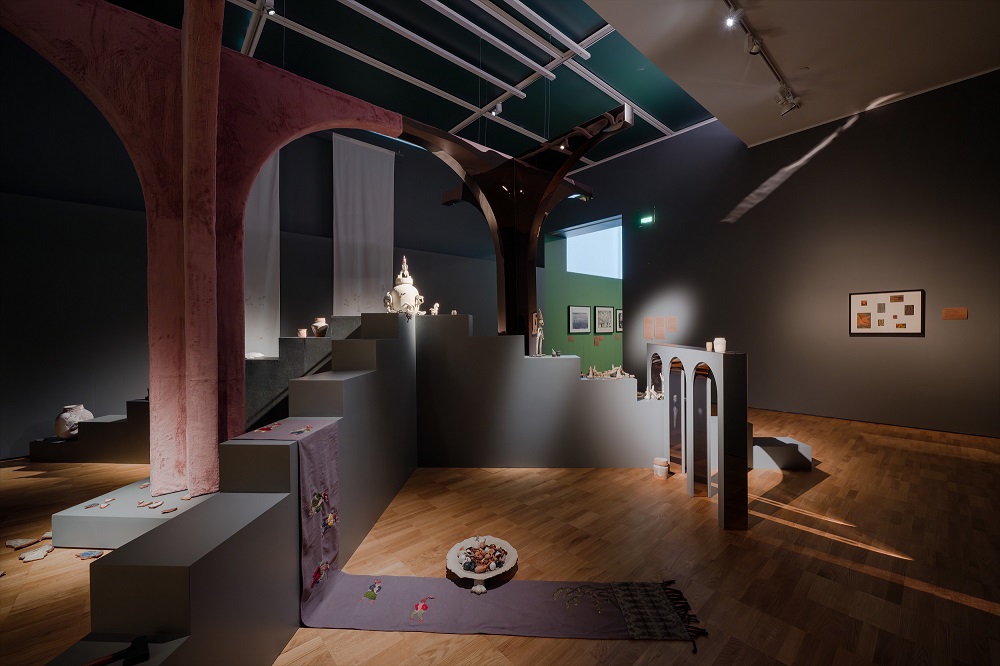
Evy Jokhova
Waiting for Geological Time
2023
Site-specific installation
Exhibition view at the Kumu Art Museum
Photo by Stanislav Stepashko
Courtesy of the artist
Mari-Leen Kiipli (MLK): I also think I got the invitation in 2020 or 2021 after I did my first exhibition using plants that I was growing in my country home (which is near Kehra, where I have family history). Kehra is an industrial town with a large working pulp and paper mill. And after this invitation came from Kumu, we talked a lot about this pulp mill and the paper factory, the Jägala River, and the pollution that creates this excess of plant life near the river. So here I’m developing my practice a bit further.
For example, when I try to grow something in the plant pot, I have to ask how to find plant species that can survive here in this museum environment. Here, I also used some of the vegetables my family has grown in the country home. Growing plants was also a big source of income during the transition period from the late Soviet era to re-independent Estonia – when people were quite poor and it was kind of a good way to sustain oneself economically.
AT: So basically, you have to check from time to time if the plants that are part of your art installation are surviving?
MLK: Yes. And probably I’ll be involved with this work the whole summer because I have to take care of it somehow.
AT: Edith and Ivar, how about you?
Edith Karlson (EK): I just checked, and the first email I got from Linda Kaljundi was in 2020. It was actually pretty straightforward: they thought that maybe I would be the person who would connect with this “animal/fish” subtheme, and I said yes because it really sounded super interesting. And I also liked that she said that it’s going to be a long process and that we will have time to deal with it.
Actually, I remember, when I got this email, I was hanging around in Ida-Virumaa, so it was really like a sign because of all these melancholy vibes that you get there in these industrial areas. There is some pain and ther is some beauty and it is all very intriguing.
Ivar Veermäe (IV): I don’t exactly remember when I got involved, but it was certainly more than a year ago. In some sense, my work was turning in this direction anyway. Previously my practice was a lot about technology, but always through the lens of some specific place, like a small part of a wider environment. And so the idea of this exhibition seemed very interesting to me and felt really fitting.
I visited many scientists and people working at Kohtla-Järve Museum of Oil Shale. I’m always gathering information on preparation stages, but this time it was more extensive, so now I have a huge collection of material. Only a small selection is presented here in Kumu, and I’m definitely working further with this material.
AT: So what is your opinion on the matter of this oil shale business: should Estonians just keep digging it up and burning it because it is energy and it is there in the ground?
IV: Not digging it anymore would be better. Or rather, concentrating on how to consume less. Humans are really energy-needy. How to be less needy, that’s the question.
AT: But during this process, what has been the general mood or mentality? I guess what I’m trying to ask you all is that – if I think about the Anthropocene as a keyword – it’s really a melancholic issue in the sense that it says, metaphorically, that the damage is already done and the planet is pretty much ruined. Geologically speaking, the human race is changing the face of the planet. I mean, what is there to be done?
EK: Yes, as you said, the damage is done. But I think it’s also about how you still have to find some happiness and hope. I think it’s also getting better somehow. I’ve been talking with some friends lately who were remembering the Soviet times and what was going on with nature back then and that people simply didn’t know any better. But people get smarter and smarter all the time and start to find out ways how to make it all work somehow.
AT: Then again, if you want to build a battery for an electric car, it’s not exactly environmentally friendly either.
LS: Yes, it’s complex to be alive right now. Everything that we do impacts everything else. We can’t just be extracting. We have to understand what our relationships are.
For example, when we started working in Kunda [Estonia’s biggest limestone quarry and the country’s only cement plant are located there. – Ed.], we were feeling like, “It’s so barren! It’s so empty! It’s just so vast!” And then, as we started to actually spend time there, we were learning about these plant species and bird species that were coming back there. We also learned that because they use fertiliser – like nitrogen – to do the explosions, the soil becomes very rich afterwards. So all these new trees grow, but they grow back in these really specific patterns and weird grids that mimic how the blasting was done.
I guess what we came away thinking about was this idea that what is happening there is that you can’t call it “nature taking it back”, but it is actually more like a collaboration or some sort of weird half-manufactured, half-natural landscape. And there is something really resilient about nature in this space and the fact that it’s not a wasteland. So that’s maybe one way of being less melancholic.
I mean, things are weird! And that’s interesting.
AT: Yes, because I don’t think that there’s going to be anyone who will address the main issue here – I mean, on a global political scale – which is overpopulation.
LS: It is what it is. We can’t make decisions about ourselves like that. We have to just accept that this is who we are.
In some ways, I used to be much more like, “Things have to change!” Now I’m much more like, “This is where we are.” And it’s interesting. What does it mean to be participating in it? I think accepting the situation is a part of what actually helps us.
EJ: I think this is one of the reasons why this exhibition is so interesting because, yes, the topic is really melancholic, and yes, we’re super needy as human entities.
During the installation time, I had some spare time to look at all the other artworks, the historical works. The problems that we have created are often not created out of malice but out of best intentions. So, for example, in the 1960s, they’re saying, “We need to feed all these people! We have this technology; we can do this!” The road to hell is paved with good intentions. Right?
Well, this is kind of where we are now. We paved it all with our good intentions, often delusional, but also because we didn’t necessarily know better at the time. I find it one of the most interesting points in the exhibition because now we can see how certain things were delusional. But it was not apparent at the time.
Why did I create this parallel universe of gnomes for this exhibition? I mean, we have “gnome propaganda” in there! It’s a little tongue in cheek: there’s an embroidered towel of happy dancing gnomes in the forest. So in a sense, it’s also a parody or farce on this very topic.
And I think what Lou also said – this idea of interdependence – it’s a big topic recently, and I think really important. Push and pull, take and give back. I do feel that, in recent years, there has been an increasing awareness of this mindset and the impact that we make on the planet.
Of course, there are a lot of online meetings now. Initially, when I was joining those, I thought that actually, this is a great way to communicate – people are no longer flying or travelling to meetings. But also, as I found out relatively soon after, all the data storage and energy leave a huge carbon footprint. At least now we’re a bit quicker at understanding these little mini-delusions. We are needy, but we’re also incredibly adaptable.
In a philosophical sense, there’s also the negative aspect of hope – of hope becoming a certainty. We know nature regenerates, but do we really know it? We don’t. It’s a hope that has become a certainty. So we continue trashing things, assuming [nature] will regenerate. And in some cases, this happens and it’s amazing. For example, as a side effect of explosions, plants grow.
However, there is a big push to slow down. The reason I use super labour-intensive materials is that these are things where you give time. Hopefully, many of us are now more capable of recognising these things sooner. So there is hope. It’s melancholy, but there are these mini-movements… If everyone does a tiny bit and laughs along the way, maybe it’s not so bad.
AT: I guess this is a bit like Mari-Leen’s installation’s topic as well, right? Tending to plants, it can be very therapeutic. It’s useful because you can eat the cucumber later on, but it’s also a therapeutic process.
MLK: Yes, coping with all these things is important.
For me, quite a sad topic is also deforestation in Estonia. I’ve seen many of my favourite forests cut down – places where I used to go all the time to pick berries or mushrooms. For example, behind our house, there was this forest. In my imagination, it was “endless”, kind of like the cosmos or something like that. But then it was cut down, and the area of the forest clearing was, in fact, so small it totally shifted something inside of me.
Later I decided to spend quite a lot of a lot of time in this clearing just to adapt to the situation. I felt it was a healthy thing to do. And I think I eventually just accepted that there was this clearing now. I even had some bits of it included in my installation.
AT: Figuratively speaking, I think if people pronounce this word out loud – a tree – they usually imagine something with a diameter of maybe 20–30 cm, the size of something you can grab with your hands. But in medieval fairy tales, a tree is like 200¬–300 years old, it’s really thick, it’s scary and it’s huge.
Even in Estonia, which has quite a lot of forests, we are still usually talking about younger forests. So we have adapted to this idea over time that a normal forest is in fact a young one.
MLK: Yes, and when it grows a bit bigger, it’s “such a waste”!
EK: I just wanted to add that when it was Covid-19, I bought a small forest. Only about one hectare, but large enough for me because it’s a very old forest. Some trees are more than 100 years old. I plan to hold on to this old forest so everything remains untouchable.
But what was interesting was that a small part of it was cut down by the previous owner, so I’m walking in this fairy tale forest and then in this cut-down part of the forest, and I can see how it starts growing again. I have some young trees there and I try to shape them to grow how I want them to. So now I feel very excited about this.
However, more generally I feel pretty guilty because of the way I work. I use all kinds of materials because, as an artist, I’m simply interested in all kinds of materials. For example, I use some extremely toxic materials because they somehow work if I want to make large-scale sculptures. And actually, it has always been an issue for me.
The problem is that I haven’t managed to find how to do my things without using these materials, so I’m constantly trying to figure out how to change that. For example, I have been using epoxy and plastic for years, and last year medics said that I have asthma. So I have developed physical reactions to all these things I have been working with. Still, I haven’t found the right answer. I haven’t found a way to do my things without feeling guilty.
The thing is, I never have a straight plan when I start doing something, so I overwork and I overproduce. This means I do everything totally wrong in the sense of making the world a better place! But now I’m just slowing down a little bit. I don’t use that much material anymore. It used to be that every time I participated in an exhibition, I always produced a new work – which in itself is questionable. It would be so nice if an art piece had a longer lifetime.
AT: Maybe what artists can do in society is simply raise awareness of such issues? Life is composed of those tiny little choices.
EK: True.
AT: Or maybe you could just sell all the artworks from the storage at Art Basel and then buy more forest?
EK: Ha-ha, yes!
Andreas Trossek is the editor-in-charge of Kunst.ee.