8. IV–31. V 2013
Tam Gallery
Peeter Tooming’s (1939–1997) commemorative exhibition “Siin ma olen” (Here I am) is a sincere mark of respect to an artist whose life unconditionally centred around photography and film art. The exhibition is primarily an overview of the artist’s work between 1970 and 1985. The few dozen works that are exhibited at Tam gallery mostly include Tooming’s most famous portraits, landscapes and nudes; in addition, there is also a mock up of the book “Hetked” (Moments), which was used as the basis of his 1976 “photo film” of the same name. The purpose of the exhibition remained slightly vague. It is unclear why those particular photographs from that period were chosen. Considering that Tooming’s work was based on stories and a clear conceptual structure, one would expect the exhibition itself to be more narrative. The main denominator seemed to be the international acclaim that those photographs received and to emphasize and affirm this – the mounts of the photographs were stamped accordingly. Although the accompanying text for the exhibition states a bit incorrectly that this is the first time since Tooming’s death that his original work has been exhibited to the public,1 nevertheless recalling his work is absolutely necessary, but it should be done with more emphasis on the meaning of his work and on introducing the photography of that era.
Tooming’s experimental style began with the photographic group Stodom2, formed in 1964, and which included Andrei and Tatjana Dobrovolski, Kalju Suur, Rein Maran and Boris Mäemets and later also Peep Puks and Tõnu Tormis. Stodom’s work was a platform for championing photography and experimenting with the photographic means of expression, and focused on the subjective nature of photography and provokingly experimented with different forms.3 Tooming himself called the main active years of Stodom (1966–1975) the technicist wave in Estonian photography.4 The technicist wave carried on into the 1980s, when editing, the mechanical denaturing of photographic surfaces, tonal and optical dislocations and surprising camera angles, which sometimes helped create unlikely ratios of scale between objects in the photographs, were still relevant.5 The goal was to use tools that emphasized visual values and the creation of a singular photograph that is unique and artist-centred without relying on the camera. This modernist approach in Tooming’s work as well as in the work of other members of Stodom became intertwined with the selection of utterly poetic motifs. They were mostly wandering around in rear courtyards, taking pictures of ruins and silhouettes. Tooming’s nudes, landscapes and archaic farmhouses are rather romantic, but carry a strong sense of gloom and drama. The work of Stodom’s members was usually based on a narrative or a story, which in itself was an innovation on how to approach photography. They started making “photo films”, which created a completely new genre.
Tooming organized exhibitions, initiated a plan to establish the Photographic Museum, presented photography prizes, made television shows on photography, wrote photography criticism as well as the history of photography. Peeter Linnap has claimed that thanks to Tooming’s comprehensive work, people learnt at least something about photography, but the interpretations of one person are inevitably one-sided and limited.6 A revival of sorts in Estonian photography took place in the mid 1960s, which continued to affect its development until the end of 1980s, but it was not enough to create a permanent tradition and to organically combine photography with visual arts. The main problem lay in the fact that in the mid 1960s there were no local traditions to lean on. When Tooming asked his peers in his 1989 film “Fotomure” (The Problem of Photography) how well Estonian photography is known in the world, he reached the conclusion than despite tremendous work, internationally renowned experts in photography knew nothing about Estonian photography.7
Even nowadays, when we study this era, we have to acknowledge that the only information about Soviet photography is from Tooming himself, which is why it is difficult to get an adequate picture of photography at that time. Later approaches are mostly overviews (Peeter Laurits, Eero Epner), only Peeter Linnap has studied Soviet photography in more depth. We clearly have to be very critical of Tooming’s writings, which lack any kind of neutrality. He promotes everything that was connected to photography and did that with manifestos, which is why his photo historical and theoretical evaluations are rather limited.
In the 1990s, a sudden distancing from Soviet photography took place, and it has remained so even until today – the photographic art of that time is practically “invisible” and excluded from art history, just as in the Soviet times. There is no adequate approach or critical evaluation of the history of Soviet photography. In light of this, the exhibition at Tam Gallery is certainly praiseworthy, but the solution is symptomatic: it is an arbitrary reminder of an era that needs to be unfolded before it completely falls into oblivion.
Merilin Talumaa is a MA student at the Institute of Art History in the Estonian Academy of Arts.
1 A large-scale retrospective photo exhibition took place at the Photo Museum between 15. V 2009–2. V 2010 “A pioneer in photography. Peeter Tooming 70”. Curator Mall Parmas.
2 The first exhibition of Stodom took place in 1966, in the foyer of the library of Estonian Academy of Sciences, which was part of a joint exhibition called “Painting. Graphics. Photography”. See Peeter Tooming, Stodomlikud kuue- ja seitsmekümnendad. – Teater. Muusika. Kino 1997, No 4, p 130.
3 Eva Näripea, Turistlik eskapism ja sümfoonilised variatsioonid: Tallinna vanalinn vaatefilmides 1960.–1970. aastail. – Kunstiteaduslikke Uurimusi 2005, No 2–3 [14], p 12.
4 Peeter Tooming, Fotomontaažist. – Teater. Muusika. Kino 1987, No 8, pp 45–46.
5 Peeter Linnap, Peeter Tooming (1939–1997). Polüskoopiline tagasivaade. – Cheese 2009, No 34, p 22.
6 Ibid., p 25.
7 Ibid., p 27.
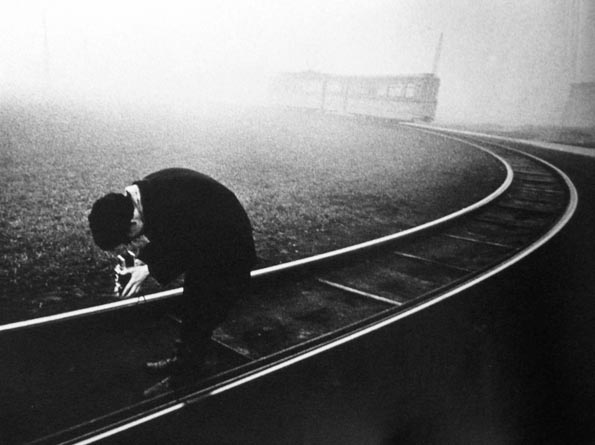
Peeter Tooming
Photographer (Peep Puks)
1970
Photo
Courtesy of the artist