18. III–27. VIII 2023
Tartu Art Museum
Artists: Paul Kuimet, Tõnis Saadoja (+ Friedrich Deppen, Oskar Kallis, Julie Hagen-Schwarz, Oskar Hoffmann, Kristjan Raud, Paul Raud, Richard Sagrits, Konstantin Süvalo, Aleksander Tassa, Aleksander Uurits)
Curator: Eero Epner
In some ways, it is strange that Paul Kuimet and Tõnis Saadoja have not exhibited together before. Actually, not just “in some ways”. I suppose it really is strange because I have come across similar thoughts from others – Anti Saar also introduces his exhibition review with a similar reaction: “It was a long time coming.”1
It really was, and fortunately still is. And the show is good. Very poetic, not to say non-political, but perhaps there is no reason to point that out.2 The works are good, both individually and in relationship to one another.3 The slightly shifted format of the exhibition4 is in fact pretty good but at the same time deserves further criticism, especially when it comes to the confusing information5 about the participants6.
But confusion7 aside, it’s difficult to think of anything more to add8 that would be relevant.
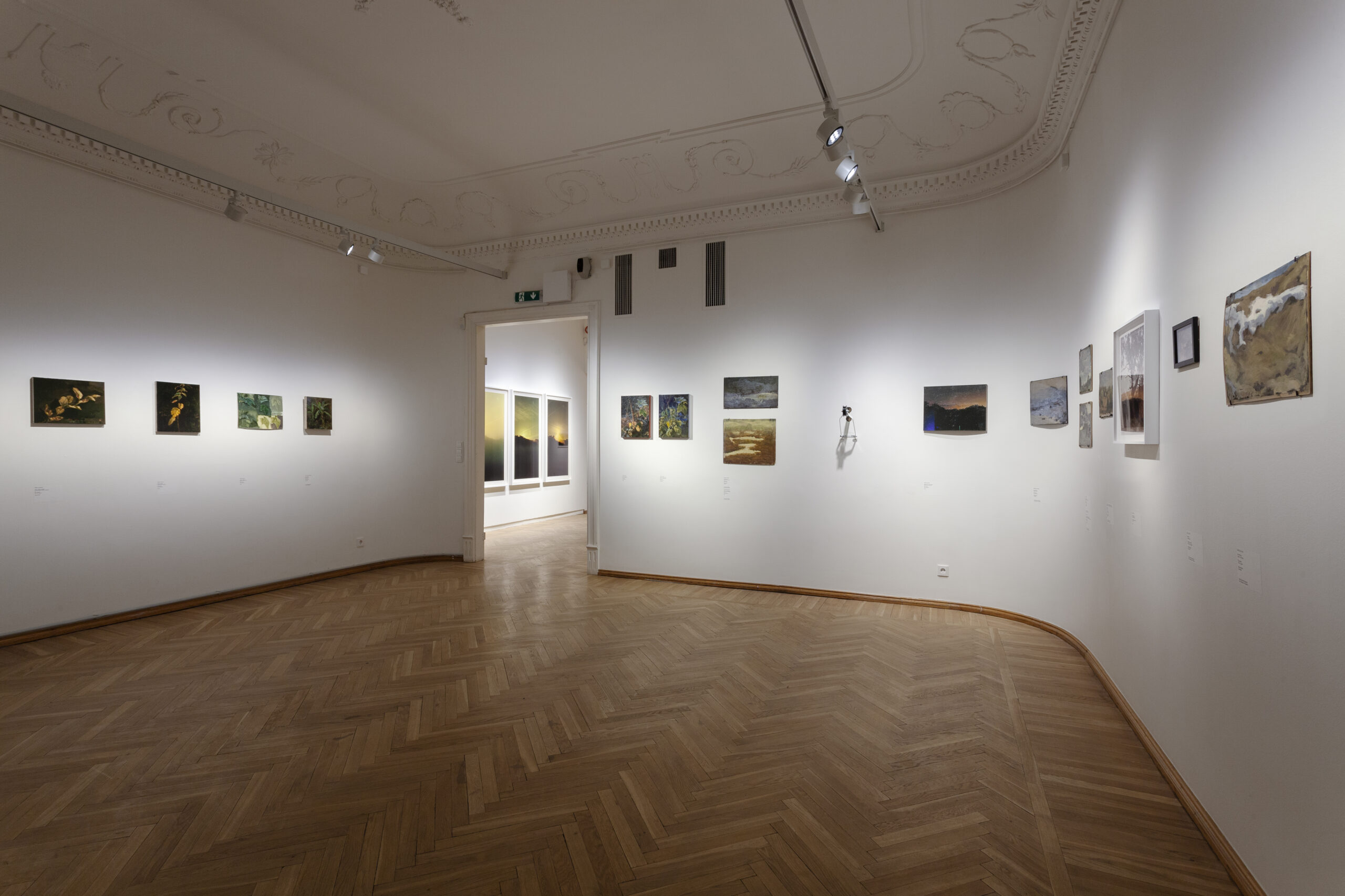
Exhibition view at the
Tartu Art Museum
Photo by Paul Kuimet
Courtesy of the artists
1 See: Anti Saar, Mul on sinu järele igav. – Postimees 14. IV 2023. An idea worth borrowing from his review would be this: “Since the artists recognise a certain nostalgia or longing in this exhibition, it is worth recalling that a century ago the word for longing [igatsus in Estonian] used the same stem as the word for boring [igav]. This exhibition is also boring in a good way. And very beautiful: instead of fleeting appeal, the eternal beauty of transience.”
2 See, for example, the interview: Tõnu Karjatse, Paul Kuimet: avalikus sfääris on iga kunstiline žest poliitiliselt laetud. – Eesti Rahvusringhäälingu kultuuriportaal 26. III 2023. Or for another example: Priit Kuusk, Eero Epner: kunsti poliitiline potentsiaalsus ei sõltu tema temaatikast. – Eesti Rahvusringhäälingu kultuuriportaal 26. IV 2023. In this last piece a comment by Priit Kuusk (alias Wend) was particularly striking: “And what can I say – art is powerful! It moves mountains if necessary, and in this exhibition, made a river flow through the walls! If you don’t believe me, go and see for yourselves!” At first, I thought, wait a minute, moving mountains belongs to terraforming or something… But then I remembered Francis Alÿs’ action of moving sand dunes in “When Faith Moves Mountains” (2002), where both the work itself and its rather apt motto were a metaphorical comment on social reforms in Latin America – “maximum effort, minimum result”.
3 At times, the new works of Kuimet and Saadoja even seem surprisingly fresh, especially since it would not always be logical to expect this, based on the medium- and format-sensitive approach of both artists, finely tuned over the years – at least not without constant changes of direction or shifts in their approach.
4 I have in mind here a certain hybrid format that freely mixes the formats of solo exhibition, joint exhibition, curatorial exhibition and/or group exhibition, as well as museum exhibition, one of the variations of which has already become characteristic of Epner to some extent. Perhaps in a very simplified way, this means juxtaposing, in cooperation with artists, current work and works in museum collections, which instead of highlighting differences or anachronisms rather enhances this “strange contemporaneity” of works and authors from different eras. Take, for example, “The Return of Innocence” with Edith Karlson (Estonian Museum of Contemporary Art, 2021) or “Silent” with Jevgeni Zolotko (Tartu Art Museum, 2020).
In terms of format, of course, the generational format initiated by Tamara Luuk, which has become part of her curatorial style, seems akin to the above examples, as it consists, above all, in starting a dialogue between different generations. Take, for example, Evi Tihemets and August Künnapu’s “Happiness and Everything Else” (Tallinn City Gallery, 2022) or Sirja-Liisa Eelma and Mari Kurismaa’s “Repeating Patterns” (Tallinn Art Hall Gallery, 2021) or Mall Paris and Edith Karlson’s “Sisters” (Tallinn Art Hall Gallery, 2019/2020) or Kate Lyddon and Angela Maasalu’s “Throbwerk” (Tallinn Art Hall Gallery, 2019) or Peeter Ulas, Villu Jaanisoo and Maria Metsalu’s “Wave on Parquet” (Tallinn Art Hall Gallery, 2017) or Tiit Pääsukene and Kris Lemsalu’s “Beauty and the Beast” (Tallinn Art Gallery, 2016). At the same time, Luuk’s “May You Be Loved and Protected” (Tallinn Art Hall, 2020), where new works by Dénes Farkas, Tõnis Saadoja and Jevgeni Zolotko were juxtaposed with photographs from the Prinzhorn collection from previous centuries, is very similar to the “Epner format” described above.
The exhibition “In the Shadow of the Twilight” by Imat Suumann and Eike Eplik, curated by Peeter Talvistu (Tallinn Art Hall Gallery, 2018/2019), or the exhibition “To Sense the Light, You Must Close Your Eyes” by Kristi Kong and Mare Vint (Tartu Art Hall, 2022) could also be seen in a similar light to Luuk’s. Moreover, the latter of the two was intentionally in dialogue with the exhibition “Common Threads, Polar Bear and Elephant” by Laura Põllu and Andres Tolts, curated by Šelda Puč·ite (Kogo Gallery, 2022), thus initiating a dialogue of dialogues, as it were.
As you can see, (curatorial) exhibitions that relate different eras either through the artists themselves or through their works have already become quite common in Estonian art life. To conclude this undoubtedly incomplete list, I would also like to mention the exhibition “Dialogue. Mare Vint and Jaanus Samma” (Kumu Art Museum, 2017), the logical incentive for which was probably the artists’ earlier collaborative exhibition “Mare Vint. PARK. Jaanus Samma” (TAM Gallery, 2010) rather than some new curatorial undercurrent gaining momentum. But then again, why not both?
5 The issue of information is also present in the review by Anti Saar, who discusses it in terms of the “risk of misinterpretation” (i.e. as a criticism of the non-communication of essential information). My issue with the communication relating to this exhibition is a little different, though.
6 At the opening, I was bothered by the inconsistencies regarding the artists participating in the exhibition, which in retrospect overshadowed the whole experience because in order to identify the names of all the artists, I needed to submit a follow-up inquiry to those involved after I had left the exhibition hall. While there at the exhibition, the list of artists on the wall was as follows: “Friedrich Deppen, Oskar Kallis, Paul Kuimet, Julie Hagen-Schwarz, Oskar Hoffmann, Kristjan Raud, Paul Raud, Tõnis Saadoja, Richard Sagrits, Konstantin Süvalo, Aleksander Tassa, Aleksander Uurits.”
Elsewhere in the media communication and also in the accompanying text of the exhibition in A4 format, only Kuimet and Saadoja were initially mentioned as artists. In the case of the other artists, one could say that even mentioning them was skilfully avoided, instead referring to “works found in little-known corners of art museums”, which were chosen “from works that have generally not been exhibited”.
The accompanying text of the exhibition concludes with this general statement: “The exhibition includes works from the collections of the Art Museum of Estonia and Tartu Art Museum.” This sentence also circulates elsewhere in press releases and media coverage, where other signifiers moving in two different directions also appear, such as “old masters” or “co-authors”.
7 It is admittedly understandable that hybrid or intersectional or other non-standard formats that explore intermediate areas and common ground may be accompanied by communication deficiencies. But the exhibition “Landscape Passes through the House” is not so unprecedentedly experimental as to be difficult to define or formulate.
Despite this, based on the available information, it is still difficult to say exactly whose exhibition it is – and this is not due to a lack of information, but because of an overabundance of inconsistent information. This is also a very contemporary and more general problem.
8 Perhaps, as a last modest endnote, one could add that the exhibition format, which has already established itself in many ways, is undergoing yet another shift in its current course – and a similar change compared to their previous work can be seen in the new works of both Kuimet and Saadoja, as well as in the medium- and format-related issues reflected in them.
Marten Esko is an art historian, curator, art worker, exhibition organiser and writer.