19. V–18. VI 2023
Tartu Art House
Curator: Maria Arusoo
Benjamin Moser, the biographer of the Ukrainian-born Brazilian writer Clarice Lispector (1920–1977), once wrote a friendly warning: “Be careful with Clarice. It’s not literature. It’s witchcraft.” A similar air of caution hangs over contemporary painting, where artists raise the chalices of Symbolism and Surrealism, sometimes intoxicating themselves with one, sometimes with the other. Existing solely on canvas or paper, this realm of images comprises characters, landscapes, narratives, colours, and moods driven by desires, paranoias, and viewpoints that, a few centuries ago, might have led their creator to the stake. In her solo exhibition “A Fool with a Heart of Glass” in the large gallery at Tartu Art House, Angela Maasalu witnesses the decline of our modern world, contemplating people’s desperate attempts to cope with their egocentricity-induced anxiety.
“It’s a state of touching the surrounding energy, and I shudder”1
“A Fool with a Heart of Glass” presents Maasalu’s paintings and drawings from the past three years – pieces that feature faceless human bodies, creatures veiled behind masks, animals evoking the visual crudeness of mediaeval art, ominous landscapes, and flowers and tattoos loaded with messages. Central to the exhibition are works that share the image of the jester or beings that hide behind masks.
According to the artist, these circus elements in her work originate from her kinship with the pantomime character Pierrot, whose unrequited love for Colombina has rendered him a symbol of melancholy across cultures.2 This time, the jesters and masked figures confront the absurdity of living in the contemporary world, providing commentary on individualism, hubris, folly, and the irrational insistence that only personal achievement and a coveted image will bring people the joy and satisfaction they so desperately seek.
Though numerous figures in Maasalu’s works shed tears, the oil painting “The Contender” (2023) best encapsulates the brutality of cruel optimism by showing a naked and helpless body sprawled on the edge of a turquoise tennis court3. Is this a portrait of a person still blinded by fantasies of love stories, material possessions, necessary new routines, a career and the good life? Or does it depict someone newly awakened to the sway their desires hold over them? Whatever the artist’s intent, “The Contender” aptly captures the intermediate phase in people’s daily struggles – the moment of frustration, collapse and solitary sobbing in a fetal position.
A pleasant touch in the exhibition is the inclusion of drawings and watercolours alongside the oil paintings, offering a much-needed respite from the densely covered canvases. For example, the watercolour “A Can of Worms” (2022) depicts a tipped-over bare-bottomed can releasing wriggling worms. Its simplicity echoes the images conjured by the mind just before slipping into sleep, perhaps hastily sketched by the impassioned artist in the near dark.
However, Maasalu’s drawings and watercolours do not come off as sketches, as evidenced by the haunting works “The Enemy Never Sleeps” (2022), “Mother” (2022) and “Come Over” (2022). Positioned in the centre of the large gallery within different nooks of the slightly translucent curtain wall, these pieces enhance the theatrical aspect of Maasalu’s work while also adding to the interpretation a hint of struggling within the recesses of the subconscious mind.
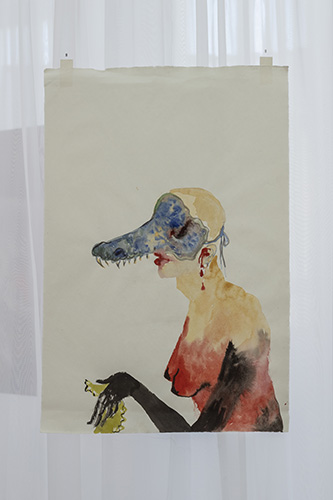
Angela Maasalu
Bleeding Ears and
Crocodile Tears
2020
watercolour on paper
68 x 45 cm
Courtesy of the artist
Photo: Anu Vahtra
“Not having been born an animal is a secret nostalgia of mine”4
The bodies of Maasalu’s creatures are often laced with openings through which something tries to push, leak, surge, flow or just peer out. Drops no longer contained in the subject’s body have become tears on a mask or ornaments on a fence. These creatures, drained by or – alternatively – immersed in life-giving water, are caught in a moment of transformation. Whether this transformation leads to complete annihilation or promises rebirth remains uncertain.
Take, for example, the oil painting “Swimming Lessons (After Mary Oliver)” (2022), portraying a faceless human figure entering a shallow body of water, the violet soles of its feet flashing. The work’s title references a poem of the same name by American poet Mary Oliver (1935–2019), wherein she uses the allegory of a swimming lesson to address the topic of coping with life’s difficulties. While Oliver’s poem suggests that most will reach the shore instead of drowning, she doesn’t dismiss the reality of trauma – moving from one struggle to another, we learn little about living and life’s bright moments and more about the art of survival. In Maasalu’s painting, the poem’s closing lines are embodied by an ashen violet skull painted on the figure’s back, revealing the potential scenario of drowning in shallow water.
Sometimes Maasalu depicts moments when the transformation is visibly physical, like when an animal (usually a reptile) overtakes a human body. While “Sorcerer” (2021) portrays a serpent forcefully piercing a figure, the watercolour “Becoming a Lizard Human” (2021) shows how physically transforming from one creature to another need not be violent and painful. Instead, it can mark the beginning of self-discovery. Admiration of animals and animal nature echoes through Lispector’s poetic-philosophical meditation “Água Viva”: “I know a ‘she’ who humanized animals talking to them and giving them her own characteristics. I don’t humanize animals because it’s an offence – you must respect their nature – I am the one who animalizes myself. It’s not hard and comes simply. It’s just a matter of not fighting it and it’s just surrendering.”5
Perhaps Maasalu’s first impulse is to transcend her innate and learned “humanity”, increasingly surrendering to moments when she is overtaken by the inexplicable urge predating natural language to outgrow her human body. Whatever form Angela Maasalu assumes next, I suggest you be careful with her.
1 Clarice Lispector, Água Viva. London: Penguin Books, 2014 [1973], p 7.
2 Maria Arusoo, Jesters’ Masks and Crocodile Tears: The Painterly World of Angela Maasalu [interview]. – Echo Gone Wrong, 23. VI 2023.
3 See more: Lauren Berlant, Cruel Optimism. London: Duke University Press, 2011.
4 Clarice Lispector, Água Viva, p 45.
5 Ibid., pp 42–43.
Brigit Arop is a freelance art worker engaged in
curatorial and writing pursuits primarily centred on women’s and queer experiences. She holds a Master’s degree in Curatorial Studies from the Institute of Art History and Visual Culture at the Estonian Academy of Arts (2023).