SUMMARY
Tanja Muravskaja’s newest series, “Gardens” (2025), turns the surface of the Baltic Sea into a theatre of looking. Each photograph captures waves breaking into countless points of light. In some images, they resemble lava eruptions and, in others, distant star fields. Step closer and they shift again, refusing to settle into recognisable representation. Rather than having a particular focus or centre, the shimmering dots (and the slight movement of waves) extend to the edge of the frame. What at first appears to be a simple surface of light becomes, upon closer examination, a sustained exercise in seeing.
Working with her camera, Muravskaja creates works where every dot retains its sculptural identity. Her continuous surfaces gleam smoothly, suggesting indefinable depth. These photographs show the natural world, but do not depict specific places. Rather, they explore the limits of the visible.
Getting closer to each of the works requires the visitor to move through the exhibition space, which Muravskaja designed together with the artist Jevgeni Zolotko. Her fourteen large-scale photographic prints were hung back-to-back on the load-bearing columns of the historic Saarinen House in central Tallinn during the 8th Tallinn Photomonth. Taller than the average viewer (165 cm), each photograph hovered just above the floor, producing a rhythmic procession through the space. At close distance, the viewer met a restless surface in which dots do not coalesce into a stable figure and patterns oscillate between water and sky. Muravskaja’s works demand of their viewers the same scrutiny that she herself puts into making them.
Muravskaja has long been known for incisive photographic and video works addressing identity and power. With “Gardens”, she has turned to exploring reflection, perception and the elemental properties of the photographic image. After two decades devoted to portrait photography, Muravskaja felt the need to distance her work from any questions of identity or narrative. In 2019, at the invitation of Kumu Art Museum in Tallinn, she turned her attention to real gardens and photographed those of the writer Friedebert Tuglas and his wife, Elo Tuglas. Already that year, during a roundtable at Kai Art Center, Muravskaja noted that she was no longer interested in photography depicting people. In the following years, she resolved to produce seascapes, first in smaller formats and then larger, as she began to move away from her earlier personal style.
Yet in 2025, she returned to portraiture once again when she produced a double portrait of herself with her former teacher, the artist Sirje Runge (“Tanja Muravskaja, Sirje Runge. Self-Portrait”, 2025). “Resurgence”, a term from hydrology, immediately came to my mind when I saw this delicate yet extremely powerful work: resurgence refers to a stream that travels underground. Even when invisible, it is always there and sometimes re-emerges to the surface.
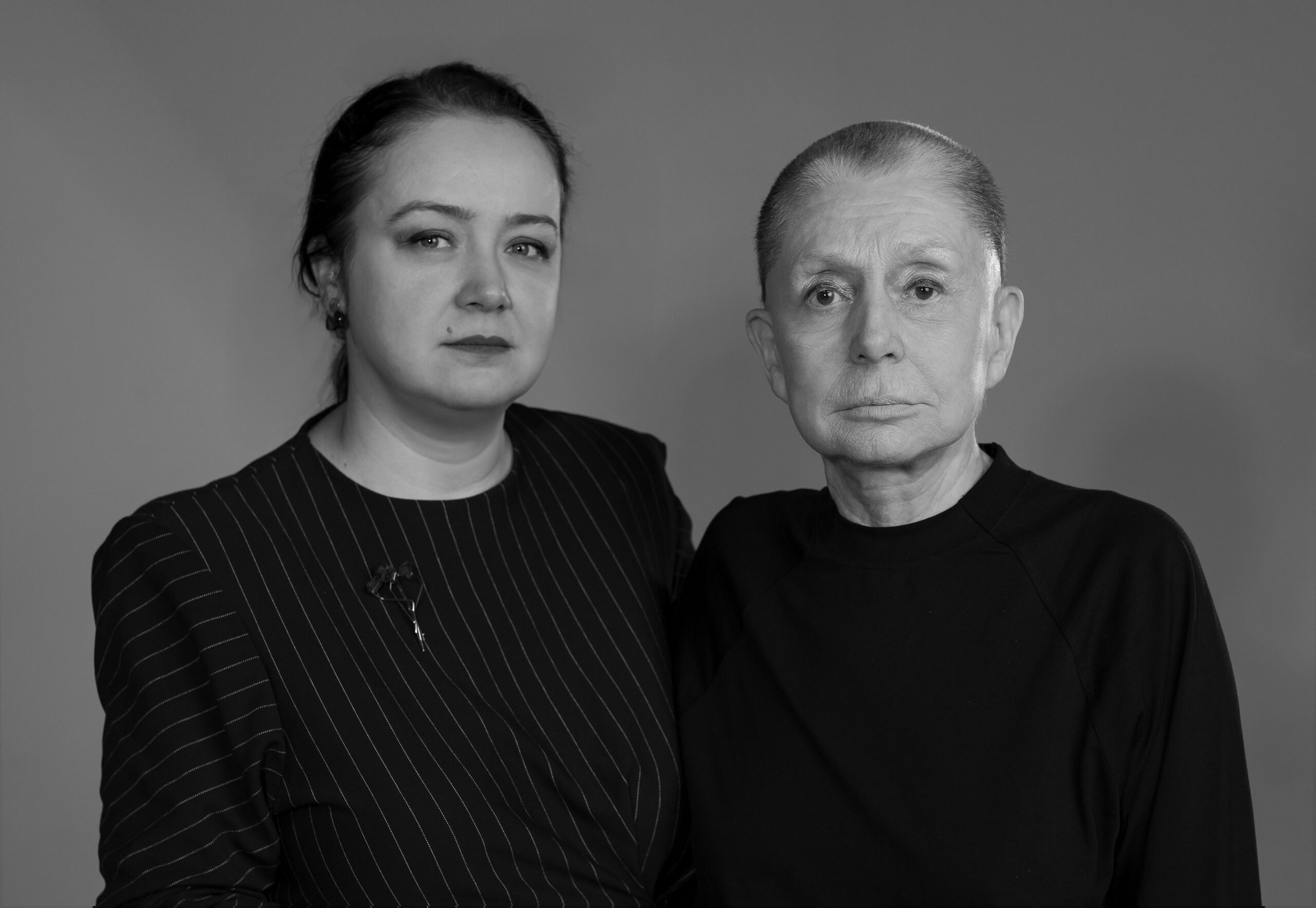
2025
black-and-white photograph
In “Gardens”, the waters of the Baltic Sea become a site where perception and belonging intertwine. Muravskaja mentioned being able to take photographs everywhere, “but good images come only in Pärnu.” Maybe it is in a way a response to the feeling that she did not belong. Born during the Soviet period in 1978 to parents who relocated to Estonia from Ukraine, she has long questioned her own identity. Making art allows her to find her way home. That rootedness inflects the work without determining it. The sea she depicts is specific and personal, but the resulting images resist geography.
Tanja Muravskaja’s attention to light and perception echoes her fellow artist Sirje Runge, whose parallel solo exhibition opened at Kai Art Center during the 8th Tallinn Photomonth. The link between these two artists from different generations might not seem immediate, yet there is a crucial point of connection: their sensibility for transforming form into light, each in their own way and on fragile ground. Runge on hardboard and canvas, Muravskaja on photographic inkjet prints.
Runge’s engagement with light, colour and perception made an impression on Muravskaja in her early years as a student. In 2002, Muravskaja enrolled in Runge’s class on colour theory, a course that is also featured prominently in the exhibition at Kai Art Center. Central to Runge’s teaching and practice is the concept of värviruum, or colour space:a living field where light, emotion, and structure interact.
In a conversation earlier this spring, Muravskaja described her new series as “quiet things”. The works resist the speed of digital imagery, offering instead a cultivated attention to light and surface. In this sense, “Gardens” also extends the lineage of Vija Celmins, an acknowledged inspiration, whose drawn and painted seascapes likewise test the limits of representation.
Suspended on the surface of water, the sprinkles of light encapsulate the relentless wish to reproduce the visual world. Just as Runge, after fifty years of painting, placed the monumental canvas “Great Love / Beautiful Rotting” (2021) outdoors so that the forces of nature could complete the work, Muravskaja treats the sea’s liquid surface as she once treated her sitters. She returns to it over and over again, to depict the sea under different conditions and to collaborate with different shapes of light. Focusing on the mutation of surfaces becomes an abiding obsession. Most of her seascapes are still recognisable images, but the place and time are indeterminate. What these new works provide is a constant presentness that resists translation into the mimetic, or even into words. They draw the viewer’s attention into the very act of looking. Like Runge’s explorations of light on canvas, Muravskaja’s “Gardens” reminds us that fragility is not a weakness, but a form of presence.