“You’re free to draw parallels, I don’t mind” is how the artist responds to the observation, made somewhere else, that he has one foot in the late 1960s hippie era and the other in early 1990s MTV. His art conveys a strange nostalgia for times that Robin Nõgisto, born in 1992, has never truly experienced himself (or so we discussed during the interview).
In the spring of 2024, Nõgisto held a solo exhibition at the Nelja Nurga Gallery in Kärdla, on the island of Hiiumaa, its title “Hippie Gipsy Roygbiv Machine” displaying deliberately jarring grammar. The invitation for the Kärdla exhibition came last year at the opening of Rainer Jancis’s sound installation at the Tahkuna lighthouse. By summer 2024, some of his works had already found their way to the Estonian embassy in Paris, and in late July, nomaadgalerie, also in the French capital, which was busy hosting the Olympics at the time, hosted his solo exhibition “Portable Mystic Windows”.
How does one go from Hiiumaa to Paris? Robin Nõgisto was nominated for the Akzo Nobel Art Prize in 2018 and 2021. His first nomination, submitted by Kunst.ee, was for his painting “The Bio Feel” (2017), which was exhibited at the Estonian Artists Association’s annual show. The rainbow-coloured painting features grinning skeletons, factory chimneys and other things of the like. “I think my works exist outside the zeitgeist of any specific era, but they’re definitely influenced by everything I’ve seen since childhood,” he says.
Nõgisto and I talk about Archive.org. We both often browse through the literature found on the site, including all sorts of colourful, now-defunct magazines from today back to the 1960s. Right now, he is reading a story by H.P. Lovecraft. He also enjoys listening to old radio and theatre programmes, especially anything horror-related. “Sci-fi and fantasy are always in the back of my mind. I believe art has a place in the conscious realm, but for me, it’s more of a fantasy world,” he explains.
Our conversation shifts to psychedelic concert posters from the late 1960s. Not only rock posters but also those for jazz were made in a distinctive style back then. “The colours in those posters have definitely influenced me. The typography wasn’t immediately decipherable, which made people curious to explore those blots and patterns more closely,” Nõgisto says.
Nõgisto’s creative process usually starts with an idea, but this often clashes with reality and evolves into something else. The idea may be flawed, and then the process of correcting those flaws begins. The work itself starts to dictate what it needs. “There’s no specific reason to do anything at all,” Nõgisto says. As an early riser, he often wakes up and immediately shuts out the world to immerse himself in painting – a good way to disappear when he feels like it.
Nõgisto’s paintings are mostly large-scale. “I think they’ve always been big,” he muses. “But the sizes vary. What is “big”?” Nõgisto finds the variation refreshing. For him, making smaller paintings is more challenging and even annoying. “I think it’s actually easier to start with something big and then scale it down.”
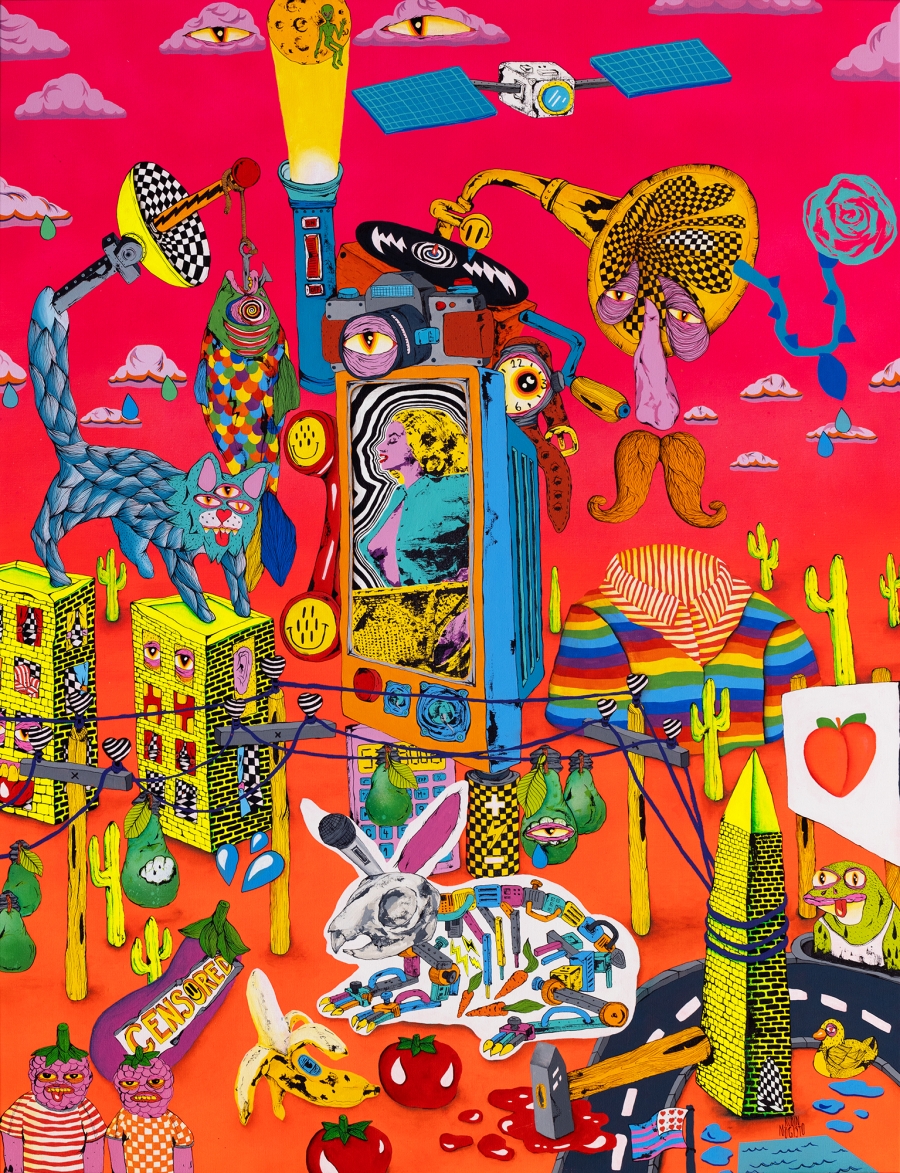
Robin Nõgisto
Into Vast Past
2023
Acrylic paint, aerosol paint, oil on canvas, 170 x 200 cm
Photo: Lauri Trolla
In 2017, Nõgisto graduated from the Estonian Academy of Arts (EKA), majoring in painting. He didn’t get into animation. The artist enjoyed his time at EKA despite the initial setbacks, although his style was never one of them. “What I remember most are the conversations, conceptualising what we’re actually doing. Painting is great, but what do we paint? Why do we do it?”
Naturally, one wonders what kind of music an artist like Nõgisto listens to. Stoner rock? An obvious guess, but not entirely off base, he admits. Robin’s wife, Olivia, is also an artist. They used to play in a two-member band – Olivia on drums, Robin on guitar – like the US rock duo The White Stripes, who were active from 1997 to 2011.
Nõgisto has quietly released two albums worth of songs online, singing like there’s no tomorrow, thrashing and beating. Making music hasn’t made him rich, but it has made him wiser. He also created the music videos for the songs.
Is it easy to learn guitar when you have to practice quietly? Nõgisto can’t read music but confirms that his neighbours dictate his practice routine. “That’s why it’s good to drive to the forest and turn up the amp,” Nõgisto says with a smirk. “I guess I’ve always been a solitary character. Some events just pass me by – even in Tallinn – but since Hiiumaa is quiet, it’s easier to control the noise level.”
Robin has stayed in Hiiumaa all year and only briefly went abroad last year. “You can surf here!”