SUMMARY
Soho Fond has his own artistic myth, story and legend. I think he is Estonia’s greatest artistic legend after the death of Konrad Mägi in the Tartu Neurology Clinic. It might be worth comparing his biography to that of Ülo Sooster. However, while Mägi and Sooster are absolute luminaries and have a place of honour in our art history, Soho Fond is still more of what you would call an emerging artist.
So what makes Soho Fond legendary? Soho Fond, who studied at the Liberal Arts Department of the Estonian Academy of Arts (EKA), was a criminal in the eyes of the society of his time, a so-called “Viru Businessman” – he even served a criminal sentence for behaviour that would only cause confusion among the younger citizens of the newly independent Republic of Estonia. More specifically, citizens of the Soviet Union (and thus also the Estonian Soviet Socialist Republic, or Estonian SSR) were forbidden from owning foreign currency, but at the same time, the Finnish markka was an important part of the underground and illegal business centred around the Viru Hotel at that time.
It might also be interesting to know that after the end of my EKA elective course in the spring of 2011, Soho Fond suggested that I become the supervisor of his master’s thesis. As far as I know, I still am – except that this student-teacher relationship has not yet been officially formalised.
During these dozen years, Soho Fond has, among other things, had an impressive personal exhibition at the Hobusepea Gallery (“Viru Businessmen / Monkey Business”, 6–18 June 2012), where he explored his past life as part of the Viru businessmen subculture. He has made diagrams on panels of the so-called food chain of that time and arranged the gallery as a kind of temporary museum of the Viru profiteers. Or should I say, their temporary shrine? In the spring of 2013, he organised a get-together of former Viru business leaders at the Viru Hotel, including a conference and presentations on the subject. He has also returned to the restaurant business to create some striking, well-praised and stylish, yet lavishly eclectic examples of interior design for several restaurants – most notably Manna La Roosa and Tai Boh, which are located in the same building on Vana-Viru Street.
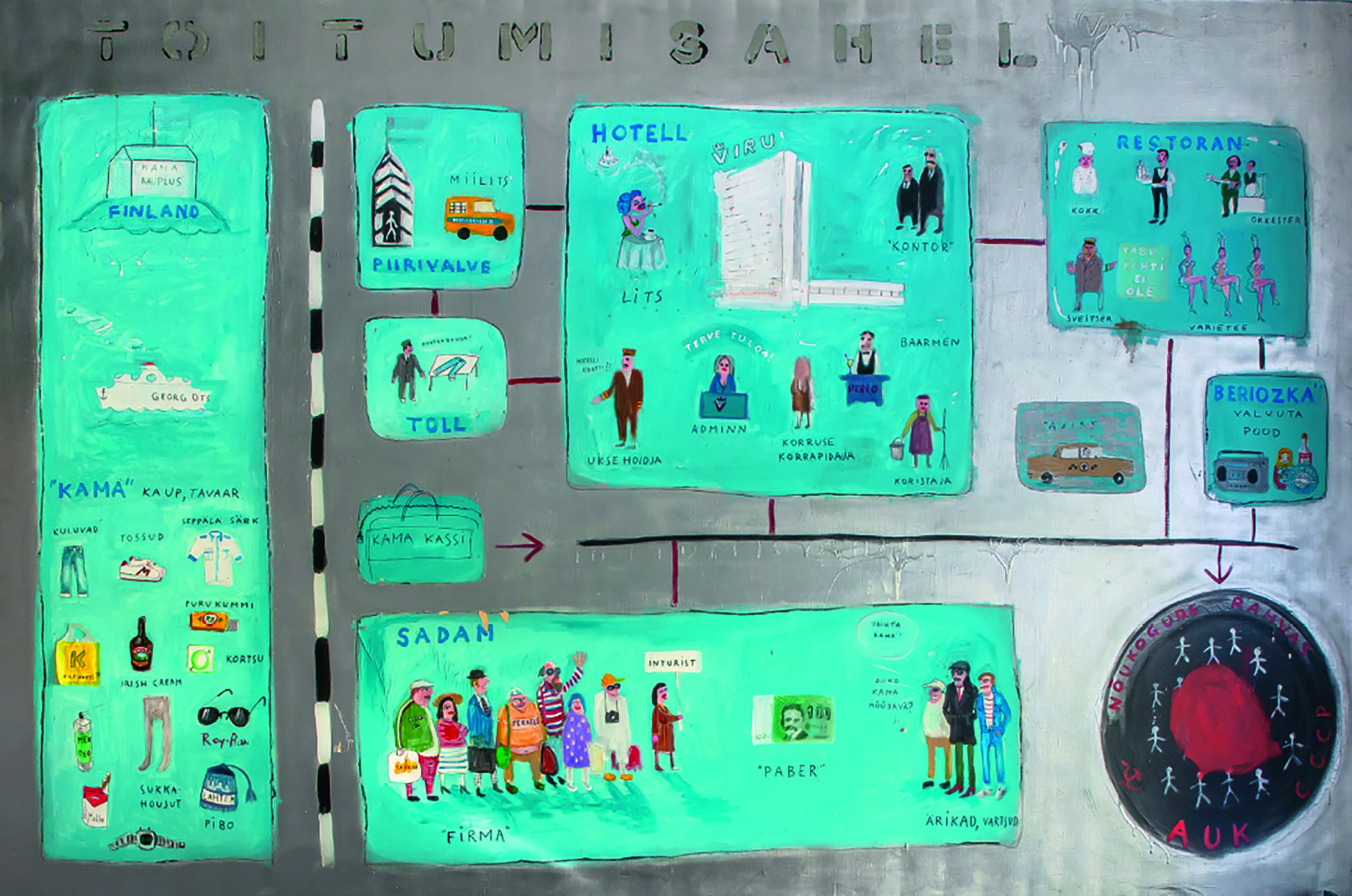
Soho Fond
Food Chain
2013–2014
Oil on canvas, 199 x 299 cm
Estonian Academy of Arts
Photo: Arne Maasik
But Soho Fond’s love of adventure has not been limited to the previous decades of his life – in the intervening years, he has partially moved to the Indonesian island of Bali and devoted himself to establishing an art centre there.
And despite all this, he has continued to paint abundantly and passionately! As Soho Fond recently told me in a private conversation, when he initially started studying at the EKA Open Academy, he was convinced that he would soon be called out on the fact that he could not really draw or paint. Still, despite these shortcomings, he decided to hang on in the Academy for as long as possible, as if underground. Unfortunately, though, he acquired the technical skills of a “real” artist in the course of those long years.
Soho Fond’s paintings and interiors reveal another of his special contributions to Estonian art. Namely, humour. As an artist, Soho lives as if he is in some kind of post-post-pop art piece. Soho’s paintings are simultaneously influenced by the great names of the art history of the free world, whom he unabashedly quotes, by the sensationalist mentality of the yellow press, and in terms of brushwork, by our own masters: Tiit Pääsuke and Laurentsius.
In the summer of 2023, Soho Fond’s exhibition “Studio 23” was briefly open in the Põhjala Tehas cultural district (1–15 September 2023) – a kind of symbiosis of a personal exhibition in a pop-up gallery and an open studio. Having been there a couple of times, I saw several assistants working – just like a real Soho Fond factory.
As for the artist’s humour, even his name is a joke from the turn of the millennium, when the Names Act did not yet prohibit private individuals from assuming the names of legal entities. Under his birth name, Margus Sulengo, the artist was involved with an organisation called the Soho Foundation, uniting both entrepreneurs and cultural figures through the goal of developing the cultural environment of the Rotermann district in the centre of Tallinn – still a dingy place at the time – and turning it into Tallinn’s Soho, as it were.
When he began to study at the EKA Open Academy, Margus Sulengo decided to pay his tuition fees as a scholarship from the Soho Foundation. Unfortunately, paying the tuition costs of a private person by a legal entity turned out to be more expensive than usual. So, Margus Sulengo decided to solve this small problem by adopting the legal name SOHO Fond, thus officially becoming the first holder of a scholarship from the Soho Foundation.
The rest, as they say, is history.