An exhibition titled “Kunsttööstuskoolist akadeemiaks. 100 aastat kunstiharidust Tallinnas” (From the School of Arts and Crafts to the Academy of Arts. A Hundred Years of Art Education in Tallinn, 5. XI 2014–22. II 2015) was recently opened and a book of the same title presented at Kumu. Today (8. XI 2014) a new gallery space for the Estonian Academy of Arts will be opened in the courtyard of the Tallinn Art Hall. KUNST.EE asked me to interview you, given our long professional relationship (Solveig Jahnke was communications manager at the EAA from 2006 to 2014; Signe Kivi has been rector of the EAA since 2005. – Ed.), although the real reason is this important anniversary “’ 100 years of higher art education in Tallinn. What reflections has this occasion inspired in you?
Mostly, I have been thinking about the time when I myself was studying. My life changed when I was accepted in 1975. I did not consider myself very strong and competition was tough at that time “’ there were over 40 applicants for the textile design curriculum. The world that it opened up for a good girl straight from high school was really exciting, different, free. So, this year has been very retrospective for me in this sense. Mart Kalm (EAA’s Vice Rector for Research – Ed.) instantly jumped at the idea of doing an exhibition and compiling a collection, which “’ I concede “’I have not yet managed to read, but only browse. Both the exhibition and the catalogue were compiled by an art historian and offer a useful bystander’s perspective.
Soon you will have been rector of the EAA for two terms, that is, ten years. The EAA has announced a competition to find a new rector. What have you been able to initiate?
By now it can be said that the creation of a new environment has been initiated and I would never have believed that it would be so complicated, that it would be so difficult and that it would take so long. I think a more serious analysis “’ that very same bystander’s perspective “’ still lies ahead. It requires the distance of time. What I can say now is that I continue to be very concerned that there is no wide-spread awareness in society and among decision-makers about the position of art and visual culture, no understanding of its importance, no seeing it in the different aspects of the spheres of life. I am afraid that in this direction we have not achieved a significant change, although the goal has been part of the academy’s development plan before and was also included in both of my own programmes as rector. I can certainly say that for me personally, these have been the most difficult times. All my previous jobs have lasted three, five or two years “’so it is a large piece of my life and also a part of my health.
When you were working towards creating this new environment “’ it even pains me to say the word “building” here, but still, inevitably…
Let’s say it, let’s say it!
… then there were very many complaints, from inside the academy in particular, as to why the rector was only engaged with the issue of the new building while she could have addressed more substantial questions. But this, after all, was the very first objective that you had set yourself as the rector! Have you thought about why, at one point, this opposition inside the academy emerged?
When I was elected as rector for the second term (in 2010 – Ed.), the processes concerning the new building were already under way. The first difficulties had already appeared, but the whole organisation actually felt unified and was looking hopefully to the future. During my second term, I therefore focused more attention on the structure of the academy, mainly on turning our university towards research (and I mean not only the one department that has been engaged in research all along, that is, the Institute of Art History) “’the importance of research development, of study and analysis as well as creating the position of researcher in each faculty. This was actually priority number one because it felt like the process of the new building had been started and it only needed to be carried on. Therefore, I can say that the essential part of a university, that is, teaching and research and setting the academy on that path have by now been a success.
And another process, which for very different reasons we were not able to complete, has finally, by overcoming immense difficulties, been successfully turned into a new direction. Two years ago in the summer I decided that this had to be. I saw very clearly that going on with the same project would strain us and that, instead, it would be reasonable to quickly make new agreements, basically almost to start from scratch and perhaps take on precisely the opposite goal “’having failed at erecting our own landmark in the centre of Tallinn, as it were “’ that is, to look for a historical building that we could fill with our creative content.
Are there any substantial goals which failed or which you reassessed or changed your mind about? For example, internationalisation was one of your goals when running for the second term, also the merging and splitting of curricula and much more.
Today, someone else’s view on these questions would do more justice to the matter. I have not managed to write down or think over what has been done. However, I do believe it is not a cliché if I reiterate the point that no leader can get anything done alone.
It seems to me that despite a couple of very “’ all in all I must now say “’ unfortunate personnel choices, I still managed to surround myself with people who were very able in their fields and, rather than anything else, bore the responsibility of handling their particular areas as they should have in a university – the vice rectors for academic affairs Andres Tali and Liina Siib; the deans Toomas Tammis, Lylian Meister, Anneli Randla; the creation “’ in connection with a very important change of direction for the university “’ of the position of a vice rector for research during my second term, and so on. We have a small organisation and, for various reasons, people’s positions inevitably changed pretty quickly. Today I can say that Anne Pikkov as vice rector for academic affairs, Mart Kalm as vice rector for research, Andres Tali with his aspiration to very seriously assume responsibility for the fine arts Master’s programme, Tanel Veenre and others “’ there is great potential in these people.
What actually needs to be changed quickly is our university’s Master’s programme, for it to be really attractive, internationally competitive, largely in English. For there to be energetic young faculty members, who are not yet stars, but who do have that ambition and are actually real motivators, who are driven. Years ago, we tried another alternative, making an effort to bring international superstars to the university and it seems to me that this did not prove to be justified. One person can do very little and they should then be surrounded with what, given the conditions in Estonia, is practically a small state, whom they actually use, who help them.
We have tried out different models. What I can say in retrospect: it has been very, very complicated. Life in Estonia has changed rapidly. From the frame of reference of the period when I first became rector, which was very positive, also in Estonian economy “’ we have gone through a great recession, which I, by the way, did not believe would happen. I was very positive that since we are a small, compact state, which at one point has made very important changes, we would also be able to pull through this period faster, rather than falling so low. All this was the backdrop to our first project for a new building at 1 Tartu Road. Obviously, these long-term, cumulating problems and the reluctance on the part of the Ministry of Education to support us with this project “’ all made the situation inside the organisation very tense and I felt that.
What would you think if the EAA were to be merged with a larger university “’ what would the EAA gain and what would it lose?
If merging the EAA with one or another university would bring Estonia out of the present standstill and “save” the positions of higher education, I would think positively; but no educated person could possibly believe that. Estonia is so small that our higher education should in fact be seen as the University of Estonia, with all the existing public universities with their specific competencies and curricula subordinated to it “’ not duplicating each other’s curricula. This is not a novel idea, but it is something to strive for.
In your anniversary speech at the EAA ceremony at Kumu art museum on 3 November you recalled the role of ERKI (Estonian State Institute of Art, the name of the EAA from 1951 to 1989. – Ed.) in Estonian history. Have today’s statesmen forgotten these facts already?
These eras are, after all, incomparable and this may also apply to our talking about the “spirit of ERKI” “’ about whether it still exists or whether it has dissolved. There are many things that we will never get back and that will remain a kind of painfully sweet memory for one generation or another. But we can’t force the younger generation to feel the same way.
Today, the spirit of the Academy and the aching of the artist is not so much about the fact that we are no longer together in one place, but the fact that we have different communication channels and artists express their attitudes through their work and are free to do so. There are many who have already made a name for themselves before admission and it is also perfectly natural to get involved in and dive into art life as a student. As strange as it sounds today, can you imagine that back then it was prohibited for us?! Although I always speak with exaltation about my teachers, participating in exhibitions was forbidden to us and we complied, and now I think: was that so great? But those student years were still amazing.
So, I should say on a critical note “’ and, admittedly, on a self-critical note “’ that artists have lost their vocal role compared to actors, musicians and representatives of many other creative walks of life. Although, it is not a competition either. I suppose it goes in waves and, on the other hand, today we cannot and should not draw a line between artists and other walks of life, a line that did exist back then. We see artists on the stage and actors doing exhibitions… and art critics have been doing exhibitions for some time now.
How do you explain to yourself the fact that artists have lost their vocal role; what has caused this?
I don’t. I just said it out now and I have felt it when some sore points have been raised in society, when the younger generation, and either actors or musicians in particular, have voiced their positions more courageously. We have, indeed, tended to stick to our knitting. We interfere when someone intrudes into our territory or takes something away from us or if there is not enough money. There is less of that broader social thinking.
When you became rector, you left politics. Why?
It has been and continues to be a good academic tradition, which I fully accepted. Yet time has made a change here. I have come to the conviction that you can only affect decisions if you are one of the decision-makers. At one point, however, I was a stranger among my fellows and a fellow among strangers. Academically, a neutral position is highly justified, but in the rapidly changing modern world I am no longer very sure about that.
I dare not say who will be the first rector to stick to their views, find a larger number of supporters, while certainly having to deal with the problem of defending their partisan views during their term in office. This is quite an effort, but perhaps the time will come, or not. Estonia is small. And so this is also the reason why “’ now that the competition for the new rectorship has been announced “’ I have let the EAA Council know with full determination that I once again want to be around when the decision is made.
Under your rectorship, many substantial changes in academic organisation have been made at the academy, take for example the fact that the admission requirements were modified somewhat “’ first in the Faculty of Fine Arts, then also in the Faculty of Design. Has this justified itself?
Being faced with very strong international competition and looking at how our partner universities select their students, we actually see that we have been unnecessarily conservative. In 2005, the volume and type of assignments for admission to the Faculty of Design was practically the same as when I myself was admitted 30 years ago, except the “red subjects”, of course. It seemed to me that we would be able to sift out the best of the best using our own somewhat more contemporary methods and I see that this has justified itself. Art has changed so much and at one point it seemed to me, and it still seems to me, that the academy needs to change more rapidly.
There have also been rather radical changes in the study programmes “’ first in the fine arts curricula, where there is joint admission and specific curricula are chosen in the second year, and from this year also in the Faculty of Design. Please tell us in more detail what exactly was done and why?
Here I must first and foremost give credit to the specific people who implemented the required changes in their faculties, despite the fact that I am not a good delegator. This burden has been borne by Andres Tali as Dean of the Faculty of Fine Arts, where the major fundamental changes were in fact made before my rectorship, and Lylian Meister as Dean of the Faculty of Design. And this has been a really complicated thing to do in the Faculty of Design, which is the largest in the Academy, with very forceful, recognised leaders in their respective fields.
I remember when I was running for the professorship of the textiles department in 1996, one of the examples I gave was that I would like to change the curricula so it would flexibly allow the students to receive instruction in a variety of technologies within a single curriculum, helping them to set more exciting goals in their field and to use different materials. I illustrated this using people who for me were the great figures of the 1960s: Bruno and Mall Tomberg, Bruno Sõmer, Mari Adamson, Adamson-Eric and others – they felt comfortable with very different materials. Already back then, the question for me was that something must have been different in their education for this to be possible; and why, then, was this no longer true?
As head of the textiles department, I was very concerned about how closed our university had become. And this had not changed much by the time I became rector, either. Privately, I even called our departments little kingdoms. This is now changing, but we have lost a lot of time and I think that it is the taint of Soviet-era teaching that is most to blame here. Although the red subjects have gone, a kind of conservatism remains. You cannot say that tradition is all that counts: “This is my space. I know it. Don’t come and disturb me!”
The academy is a centre of competency for so many specialist fields and they are afraid that when this concentration disappears, the specialist competence will also disappear, as it already has in so many other universities abroad.
Precisely, but I want to emphasise here that I very much like the idea of the Design Faculty that rather than being necessarily associated with a university, competency is a common goal of our university and professional associations. That if at some point there are not so many students in one specific programme, the competency still exists “’ the people do not disappear in the meantime, because their studio exists and keeps providing its services. I believe that here, too, we have lost so much time. We were not able together to use the special funds that came from the European Union in previous periods to create precisely the kinds of centres of competence that would be used by both universities and professional associations.
The academy’s fine arts people, at any rate, seem to be happy with the changes made there?
At our university, the position of the director of a curriculum is always extremely important “’ what the professor is like as a person, that is, whether the person is open, positive, willing to cooperate. We have very many examples here. There was a low point in sculpture, but with the arrival of the new faculty member, Kirke Kangro, there is not enough room for all the students. However, this remarkably free creative flow has met with criticism both inside the institution and in artistic circles. We may be satisfied ourselves, but it is possible that at some point the other extreme is reached.
In the end, it seems to me that the university is still a school, and regardless of changes in admission and curricula I see that nothing has stood in the way of those young people who have the inner aspiration to be an artist. Neither an unapproachable or critical professor nor a certain poverty in the environment. Compared to all other Estonian universities, let alone universities in neighbouring countries, we have been in an exceptionally poor environment for decades and decades. At the same time, when foreign students have given feedback, they have very rarely pointed out these shortcomings; instead, they have tended to see the positive in the dedication of the teaching staff and the closeness of the professors.
Is it fair to say that these curricular changes were motivated by the liberal free market economy and the need to show that art, design and architecture are also profitable areas and make sense economically?
The EAA cannot avoid having to demonstrate its role on this carousel of economic success. Yes, our studios and workshops are in the basement, but our creative work is Estonia’s diplomatic representation. This has to be explained time and time again. To business people and entrepreneurs, in their own language. It is actually not quite impossible, but it requires cooperation and a positive attitude. While in the Soviet period, art was used to inculcate ideology and artists rather tended to speak “between the lines”, now a situation has developed where our participation could in fact be better taken advantage of.
The academy has positioned itself as a university of art, design and architecture, but our name “’ the Academy of Arts “’ needs to be explained to our partners, especially in international communication. Yet the fact is that with our partners we founded the Design Centre in 2007 and the Architecture Centre in 2008, and this has already begun to bear fruit. These areas are better known and more respected.
Indeed, many artists present their work as a product; many do it ironically, but many also do it in full awareness and without any irony whatsoever. Or they use methods borrowed from politics “’ politics is visual and has for a long time understood the impact of the “image”. The options are many and it all depends on the artist. Some sell the painting, some sell their persona, some sign their name on previously created objects “’ the audience may have some difficulties digesting all this at once, but do they have to? What is important is the availability of choices for everyone.
Solveig Jahnke worked as communications manager at the Estonian Academy of Arts from 2006 to 2014.
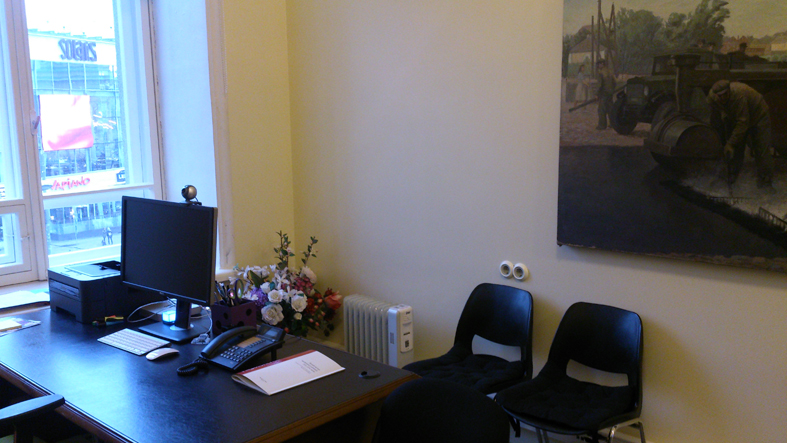
Office of the rector of EAA at the end of 2014
Photo by Solveig Jahnke