25. X–30. XI 2014
Tallinn Art Hall
“Can’t Go On, Must Go On”
Artists: Mihkel Ilus, Kristi Kongi, Katrin Koskaru, Mihkel Maripuu, Anna Shkodenko, Mart Vainre.
Curators: Mihkel Ilus, Elin Kard.
2. X–13. X 2014
Hobusepea Gallery
“The Night Your Mate Danced Like A Tree”
Artist: Laura Põld.
27. VI–2. XI 2014
Kumu Art Museum, 5th floor
“Blue Lagoon”, “I’m a Painting”
Artists: Frank Ammerlaan, Ei Arakawa, Kerstin Brätsch, Merike Estna, James Ferris, Annie Hémond Hotte, Juste Kostikovaite, Kristi Kongi, Kris Lemsalu, Nicolas Party, Katinka Pilscheur, Jon Rafman, Dan Rees, Samara Scott, Simon Daniel Tegnander, Taavi Tulev.
Curators: Merike Estna, Kati Ilves.
14. V–15. IV 2014
Tallinn Art Hall
“Compulsion”
Artists: Liina Kalvik, Jaan Toomik, Vano Allsalu, Mihkel Ilus, Mihkel Maripuu, Manfred Dubov, Soho Fond.
Curator: Teet Veispak.
22. III–4. V 2014
Tallinn Art Hall
“Spring Exhibition”
The 14th annual exhibition of the Estonian Artists’ Association
Participants: 78 artists.
There is not a more thankless task than writing about painting in this day and age. Even considering that when it comes to reviewing art, talk of the death and/or revival of painting obviously has no news value anymore, even in Estonia. Ominous silence is quite a normal state of affairs in Estonia, sometimes accompanying even quite good or excellent painting exhibitions.
“Spring Exhibition”
The ethically dubious position of young art critics to only promote the new and trendy (as half of them also moonlight as curators) is understandable considering their generation not only lacks any experience of viewing paintings, but also that certain something – passion, enthusiasm, addiction (the smell of paint and seeing the brush travel across the canvas, as James Elkins has so vibrantly described it1) – towards painting as a medium. In the context of the art scene, painting is often associated with something passé – the repetition of stigmatised canons, or exhibitions taking place in the periphery, even with semi-professional or amateur art – and so, conscious of their image, the young critics do not dare to be associated with painting, an art form with “a questionable reputation”.
Twenty years with very few state commissions has been a heavy blow for monumental sculpture, but the number of people working daily with painting as a medium has also reduced. Since the Estonian Painters’ Association has been banished from the more centrally positioned exhibition halls in Tallinn and Tartu, the association has relied on the kindness of the Museum of New Art in Pärnu for their annual exhibitions, displaying an overview of its members’ work. The dried up formats and crooked canvas frames allow the exhibition to be viewed as documentation of a unique cultural-anthropological agony.
The last three years that the Estonian Artists’ Association has held its annual exhibitions at the Tallinn Art Hall, circumstances (the large number of artists submitting their works) have forced the association to implement certain limitations – the works cannot be higher than two metres. An exhibition centred on painting offers great joy to both the artists as well as to non-professionals appreciative of traditions. Yet, some of the younger art critics have felt the need to hint that normally they would rather not visit this kind of exhibition2 – this type of affected pronouncement could perhaps be expected from an artist, but one would assume the critics apply a more professional approach to all fields of art.
Painting as “an ancient medium” needs to be perceived in its physicality, otherwise it is impossible to fully comprehend it, and furthermore, in order to describe what is going on in “young painting” at the moment, one needs to have a direct connection to the painting of previous decades, or at least a decent knowledge of what has gone before, and not only on a textual level, but also through a personal experience of looking at paintings, with an open mind and without preconceived opinions.
“Blue Lagoon”, “I’m a Painting”
If we say the “Spring Exhibition” organised by the Estonian Artists’ Association was the flagship of “conservatism” in the exhibitions of 2014 (which was nicely complemented by an exhibition held in autumn about Estonian painting of the 1970s and 1980s, organised to celebrate the 80th anniversary of the Tallinn Art Hall, and in a way also provided comparative material for the “Spring Exhibition”), then Merike Estna’s solo exhibition “Sinine Laguun” (Blue Lagoon) together with the hybrid show “Mina kui maal” (I’m a Painting) at the Kumu Art Museum brought the space and object centred painting definitions mostly by thirty-something artists living in London and Berlin to Estonians who might not travel much.
Whatever the motives of Eha Komissarov, the arch-ideologist of the Kumu Art Museum (she also led the artist talk with Merike Estna that closed the show), the exhibition curated by Merike Estna and Kati Ilves was surprisingly mild, playful and easily consumable, as it were. At a conference held in 2013 at the museum of contemporary art in Oslo titled “An Appetite for Painting” the event’s moderator Gavin Jantjes (an artist and curator originally from South Africa but based in the UK and Norway) called for a bolder stance in demarcating what is painting and what is not. The interdisciplinary practices branded as painting in the art universities in various countries have stretched the definition of painting to such extent that the medium-specific manual or time consuming technical finesses have been delegated to subcontractors in China.
Merike Estna’s studies at Academia Non Grata and the Estonian Academy of Arts, and at the Master’s level in London, have contributed to her exceptionally free and playful style. The bubble gum coloured torn batik divider curtains and colour-splashed robes were no competition to the real star of the show – the Gerhard Richter style books of painting samples, only to be handled with white gloves, that give new life to the artist’s book, a format international art practice has worn out already a long time ago.
Painting meant to be viewed in fluorescent light is nothing new in Estonia – Jasper Zoova, Toomas Altnurme and many graduate works by students of the Tartu Art College and the Estonian Academy of Arts come to mind. Urmo Raus experimented with batik-type washing machine shredded textiles already in the mid-1990s, when he exhibited at Vaal Gallery, not to mention Erki Kasemets’ well-known paint-splashed painting clothes. Taken separately, there was nothing revolutionary in any of the techniques displayed; however, Estna’s works displayed a sense of totality and a contagious un-Estonian enthusiasm, an uncontrollable painting insanity – the chairs, air conditioning devices, screens and furnishings were painted in aniline-like colours and stripy patterns.
It could be assumed that without the Non Grata influenced maximalism, Estna would not be where she is right now. The exhibition as a whole seems to follow Joseph Beuys’s postulation from the 1960s about people making a mistake already when they buy a canvas stretched on a frame. Estna does not make mistakes, at least not the kind that would need to be pointed out. And the exhibits feature paintings straight on the wall (Nicolas Party) and a video in which a painted canvas without a frame is being dragged along breathtakingly beautiful sand dunes (Merike Estna’s video “Reisides maaliga” (Traveling with a Painting, 2014)). Here and there, among wall paintings one could encounter “small formats” (smaller format equals less of a sin?) that had not been stretched on a frame; however, there was no reason to look at these works for too long, unless one wanted to take a lesson in relational aesthetics again (James Ferris’s sponges “Titter Coyly, Smile Archly: He Was Chasing a Shadow”, 2008–2014), when noticing the belt of dishwashing sponges at the base of an architectural concrete column.
Summarising the state of art in the new millennium, as described by Arthur Danto and Dave Hickey, James Elkins paraphrases: “Paint whatever you like because history is over and anything is possible. The opposite is true: history presses down more than it ever has, and almost nothing is possible.”3
What Kumu is exhibiting is only a fragment of the painting scene where absolutely everything is allowed, which fills the world biennales, top museums and auction houses. Still the older highly renowned painters who have flown above trends and have been automatically become hallmarks of art histories have not disappeared – names like Anselm Kiefer, Alex Katz, Gerhard Richter, Bridget Riley, and younger painters like Neo Rauch, Julian Schnabel, Marlene Dumas, Eric Fischl, et al.
“Compulsion”
The painting show “Sund” (Compulsion) at the Tallinn Art Hall loosely curated by Teet Veispak presented the works of two painting professors, Jaan Toomik and Vano Allsalu and five of their former and current students (among others Liina Kalvik, Mihkel Ilus, Mihkel Maripuu, Manfred Dubov and Soho Fond).
Toomik’s new stylistic approach (spray paint!) and ascetic form brought to mind Bruce Nauman-like spatial installations with silicone figures. As there were very few technical layers of painting, especially considering the presence of the “low” spray paint, reminiscent of street art, the strong conceptualisation and the sexually loaded tension came through exceptionally well.
The series of 20 abstract paintings of different formats by Vano Allsalu displayed on the right wall of the main hall is a great example of the presence of the picturesque in present day art. Allsalu has abandoned the thick layers of paint modelled with a spatula and the safe landscape abstractions – the new works are painted with a half dry brush and usually dominated by a single colour, the colouring for each separate work is now more refined. This is a promising change of direction for an artist whose paintings, with their saturated colouring, have from time to time been overwhelming for the viewer. Allsalu is approaching the same territory Paul Allik was at 10–15 years ago – medium-specific decorative features and a “light atmosphere” are no discredit anymore in the current market fundamentalist context, but almost a recommendation.
“Compulsion” also brought to a wider audience Mihkel Maripuu and Mihkel Ilus, who had previously shown their work mainly at Draakoni and Hobusepea galleries (Ilus was also invited to participate in a large project dedicated to painting organised by Kumu a few years ago). These two young artists received their bachelor’s degrees in painting at the University of Tartu and are now studying in a Master’s programme at the Estonian Academy of Arts under the guidance of Toomik and Allsalu. They are on their way to becoming the most radical innovators in painting, similar to Andres Tolts and Ando Keskküla in their time. Ilus’s room full of crumpled canvases removed from the frame and painted aluminium constructions are complemented by decorative abstractions created on the stretcher frames themselves.
“Can’t Go On, Must Go On”
The collection of works by Ilus displayed at “Compulsion” is his strongest and most carefully considered ensemble yet – an opinion that remains unshaken even after 21 October, when an exhibition featuring six young painters curated by Elin Kard and Mihkel Ilus opened at the Tallinn Art Hall. “Can’t Go On, Must Go On / Võimatu minna, kindlasti minna” strictly focuses on one generation of artists, which, on the one hand works in the show’s favour, on the other also makes it somewhat superficial and hermetic. In fact, it seems the marketing of the exhibition is directed towards an international audience.
Just like the Kumu exhibition, this show is also focused on the interaction between installational painting and the space. If we were to believe the generator of universal truisms, the media theorist Marshall McLuhan, the content of each medium is another medium.4 And if we remind ourselves that in addition to the issue of colour, two dimensional painting has often concerned itself with the space within the image and spatial simulacra (not to mention the amazing ability of the modernist painting to fill the role of the decorative splodge, the designed detail in an interior), it does not come as a surprise that through the specific installation methods of painting (which did penetrate the Iron Curtain via pop assemblages to a certain extent), new definitions of painting have been established through these deconstructions.
Ilus exhibits a wall full of decorated stretcher frames and the colourful strips of canvas applied to them, which are displayed as a fachwerk mounted on the wall. It seems as if he had taken scissors to rather sweet art déco decorations.
Maripuu’s glamorous vinyl-like PVC sheets, as if they had been slid off large billboards as voluptuous waves, are indeed exhibited in a very chic manner; the room intentionally has no localised accents, but what a pity that is! And even though the works do not require the large windows of the room to be covered with blinds, the result is somewhat claustrophobic – the environment Maripuu has created detaches itself from the city space and the whole experience is a little like a hallucinogenic trip. If that is the way he wanted to go, then he should also have covered the scruffy parquet floor with vinyl.
When Albert Oehlen, expressionist painter from the 1980s, switched from his brush-centric style of painting to composing giant surfaces out of pieces of mismatched billboards (here I refer to his 2013 exhibition in MUMOK), he always added a personal touch. Maripuu’s interest in technology and good instincts steer him away from applying his manual skills, which is truly a shame, as he is one of the most capable artists of his generation in that area. Even Takashi Murakami’s large spatial projects (in the Museum of Modern Art in Frankfurt in 2008, for instance) do not close the door for a Gerhard Richter type of abstraction, despite all the latex and plastic.
The star of the great hall among the six young painters at the Tallinn Art Hall is definitely Kristi Kongi. More than previously, Kongi’s work displays the influenced of Helle Vahersalu, her professor during her studies at the Tartu Art College (Vahersalu’s exhibition “Lumi ja rooste” (Snow and Rust) at Vabaduse Gallery in 2014 made that link rather clear). In addition to the lush palette, the space within the images painted on three framed canvases hints at the possibility of discussing Kongi’s future work through the prism of photorealism à la Urmas Ploomipuu (in the section of her work, parallel to the baseboard, she paints an electric outlet and a cord), the visible space within the image can be compared to the thin layer of paint covering a messy atelier.
When interpreted literally, the Poststructuralist term “deconstruction” produces interesting results in painting. During the 1960s and 1970s, many of the quiet revolutions within the medium of painting that took place in Western European art did not reach the local art scene (which might be the reason detaching canvases from frames has become so popular here); however, via the influence of numerous retrospectives this type of approach has shifted into focus again in Western European countries as well. Here I am thinking of artists like the group Supports/Surfaces (active 1967–1974, members included André-Pierre Arnal, Daniel Dezeuze, Claude Viallat and others), who were directly influenced by the 1968 riots and Marxist and Maoist ideologies and chose to apply deconstruction and other new definitions of painting, as it was “the most bourgeois and conservative” of all arts.
Lucio Fontana, with a background in arte povera, was shredding canvases already in 1959 (and by now there are no significant museums in the world that would not have two or three Fontanas in their collection!), whereas the Supports/Surfaces artists organised several open air shows in which presenting painting materials separately and deconstructing the object became the central ideological statement. They exhibited bared and painted stretcher frames (Daniel Dezeuze) as well as quilts folded and compiled of shredded and wavy canvas (Claude Viallat). One can only assume that the group was an inspiration to the well-known Estonian-Swedish artist Enno Hallek.
The deconstruction of painting along with the ambition to invade spaces has also been of interest for Marie Kõljalg, a young artist from Tartu, who has been instrumental in organising the double exhibition “DIE JUNG” at Y Gallery and the Monumental Gallery at the Tartu Artists’ House in 2014. Her plastic paintings based on a cascade of monochrome brush strokes and attached to wire installations did stand out at the exhibition “Lõpupidu” (Graduation Party) at the Tartu Art Museum in June.
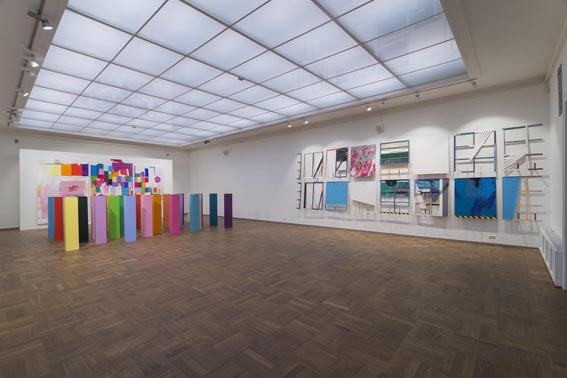
Kristi Kongi
I Am There And I Feel
That Fragrance. Thoughts
From The Room
painting installation
2014
Exhibition view at
Tallinn Art Hall,
photo by Johannes Säre
Courtesy of the artist
“The Night Your Mate Danced Like a Tree”
Laura Põld managed to cover most Estonian galleries with her several solo exhibitions in 2014 and in autumn she presented a magnificent installation, featuring large textiles and referring back to the beginnings of modernist painting, titled “The Night Your Mate Danced Like A Tree”, compatible with approaches that make contemporary painting appealing to audiences.
This exhibition helped me to open a long-forgotten file from the past. From the end of the 1950s I was intrigued by the window displays of the textile shop on the corner of Väike-Karja Street and Pärnu Road (obviously, above all I was fascinated by the building’s architecture and the streamlined neon sign). The cherub made from colourful textiles that Laura Põld had installed in the basement floor of the gallery displayed the same type of 1950s international style flow. In hindsight I realise how closely it was linked to the abstract painting of New York at the time – the aesthetic basis for it was the same. And by that time western culture had been banished only 15 years previously. Laura Põld had managed to capture something similar. At the opening I said to someone: “Like a clothing store!” I meant it as a compliment, but was faced with a perplexed look.
Direction toward the international market
Compared to Latvia and Lithuania, after 1991 Estonian painting has struggled with entering the international art market the most. Lithuanians did not invent “new artists”, but since the mid 1990s (which was the best time to do so) they put their bets on resources they already had – artists with high technical skills. Latvian painting based on photographic mutations and also suitable for salons (à la Ritums Ivanovs and others) is still a success at the art fairs and on the global art market.
The advert-like success stories published by the export agency of Estonian art (Estonian Contemporary Art Development Center – Ed.) and Temnikova & Kasela Gallery, however, do not prove any of the artists promoted have actually seen the success. Sure, we need to make up for the lost time, which is why I am still waiting to be convinced that Kaido Ole and Marko Mäetamm really have become successful on the international art market. Estonian art mostly relies on public funding and artists have increasingly heightened expectations towards society – neither of which is sustainable as a long-term policy. So, in that sense “can’t go on, must go on” is an appropriate slogan – if my readers allow me to subvert meanings a little.
Jaan Elken is a painter and a professor at the painting department of the University of Tartu.
1 James Elkins, What Painting Is. New York, London: Routledge, 1999, pp 2–3.
2 See: Maarin Mürk, Eva-Erle Lilleaed, Evelyn Raudsepp, Helen Ikla, Brigita Reinert, Anne Vetik, Marten Esko, Ülevaatenäitus – kellele ja miks? – Sirp 24. IV 2014.
3 See: James Elkins, Why Nothing Can Be Accomplished in Painting, And Why It is Important to Keep Trying. – Circa 2004, No 109, pp 38–41.
4 Marshall McLuhan. Understanding Media: The Extensions of Man. London: Routledge, 2010, pp 8–9.