SUMMARY
Erle Loonurm: You, Hilkka Hiiop, were elected Rector of the Estonian Academy of Arts (EKA) on 31. I 2025. The result was decided in the first round of voting, and your five-year term began on 4. IV 2025. How has your overall view of EKA changed during this time?
Hilkka Hiiop: I have actually worked at EKA in various roles for nearly a quarter of a century, and I used to think I knew it inside out. But this new position has opened up a completely different perspective for me – a horizontal one.
As specialists working at EKA, we all tend to remain in our own silos and, for the most part, we only see what is happening within our field. Now, though, I see the organisation and the people who work here across the whole spectrum, and I have been deeply impressed by it: the calibre of the people and the work taking place here is simply remarkable. As I stated in my election programme a year ago, EKA does not need a revolution. We are in a good position, and I am continuing many of the initiatives launched by the previous rector, Mart Kalm.
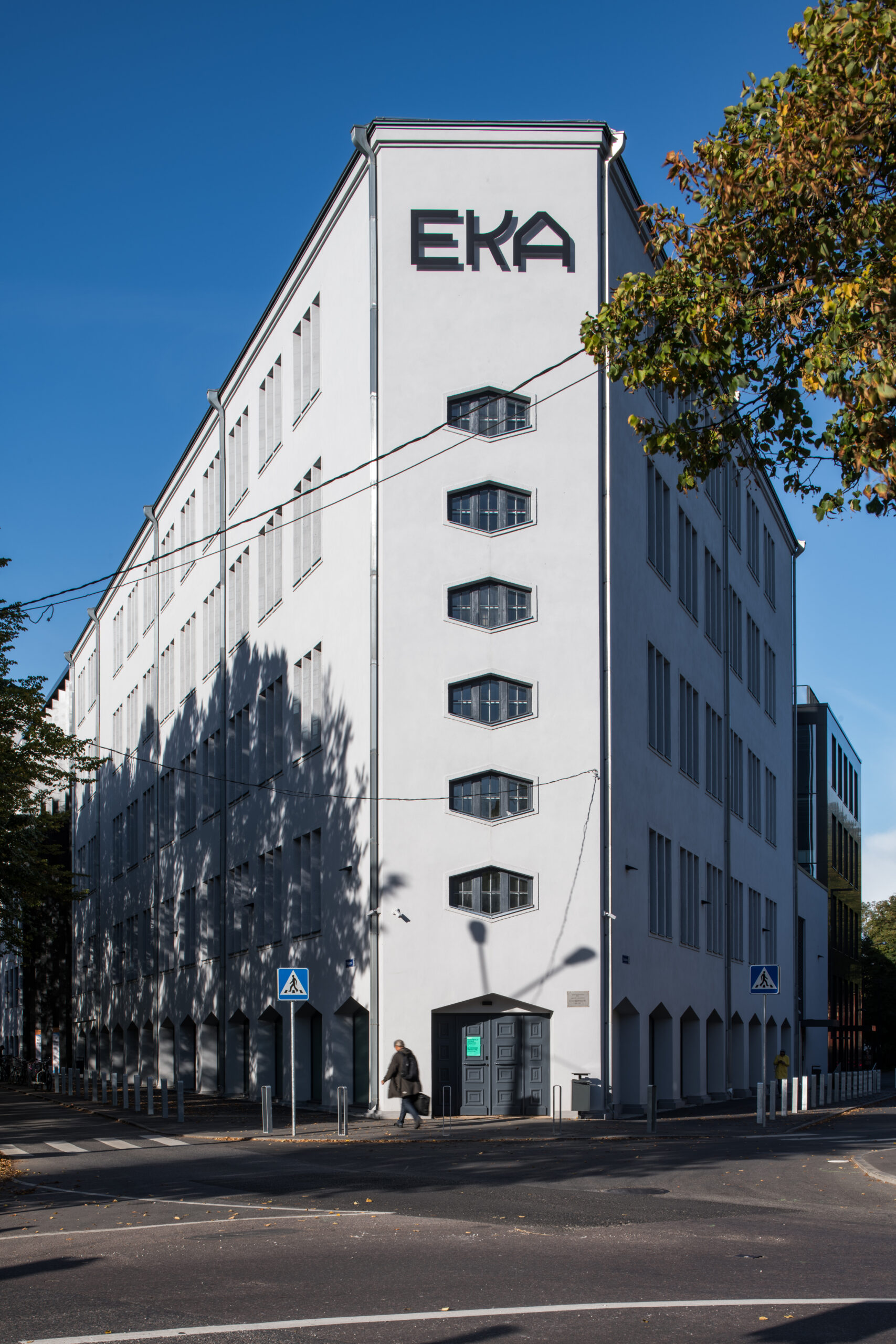
One consideration we need to keep in mind is EKA’s lack of space, which has affected our activities ever since the new building opened in 2018. We are addressing this constraint conceptually and rethinking the EKA campus, which is in a state of constant development, step by step.
Another major question is how we should understand EKA as a research institution. Traditionally, we have been seen more as a teaching and creative institution, but now our research activity is growing at a remarkable speed. However, it is crucial that we maintain a close link between this work and teaching.
A third theme we have given great thought to is interdisciplinary cooperation and how to increase it in both teaching and research. Until now, our four faculties have each developed in their own direction, within their own walls. Yet I believe that blurring disciplinary boundaries and weaving together different fields – even those you wouldn’t expect – is precisely what today and tomorrow’s society is looking for.
Our primary task is to show the depth to which the presence of art influences our well-being and our sense of being human. The more society recognises this, the more it will also feed back into the economy. At the same time, we, of course, teach our students entrepreneurship and how to cooperate with both the private and public sectors. We have directed much of our research and development work towards this aim.
When people speak about EKA, they are often thinking narrowly only of the fine arts. But, in fact, a large share of our departments are already directly connected to the economy and productivity – from architects to industrial designers. At the same time, we must also act as “market makers” who are responsible for explaining why and how the urban space around us affects human well-being, why the defence industry needs the input of designers, why society requires services designed by professionals in the field, and so on.
There was a time when innovation was seen as the only driving force. In that wave, many institutions providing art education pushed aside fields that upheld tradition and craftsmanship. Fortunately, though, EKA has preserved a great deal of these values and skills – just as today we are seeing that tradition has become as important a keyword as innovation. And in my view, its significance will continue to grow.
I sincerely believe that the role of the humanities, and above all the role of creativity, will become increasingly important in the future: The wisdom of the future lies primarily in the hands of creators. What makes us human is the need to express ourselves meaningfully. And if we ever reach a world where, thanks to artificial intelligence, there is simply nothing “productive” left for us to do, then the ability to think creatively and to justify our existence through creation will become essential.
In many ways, the “art of being human” is already at a turning point. A range of forces are shaping our perception of the world at once – whether different crises, such as wars, environmental and health challenges, or the way technology is co-opting human social functions. We see the effects of all this in young people – but not only in them. People, in general, have become more fragile, and mental health is now widely discussed.It seems to me that many of these questions are linked to the uncertainty of the human role, both today and tomorrow. This brings us back to the fundamental question of what it means to be human. And my sense is that already now, and even more so in the future, creativity and art will be what defines us as human beings.