SUMMARY
“I began my artistic path with portraits,” says Tanja Muravskaja, “images that spoke about people, their fate, identity and politics. They reflected the living drama of the era.” Although Muravskaja’s exhibition “Gardens” may look like a creative about-face, her shift has occurred gradually and organically. For her, withdrawing into “Gardens” is not a distancing but, on the contrary, a form of heightened presence.
I am reminded of Wendell Berry’s poem “Questionnaire” (2009), where he asks the reader pointedly: “For the sake of goodness, how much evil are you willing to do?” At times it feels as if the louder people speak of “values” and “ideals”, the more the world bent under their weight longs for something very quiet, something that does not announce itself. A natural, simple goodness. A genuine presence.
It was no coincidence that Muravskaja returned to the beach of her childhood in Pärnu, where she made the “Gardens” photographs. It was there that she rediscovered a childlike joy in water and light. She has repeatedly acknowledged how much courage it took to step before the public with these “different” images. What gave her the decisive push was the Latvian-American artist Vija Celmins, with her unbounded ocean surfaces, star fields and spiderwebs.
Moving among the photographs is a physical experience, strengthened by Jevgeni Zolotko’s total exhibition design. I am no longer sure whether what I see in Muravskaja’s images is sunlight glittering on the sea, glowing lava fields or distant stars. But I know I am part of it.
Sirje Runge also says that these are the happiest moments in life – when you feel part of something much larger: “It is comforting to know I am made of the same elements as the stars.” I barely have time to focus on the wall text at Runge’s exhibition at Kai Art Centre before a large red-haired dog comes hurrying over to greet me. It feels good to pause and give a pat, to sense each other’s presence. As I later learn, the dog’s name is Vita – Life.
But transformation and ending – even in their most inexorable form, which seems to be death – are not things Runge tries to evade. She calls herself an artist who works with time and with her own life. With pain, which is one of the forces shaping her creative process.
“You said I am a strong person who is easily wounded,” Runge has written to a friend. “I’ll add this: my vulnerability has made me an artist and a teacher. My strength has helped me survive. But strength rests on grace. If grace disappears, I die. That is my fear. The fear that grace will disappear.”
The series “Landscape” (Maastik, 1981–1994), named as one of the high points of the exhibition and shown here for the first time as Runge originally envisioned it, is truly powerful. Pausing before one painting and then the next, I experience something pure and alive. It is a quietly bubbling joy.
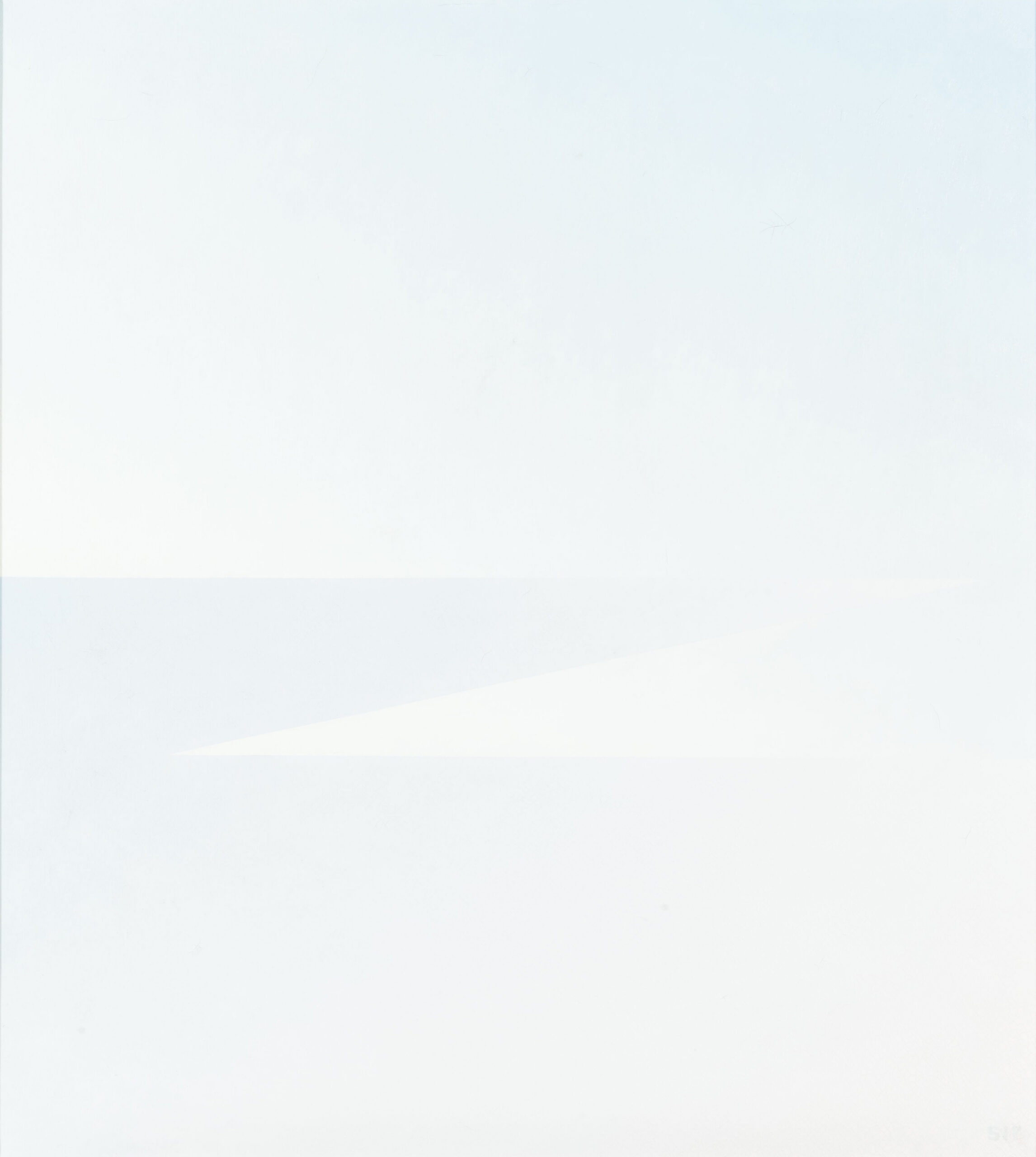
“Landscape XXV”
1983, 90 x 100 cm, oil on canvas
Collection of the Art Museum of Estonia
Runge’s most expansive work, “Great Love / Beautiful Rotting” (Suur armastus / Kaunis lagunemine, 2003–2021), installed outdoors on the grounds of the Estonian Open Air Museum and left to the mercy of sun, wind and rain, is present at Kai both as a time-lapse (excerpts from 2021–2025) and in a livestream. I watch for a long time as the season’s first sleet falls on the ten-metre-long piece covered in silver pigment, which Runge has described as her life’s work. “Growth and decay are transformation without beginning or end. That is the nature of the Universe – terrifyingly beautiful and inescapable,” says the artist.
Both artists have stressed the need to take more time when viewing their exhibitions, suggesting that their work doesn’t reveal itself immediately. I disagree. This is art that establishes itself from the very first moment. You do indeed spend a great deal of time with both exhibitions, but only because these are works that feel good to linger near.