What is needed to cause the audience to come swarming to the gallery and make even those not really into art talk about “a great exhibition”? What is it that makes Peeter Allik’s large-scale linocuts so special, so appealing?
Of course, it is first and foremost their aesthetic value: the crisp black-and-white effect of large areas meticulously realised. Even non-experts can see that Allik has invested a great deal of good old highly professional craftsmanship in his pictures. This becomes clear even to the very stupid in “Glory To Labour” (1991–2014), a wall-sized installation full of clichés. Importantly, the aesthetic focus of his work lies not only in spheres accessible to those with refined taste; on the contrary, Allik’s style includes plenty of nostalgia for the good old era of steam engines, where his motifs refer to Pop Art and low-brow surrealism. When we add here the witty titles crying in anguish for our broken country and broken world, we find something that is also mentioned in the introduction to the exhibition – a smooth “readability” which brings the masses to the exhibition hall.
In another era, such populist flippancy in Tallinn’s most respectable art gallery would have probably caused critics to screw up their noses, but apparently, nature does not tolerate an vacant spot, and considering the decades-long anaemia and stagnation of local caricature art, someone eventually had to score these vacant popularity points, be it the graphic artist and painter Peeter Allik or the street artist Edward von Lõngus. And it seems that some of Allik’s linocuts would be as suitable decorating the walls of the homes of the wealthier hipsters as works by von Lõngus.
In fact, there is only one problem with this exhibition: it all seems so damn befitting that it suggests caution. We have arrived in a situation where social criticism, especially when presented in an ironic light, has become something that can be successfully presented as a commodity – although this makes the criticism highly questionable. Leftist art critic John Steppling, for instance, condemns the overall ironic distancing, seeing apathy and conformism concealed behind the proliferation of post-modern cynicism.1 The exhibition here does not convince us that the artist’s era-specific anguish channelled via wittiness is genuine; it might as well be a fashionable posture. Although, speaking in numbers, he has already used a similar approach for a dozen years or more, and we have to admit that even if he truly says what he believes people wish to hear, he does this in a much more convincing manner than the average politician.
In his linocuts, Allik plays on metatexts and key values, mocking the vague yet heart-warming image held by Estonians of a primitive nation (in “Cranberry Fields Forever” (2012) an uplifting view of a pristine landscape is hijacked by a greedy mass of people mindlessly floundering amid the pools on a moor) as well as the belief in traditional values (in “Strong Middle Class” (1999) respectable-looking ladies are discussing a cushion with an embroidered swastika in an idyllic petty-bourgeois setting). “A National-Romantic Motive” (2008) simply depicts an all-in mass fight. Indeed, there is nothing too original about attacking national myths, but we cannot deny that the results here have a rather refreshing effect.
There are trend-conscious strikes on other topical themes as well: hollow-sounding European myths, the poisonous fruit of globalisation and the mirage of the neoliberal idyll. In “Dead Serpent” (2013) shadow figures carry the corpse of the spectre of Capitalism; the “generation of winners” is shown vomiting into the cup of solidarity in “On Fountains of Eternal Youth” (2012), while “There Is No Europe” (2013) depicts respectable-looking men wearing chamber pots on their heads as hats. In the exhibition’s key work, “Romance” (2012), two pig’s hooves meet in a setting as graceful and cosmically solemn as the hands of Adam and God in the Sistine Chapel ceiling painted by Michelangelo. On the one hand, there is a comfortable rural quality in this work, while on the other, it offers plenty of intellectual references for the viewers so they could grasp the jokes and feel like insiders, literate in culture, resonating with the spirit of the era and so on. Still, some of the more evidently sarcastic works, such as “Use Your Possibilities” (2007), featuring an inviting rat-trap, could also be described as caricatures. Where all this poster-like wit takes us, is a question on its own.
It is remarkable that in terms of the content of the works, although dark urges, misanthropy and a slightly cynical scepticism set the tone of the exhibition, Allik still manages to bring lightness and radiance even in the most raucous moments in the midwinter sleet and darkness. His works are technically flawless and not too melancholic. While revealing the shortcomings of the modern world, Allik refuses to deliver a booming sermon to the masses struck by darkness. In any case, he does not bother to propose alternatives, nor does he seem to set something up as an ideal. It probably wouldn’t be appropriate to call this exhibition satirical either. Indeed, shots are aimed in different directions, and even art that claims a sociability receives a slap with self-conscious connotations, but it lacks a clear purpose or an undermining agenda. Looking more closely, the exhibition is socially critical in a very nebulous sense. On the other hand, there is nothing that points to the ironic distancing condemned by Steppling. The exhibition does not exude bitterness or superiority; it has no patronising ambition in the style of “Uncle Peter telling you how things are”. Quite the opposite, their appeal lies rather in the fact that the artist seems to excitedly join the rest of us wallowing and rolling in the mud. Jaunty profanity has an enthralling effect, no wonder it makes people rejoice.
And yet, there is something strange about the conjuncture of Allik’s exhibition. Clearly, the artist has taken a certain discontentment as his starting point. However, it is downright paradoxical that this discontentment has turned into something that smoothly fits into the pattern rather than causing an interruption. Moreover, it is unclear whether the problem lies with the artist himself or the comprehensiveness of the pattern. If it was meant as a protest, but makes the audience nod knowingly or even interested in decorating their homes with it, it has indeed failed as a protest and does not improve the world more efficiently than a fast-fashion T-shirt with a “revolutionary slogan” or an image of Che Guevara. Or perhaps we should instead consider it a success that the exhibition – deliberately or not – points to the fact that social criticism as such is becoming a mainstream, constantly self-congratulating background surface that leads nowhere.
Mari Laaniste is an art, film and pop culture critic. She has also studied the history of caricature and comic art in depth.
1 John Steppling, The Cynicism Industry – john-steppling.com, 18. X 2014.
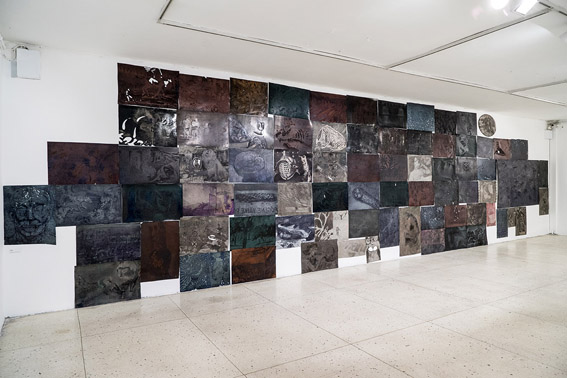
Peeter Allik
Glory To Labour
1991–2014
linoleum plates
Tallinn Art Hall installation view
Photo by Peeter Sirge