17.–24. X 2023
Vent Space Project Room
Noah Emanuel Morrison, an artist hailing from New York, unveiled his inaugural solo exhibition, “NNNNNNNNNNNN”, at Vent Space Project Room during Tallinn Photo Month. Morrison, currently a student at the Estonian Academy of Arts, delved into the presence of racist language in Tallinn’s public space and its consequences. His aim was to shed light on the coded expressions of racism within the urban environment. Significantly, Morrison’s show is the first portrayal of the experiences of a dark-skinned queer individual living in Estonia, grappling with the realities of racism here.
The global Black Lives Matter (BLM) movement has expanded the discourse on perceived racism, bringing awareness of its prevalence and impact not only to Western Europe but also to Eastern Europe. Although the movement began back in 2013, it gained a new momentum in American but also in Europe in 2020, following the tragic killing of Georg Floyd, a black man, by a white police officer named Derek Chauvin during an arrest in Minneapolis, Minnesota. This movement also made its presence felt in Estonia, revealing instances of racism and often unconscious hostility towards people with dark skin, while at the same time brought up as a more acute problem in the media.
In 2021, Kumu Art Museum hosted an exhibition titled “Rendering Race” (17. II–5. XII 2021), which focused on the representation of race and racial differences in Estonian art in the 1920s and 1930s. The exhibition was curated by the American art historian Bart Pushaw and featured both positive and negative representations from Estonian art history, encouraging viewers to recognise the use of demeaning stereotypes and labels. During the preparation of the exhibition, the museum even revised the titles of certain artworks, displaying both the new and the old titles, with the latter shown in smaller print on the labels. This decision drew attention to how titles using offensive language, such as the n-word for people of colour or “gypsy” for Roma, perpetuate historical violence and often unconscious hostility towards these communities.
“Rendering Race” garnered significant attention in the Estonian mass media, sparking both criticism in the Estonian media and, for the first time, the discussion regarding the exhibition reached the Estonian parliament, but it also received a certain amount of solidarity.1 Some critics highlighted the complexities of addressing race-related issues within a post-socialist cultural context, others accused the curator of failing to contextualise the issue and acknowledge its context specificity. However, the exhibition underscored the necessity for unlearning outdated language within museums and the cultural sector.2 The discussion also emphasised the urgency of addressing race-related and historical discourses,3 a need that still persists.
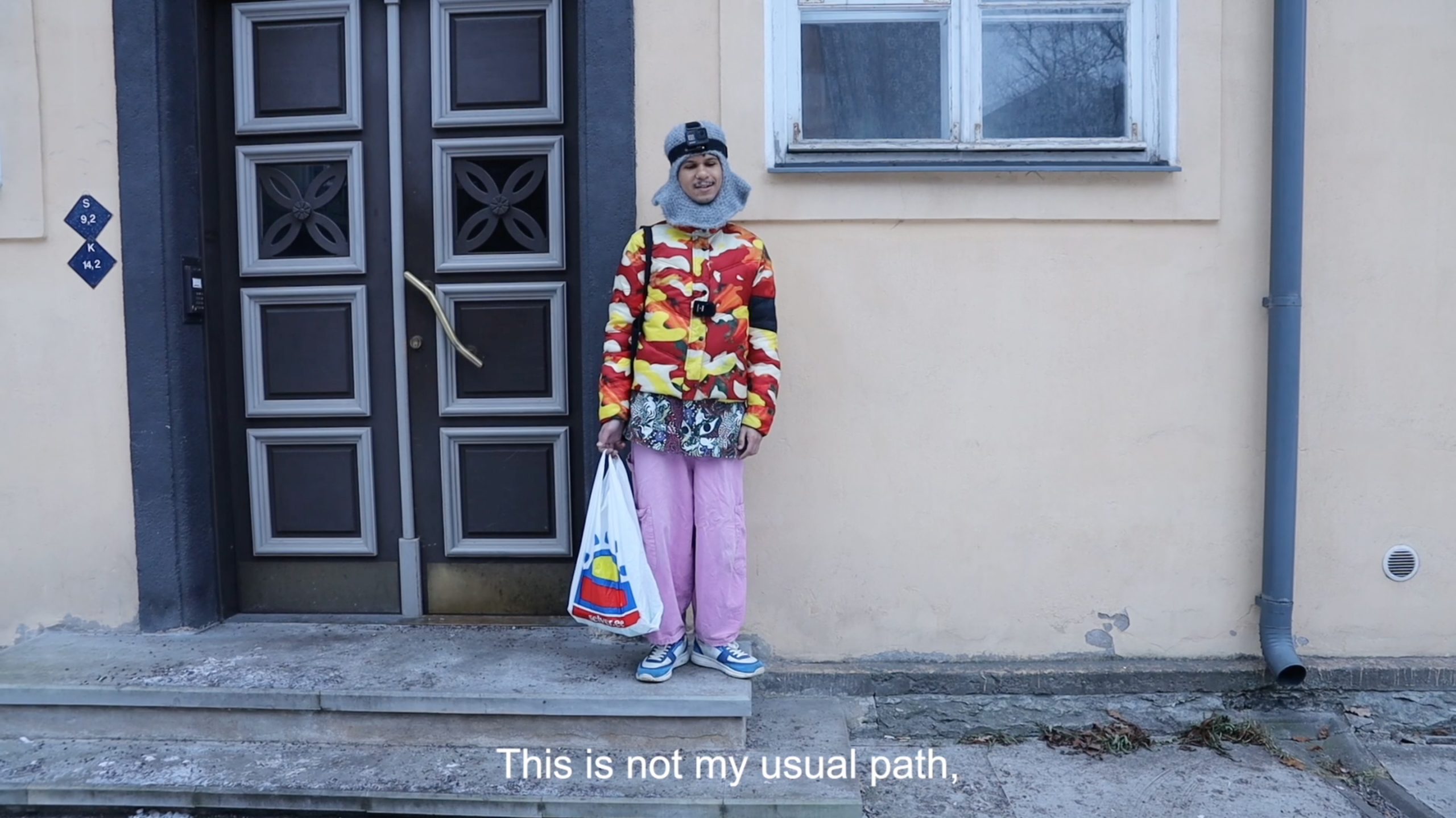
Noah Emanuel Morrison
Harm’s Way
2022
Performance documentation on video
In this context, “NNNNNNNNNNNN” served as a vital initiative, drawing attention to the need to raise awareness of racism. Morrison’s work revolves around themes of belonging, diverse identities and the construction of desire through video and photography. In the central video piece of the exhibition, “Harm’s Way” (2023), he spotlights the detrimental effects of racist graffiti on both local people of colour and visitors to Estonia. Through the public space performance, he ponders how the signs affect him and responds to the harmful messages. He describes his choices, saying that it is either the option to “swim through the mud, trying to confront them” or to “stay at home”.4 The exhibition featured site-specific video works, a video recording of a public-space performance, and a series of photographs by the artist.
The starting point for tackling the issue was a graffiti with the message “Negroes out of Estonia” on Kaarli Avenue in the 1990s, of which, as far as is known, no visual documentation has survived. However, it is known that responses to that sign also appeared in public space, including the graffiti “Negroes in” in Tallinn’s Old Town. Informed by these examples, and this own research into the history of Estonian graffiti, Morrison came to see the persistence of offensive messages in public space of Tallinn today: “I did a lot of research. I talked to a graffiti historian, Rainer Vilumaa, and I did research in a lot of public and private archives in Estonia. I did have more luck looking at private archives which were digitised. Andres Valdre had graffiti that dated back to the 1980s. There was also the online page folklore.ee. The biggest archive that I found belonged to Helen Kivisoo. [—] I think the main problem is that there isn’t much historical context given to racial matters in public out here, except for a reactionary context, like what happened with the exhibition at Kumu two years ago. I also don’t know if it is possible to escape the reactionary context in the political climate in Estonia or in Eastern Europe, or in Europe.”5
1 See the analysis of the exhibition reception: Margaret Tali, Redi Koobak, Rendering Race Through a Paranoid Postsocialist Lens. Activist Curating and Public Engagement in the Postcolonial Debate in Eastern Europe. – Postcolonial Publics: Art and Citizen Media in Europe. Eds. B. Blaagaard, S. Marchetti, et al. Edizioni Ca/ Foscari: Venice University Press, 2023.
2 Birgit Tohter, Rassismist lahtiõppimine muuseumis Kumu kunstimuuseumi näituse “Erinevuste esteetika” näitel. Eesti Kunstiakadeemia, Kunstiteaduse ja visuaalkultuuri instituut, 2023.
3 Linda Kaljundi, “Valisime neutraalsed pealkirjad selleks, et näidata üles austust mustanahaliste inimeste vastu.” Vestlus Bart Pushaw ja Aro Velmetiga. – Eesti Ekspress 31. III 2021.
4 Birgit Tohter’s interview with Noah Emanuel Morrison (notes held by the author).
5 Ibid.
Margaret Tali is an art historian and a postdoctoral fellow at the Institute of Art History and Visual Culture, Estonian Academy of Arts. Birgit Tohter is a master’s student at the Institute.