A8. IV–8. V 2016
Tallinn Art Hall Gallery
“My spaces are fragile: time is going to wear them away, to destroy them. Nothing will any longer resemble what was, my memories will betray me.”
Georges Perec, “Espèces d’espaces” (Species of Spaces and Other Pieces, 1974, trans. 1997)
The group exhibition “Kohataju” (Sense of Space) at Tallinn Art Hall Gallery by three young female artists from Northern Europe was like junctures carefully compiled in a construction that played with notions such as place and out of place, time and timelessness. All three artists constantly change the place they live, moving from one residency to another. At some point they have become randomly entangled with each other and so the current exhibition seemed a bit chaotic at first glance. Nevertheless, all three artists cooperate primarily to invite viewers to shift their perceptual boundaries. They have each staged memories of arrival in places that are difficult to define, and in fact there would be no benefit in defining them because Laura Põld from Estonia, Katrine Gram Sloth from Denmark and Johna Hansen from Sweden would rather guide the viewer behind the scenes than directly to the enjoyment of beautiful landscapes.
Laura Põld, who has mentioned this group exhibition as her best experience of collaborating with other artists and of working with space, synthesises different materials and creates an organised mess from various forms (painting, textiles, wooden structures). Põld’s pieces “Punane liuguks taimedega” (Red Sliding Door with Plants, 2016) and “Roheline sein taimedega” (Green Wall with Plants, 2016) combine Japanese interior architecture, painting, textiles, wood and embroidery. The charm of the sliding door does not lie in its decorative facade or functionality (the door may be opened and closed); the shift in space appears when the work is viewed from behind: an ordinary uncovered wooden frame with pieces of yarn hanging loose indicate the artist’s idea of showing both sides equally and not covering imperfections and incompleteness.
Põld does not fix herself in new or familiar places – she flickers with the landscape, she moves with her surroundings, never falling into familiar old poses, thereby generating infinite motion through her own senses and external environment. The artist maps the landscape, but not especially precisely – she reconstructs and photographs it, prints the image and rips it into pieces before beholding it, to then glue the remaining pieces back together while playing an endless game of mix-and-match with herself and the viewer. Põld slips aside from categories, systems and standards to recreate abstract “põldscapes” whose centre is currently where she herself is. In other words, the middle moves with the artist causing the hierarchy to waiver, the centrality collapses and everything becomes peripheral.
Johna Hansen claims she prefers working in the field of architecture through art, and her main interest is the functionality of architecture contrasted with the expedience and conventions of human behaviour. Hansen explores the social relations between space, material and human body, and how a body submits to expectations and regulative behaviour. The artist draws on everyday life that is often taken for granted. Her seemingly needless and vulnerable piece “Table Ensemble” (2015) is actually a comprehensively thought-out and composed functional mechanism created to perform a tea ceremony. The visitor takes part in a process where time is slowed down and the sense of space and locus is shifted through very simple, judicious movements and actions that take place within the half-hour ceremony.
The change in the relationship between the viewer and the artwork is a more substantial and rare experience – the delicate instrument that is seemingly constructed using the simplicity of rough wooden material starts to serve higher goals, offering alternative ways for our contemporary society to measure time and suggesting the viewer take time to ponder an artwork as such. The artist’s collection of images of plants in Japan, Arizona and Germany also cites the theme of shifting time – a tree or a plant that is hundreds of years old and could easily break under its own weight is supported by simple means that can extend its life.
With a background in scenography, Katrine Gram Sloth stages the invisible communication between objects and the physical environment in her photographic series “Rise Again / Spain” (2015). Former construction sites turned into wastelands due to the recession are filled with useless litter, with which the artist creates ephemeral piles on her photographs. Sloth claims to work with places that remain hidden behind, under, out- or inside things, and shadows and light have an essential role in her work. A geographical change in location mislays the “sense of space” in us, and we come to a state where misinterpretations can easily sneak up on us.
Sloth’s video projection “Vista Revisited” (2015) confirms the idea of a viewer as the “other” that becomes evident through visiting new places – with a certain shift Sloth reconstructs her relation to landscapes in her work as a constantly changing decoration after seeing the same mountain view every morning from the window of her home in a residency in Iceland. Like Laura Põld, Sloth also yearns to intrude on the other side of the decorative, where one could encounter unexpected, latent or unpleasant senses; the artist has covered the underpinning scenic constructions with white chalk and black coal on each side to emphasize light and shadow. Sloth seems to confirm that light and shadow are equally important and to see one, one must see the other as well.
After every residency, the three artists close another door of the room of doubt, that they seem to have learned to sense, define and label but that has yet never become a part of them. As with Georges Perec’s spaces, the spaces for Põld, Hansen and Sloth are fragile, the cities do not have street names and the buildings do not have numbers. They have surely arrived, and maybe it is not even relevant where precisely − since they have resigned long ago.
Maris Karjatse is an English linguist and freelance translator; she is currently studying in the department of photography at the Estonian Academy of Arts.
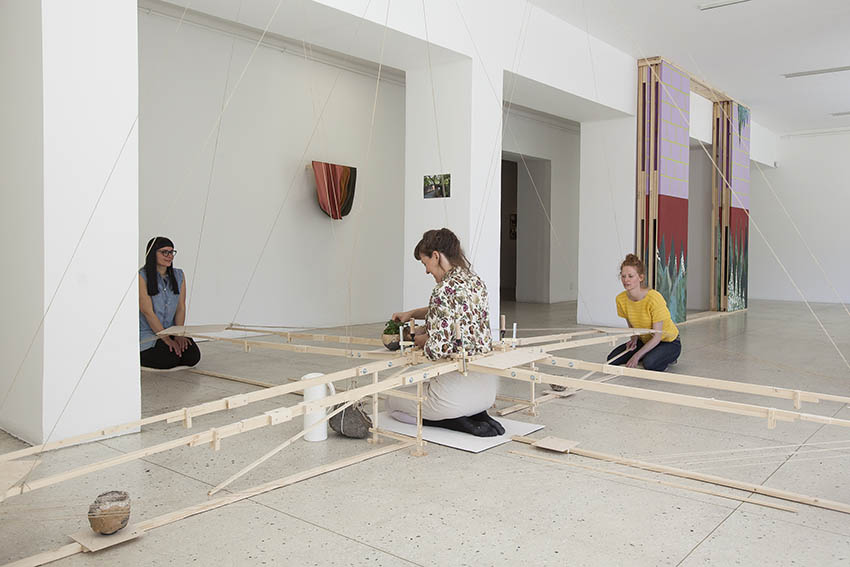
Johna Hansen
Table Ensemble
2015
installation/performance
Exhibition view at Tallinn Art Hall Gallery
Courtesy of the artist
Photo by Kristiina Hansen