SUMMARY
Strangely enough, in Eastern Europe, the following question is raised from time to time when it comes to caricatures: Is a caricature really art or not? Such a question is not raised, for example, in Western Europe or the United States (USA), where caricatures and cartoons are occasionally exhibited in major art museums.
So, where does this question come from? To find the answer, we must start with history. When Joseph Stalin came to power in the Soviet Union, he banned all humour, including caricature, because it was vulgar and petty-bourgeois. But when the Second World War began, Moscow understood that it was possible to ridicule the enemy through humour and satire. This is where the main breakthrough occurred: the art of caricature was merged with journalism. All cartoonists were appointed members of the Union of Journalists, while in other parts of the world they tend to belong to professional unions of artists.
Later, during Nikita Khrushchev’s “thaw” in the late 1950s, when propaganda had become an integral part of political, economic and cultural confrontations, the Central Committee of the Communist Party of the Soviet Union decided that satire and caricature were a good political weapon and propaganda channel to spread through the press. From then on, it was necessary to publish contributions by cartoonists in practically all newspapers.
But after 1945, many cartoonists had left Estonia; for example, Edmund Valtman (1914–2005), who later broke through in the USA. And those cartoonists who didn’t leave Estonia were later churned up under the wheels of history – either they were resettled in Siberia or sent to fight at the front, where many died.
Consequently, in the 1950s, the occupied territory of Estonia was relatively empty of cartoonists, and cartoons of very varying quality were published in (district) newspapers. Their main use was as propaganda. The second arena was so-called communal humour and social humour, but making fun of the state leadership was completely excluded. It was only in the late 1970s and early 1980s that a great number of good-quality caricatures began to appear in the press, which were no longer influenced by political propaganda. Even then, the same question was raised: is caricature art?
That said, the press editors went so far as to simply throw the caricatures in the trash after publication. Back then there was a line printed in newspapers and magazines: “The editorship will not return contributions.” This sentence was due to the requirement that during the Soviet era, editorial offices had to deposit all contributions in the central national archive. But starting in the 1970s, this requirement no longer existed.
Fortunately, some editors didn’t have the heart to throw all the pictures in the trash and kept the best cartoons in suitcases. The Estonian Humour Museum, which has existed for over ten years now, preserved these for future generations and has received a large amount of original caricatures in its collection from various editors.
Fortunately, art critics have not doubted the artistic value of caricature as a format in recent decades, and therefore there is no reason to suddenly start doubting it now. Furthermore, in the last couple of years, several caricature exhibitions have been held in our art museums. For example, the exhibition “Initiative from Below. Estonian Caricatures in the 1980s” (16 March 2024–21 July 2024) at Tartu Art Museum is almost entirely dedicated to caricature and presents work from the collections of the Estonian Humour Museum, Estonian Literature Museum, Estonian Art Museum, Estonian National Archives, Tartu Art Museum, as well as from private collections. Also, the Mikkel Museum recently hosted an exhibition of work by Honoré Daumier (1808-1879), a great figure of French art, called “The Father of Caricature. Works by Daumier from R. Paul Firnhaber’s Collection” (4 November 2023 – 28 April 2024).
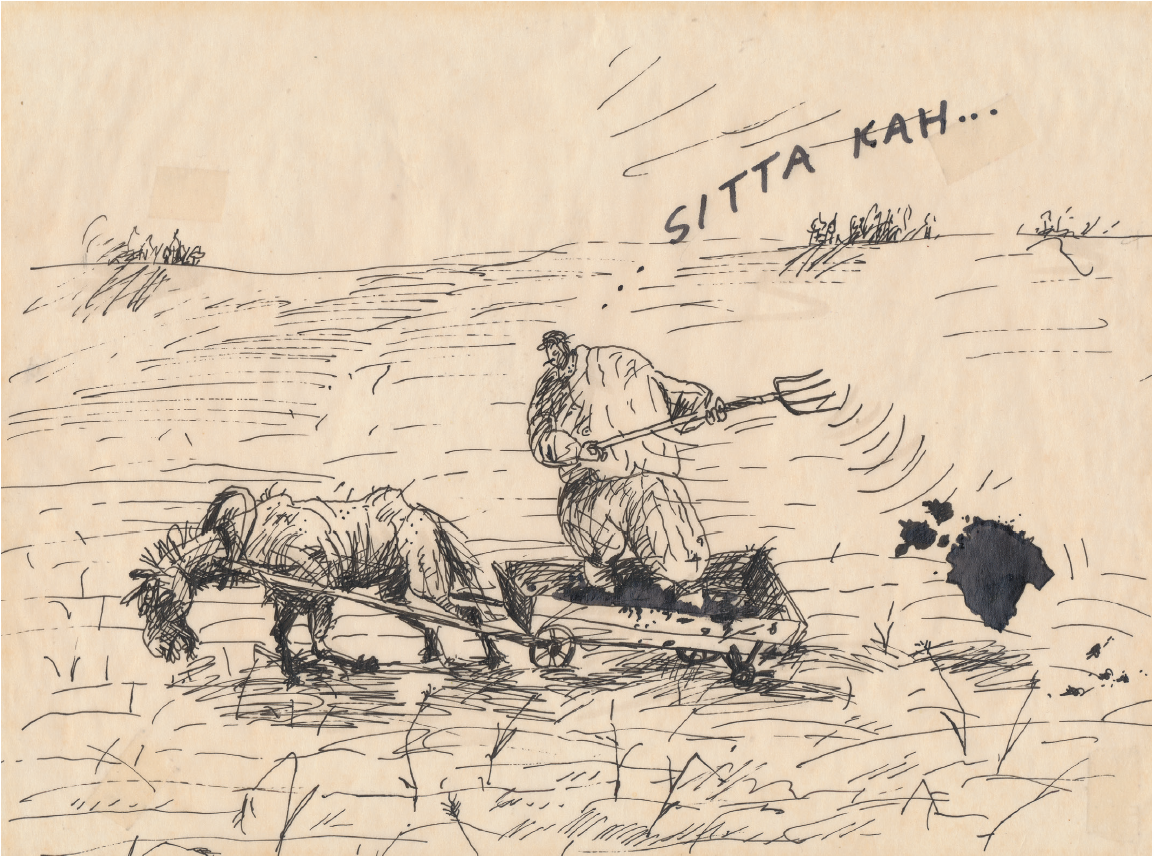
Priit Pärn
Shit happens!
Sirp ja Vasar 8. V 1987
Ink on paper, ca 22 x 29 cm
Author’s possession