SUMMARY
What I’d come to see in the gallery reminded me of Octavio Paz’s words: that time ceases to divide into days, months, hours and minutes the moment we are no longer one with it. Time moves on of its own accord, indifferent to our existence or its end. But human beings, unable to accept this and caught in what Miguel de Unamuno called a suffocating hunger for immortality, cannot imagine themselves as not existing. They fight to the last moment against the truth that everything is transient, fragile, perishable and fading.
The works in the exhibition “What I’d Come to See Had Already Gone”, curated by Fanny Weinquin, bring together transience and photography, pointing to their interconnection – the way photographs always depict something that has already been, moments that are now lost. As a conceptual key, the curator offers Roy Scranton’s essay collection “We’re Doomed. Now What? Essays on War and Climate Change” (2018), from which the title of the exhibition is also borrowed. This links the works to the bleak tangle of the Anthropocene and climate catastrophe.
Serge Ecker, an artist from Luxembourg best known for his digital practice, has created for this exhibition an installation-like series of analogue photographs of deserted (industrial) landscapes in Estonia. The series, titled “murmurare” (2022–2025), captures shadows playing across abandoned, manmade landscapes, where all signs of human presence slowly crumble and make way for new life forms. Humans build, but time dismantles.
Aap Tepper’s series “Long Exposures” (2023) centres on physical and chemical damage revealed during the digitisation of century-old glass negatives – traces of time that bring the historical photographic process into view. What emerges is the information uncovered in the act of digitisation. Humans record, but everything fades, cracks and wears away.
Birgit Püve’s “Ihidaya” series (2019–2024) explores the interplay between inner and surrounding landscapes and the search for spiritual, timeless time. Her black-and-white photographs depict mountain scenes where time flows in a geologic register. Here, time has resisted human control, and existence unfolds in a kind of shared breath with nature. The works in the exhibition function as exercises in imagining and accepting – picture a world without people, where time follows its own course, and all things human slowly break apart.
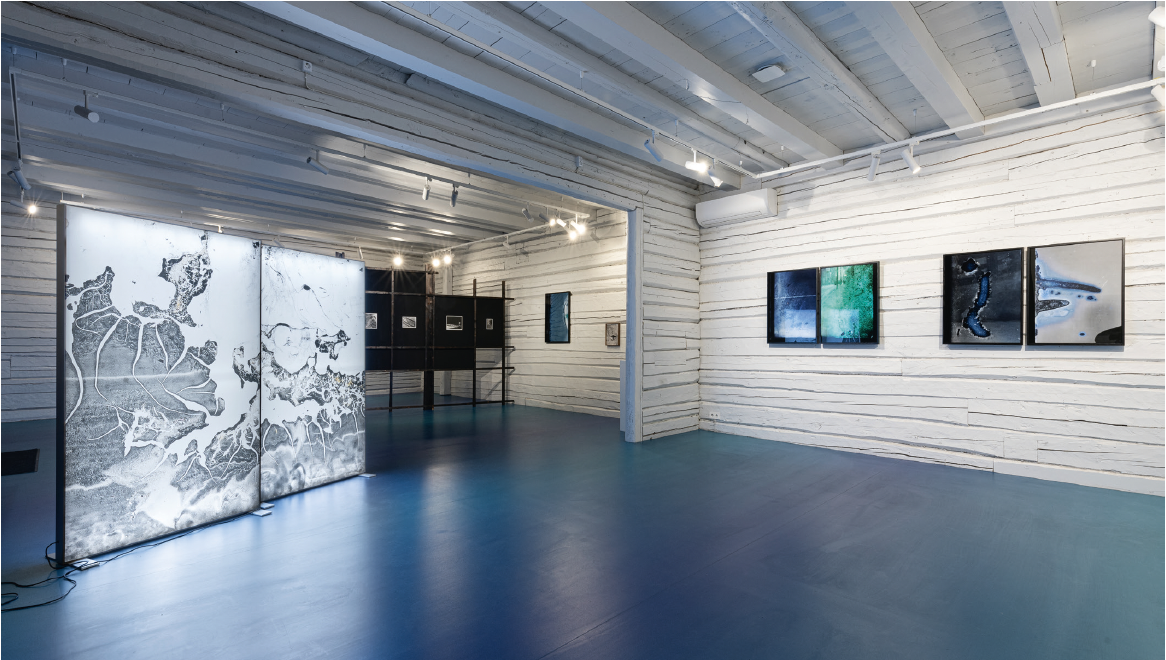
Exhibition view at Rüki Gallery
Photo: Aap Tepper