From 17. II 2021
Kumu Art Museum, 3rd floor, A wing
Curators: Linda Kaljundi, Kadi Polli
Curator of the project space exhibition “Aesthetics of Differences”: Bart Pushaw
Kumu’s new permanent exhibition “Landscapes of Identity: Estonian Art 1700–1945” (curated by Kadi Polli and Linda Kaljundi) opened this February and filled the building with audiences, received proper media coverage and also caused a more refreshingly more professional discussion. What else could you want from an exhibition?
Perhaps for it to be placed in context with our neighbours. Let me give you an example. In 2006, the Ateneum held a poll to identify whether the Finnish public had a favourite painting. Hugo Simberg’s 1903 “The Wounded Angel” won, Helen Schjerfbeck’s 1888 “The Convalescent” came second, and Ferdinand von Wright’s 1886 “The Fighting Capercaillies” came third. Melancholy, surviving the long, dark winter and the traditional hiding of the forest people behind the trees into the lap of the forest were the most commonly suggested keywords for these paintings.
What do the landscapes of identity unfolded in Kumu say about the Estonian people? Do they say anything at all? It is not a question of democratic voting but of constructing a collective identity “from the top down” through the eyes of two professional historians. It is a kind of gift to the Estonian people for their own money; the public museum offers a public service, in this case the opportunity to tell the story of the Estonian people in a slightly different way, in the cultural language of the 21st century.
Indeed, the new exhibition civilises the Estonian people, it helps them catch up with the advancing time, only by abandoning the linear chronology and treating time as a honeycomb structure in which phenomena are adjacent rather than following one another. This cluster of cells is characterised by simultaneity and accumulation; everything that has been gone through is somehow ever present in the common cultural memory and is not replaced in the progress towards a brighter future. The spatial programme of the exhibition is flowing and rhizomatic: it allows one to criss-cross through the exhibition based on one’s own choice, discover corners, passages and wormholes, quick comparisons and short circuits between different phenomena, and presents an open and complex problem instead of stacking chapters of art history upon each other like bricks in a wall.
The curators themselves have emphasised the need to remove the victim narrative from art history, to move beyond the myth of 700 years of serfdom to notions of multiculturalism, and to open Estonian art history up to more tolerant interpretations of other nations. The maiskondlik (territorial) approach to Estonian cultural history, offered by Kalevi Kull and Marek Tamm as the backbone of Estonian history in 2015, gives the exhibition its contours. This means, above all, inclusive attention to all the cultural strata that have settled here, without any conceptual opposition between ours and others’, without xenophobic stories of strangers who came to start a fight in our yard. The renewed vision of art history is not territorially limited but a certain unfinished story emphasising integration and hybridity, focusing on cultural polyphony, the curators of which point out cumulativeness – new characters keep appearing, but the previous ones do not disappear; instead, scenes and narratives are constantly enriched with different storylines.
It is noteworthy that the “Estonian story” is told in the video lectures of the exhibition by historians of different nationalities and in different languages. There are Americans, Germans, Jews, and some Estonians, although only one of them speaks the native language. Obviously, the “Estonian story” is no longer the ethnic self-narration of a select few, but an international object of scientific research. The “Estonian story” is told in several languages and from different perspectives and is discussed as a subject with which the presenters have an exploratory relationship. An effect of alienation arises: Estonians telling “their own story” have disappeared from the stage, and again, the open microphone has been grabbed by benevolent Estophiles who are dissecting the people’s self-image caught in the wind. And the self-image of these people has become a scientific problem, an opportunity to dissect the anatomy of one identity by lifting its organs into metal bowls one by one.
Hence the difference with the Finnish poll to which I referred above. Here, the direct democracy to find out the favourite of the people has focused rather on the study of a narrative composed of our favourites – or, to paraphrase a well-known song: what, oh what, are little Estonians made of?
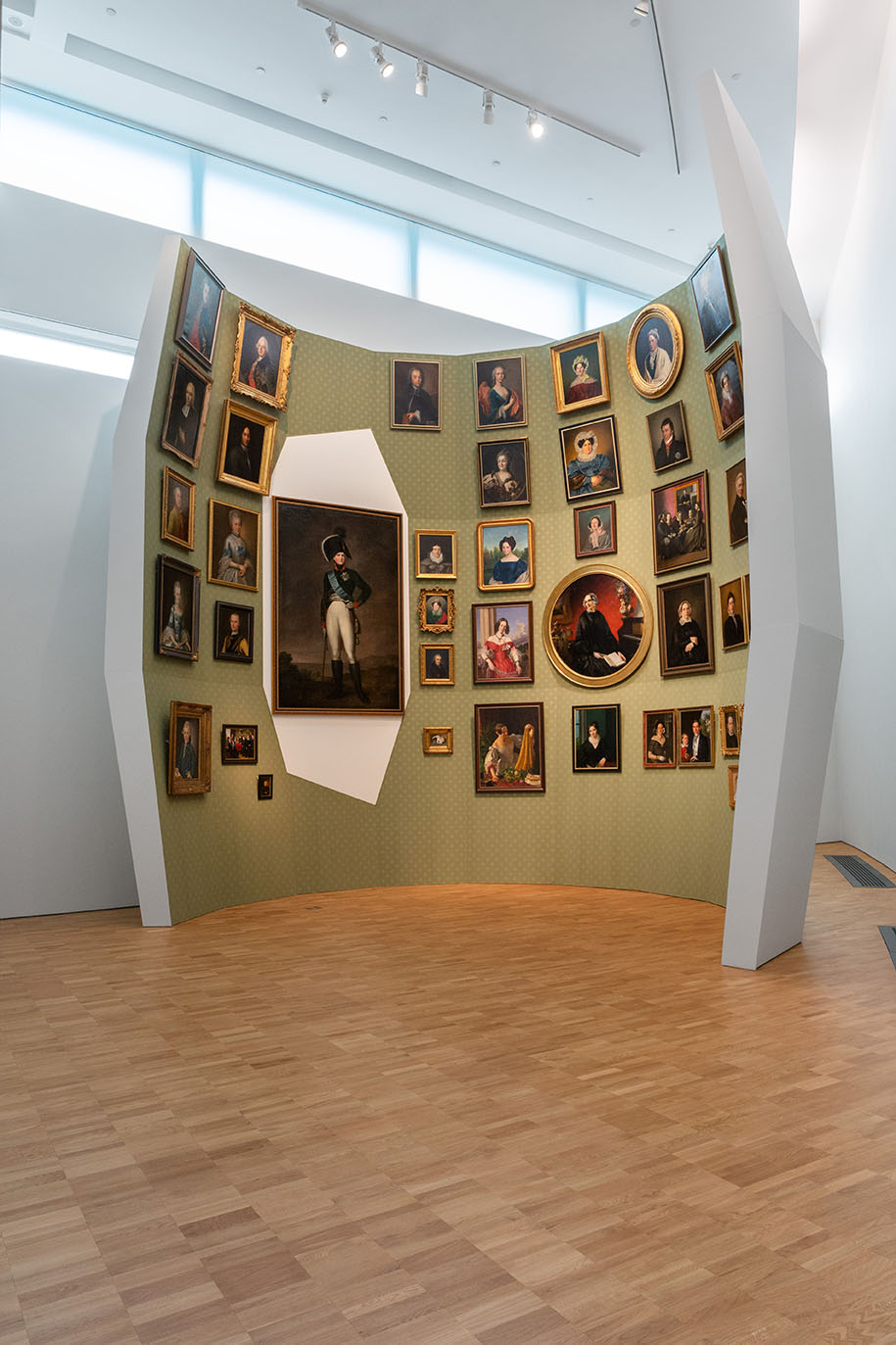
Neeme Külm, Tõnis Saadoja
The Sail
2021, site-specific installation (55 portraits of
Baltic German origin)
Kumu Art Museum
Photographer Hedi Jaansoo
Baltic Germans
The first exhibition hall offers the work of the Baltic Germans. Johann Köler, August Weizenberg and Amandus Adamson have not fallen in the rankings, and their lives coincide nicely with the aspirations of the average Baltic German to head towards the academies of Rome, St Petersburg or Paris, but in any case, into more conservative studios. The Umwelt of the rural manors and the royal arrogance of the metropolises give rise patronisingly to the first self-images of Estonians in this exhibition, initially rather as a gracious donation from the wealthier to the poorer.
However, the curators emphasise the diametrical value conflicts in this first identity donation. Carl Timoleon von Neff, a landlord painter and lifelong favourite of the tsar, for example, works hard to make the Estonian an attractive salon-friendly noble peasant, inflating them with a dignified Hellenistic stature, and he does indeed succeed in creating a certain cocktail of classicism, romanticism and Estophile orientalism. Surely, this cloying drink was drunk in front of the fireplace in the evenings, while discussing the noble intentions of the people of the manor to help the local peasants to ascend to the higher level of cultured peoples. On the other hand, in the second half of the 19th century, Oskar Hoffmann introduces a rejuvenated image of Estonians – a more realistic view of their tanned faces and the rooms of taverns with walls darkened with soot from pipe smoke. Hairy peasants have now been given the right to life just as they are – with faithfulness and empathy, Hoffmann depicts the grim situation on the lowest rung of the class ladder.
Both views of Estonian identity by the Baltic Germans have been rehabilitated as part of today’s collective self-image. After all, they, or at least the most advanced of them, gave Estonians the “Die Hard”-film-franchise-style story about 700 years of serfdom, gratefully picked up by Carl Robert Jakobson and Eduard Bornhöhe. However, it is due to them that the main activities of the Estonian people in their self-definition are “getting up”, “waking up”, “rising”, and sometimes “rising to the heavens in search of eternity for their language”. Jaan Undusk has described the conceptual position of Estonians in the narrative of the national awakening – they come from somewhere “below” and “behind”, at best, waking up from serfdom and discovering that they are missing everything that is “above” – all that is noble and high, which cultured nations undoubtedly have. The fact that Estonia is still preoccupied by “catching up with Europe” at the national level testifies to the continuing vitality of the paternalistic identity package provided by the Baltic Germans. We accepted the portraits they painted as part of our personal self-image, acknowledging the development gap that yawns between us and the generous donors. And the debt of gratitude continues to force us to the ground. But not at this exhibition.
The exhibition has set the beginning of the story in the 19th century, and a large part of what follows is mostly a chronological unfolding of art history from the past to the Soviet occupation. However, the chronotope of the exhibition also offers a plot that goes back in time and stays in the 18th century, when the reopened University of Tartu had not yet begun to vent the provincial spirit here, and Kristjan Jaak Peterson had not yet demanded that “the language of this land” have an equal place “under the skies and in the wind of song”. Heading straight on from the first hall, we go back to the 18th century. And here the curators have not left out the legendary initiative of Põltsamaa’s Estophile August Wilhelm Hupel to create a topographical overview of Livonia and Estonia (1774–1784), which as an introduction informs the reader that there are no significant cultural sights here.
The 18th century exposition is filled more or less entirely with chamber drawings by the noble misses and youth, and whether these belong to the Estonian narrative is indeed debatable. One can agree with Hupel, for the local people – whom he elsewhere reproachingly calls cattle breeders and degenerates – there is nothing to see in this hall. Except, of course, for the bare bottom in Gottlieb Christian Welté’s painting, which has given the curators the opportunity to speak “tongue in the cheek” about the rococo frivolity in local painting history.
National romantics
However, turning left from the first hall, we come across the national romantics of the beginning of the 20th century, and here the narrative of waking up from the night of serfdom steps into sight in all its beauty. Kristjan Raud, Oskar Kallis and early Nikolai Triik are all present. August Jansen’s “Swan Hunt” (1915) is again giving its everything to squeeze out the last of the dreamlike desire to return to the lap of a primordial nature as a free Viking people. At the same time, the flowing spatial programme of the exhibition and the exhibition strategy, which adheres to the principle of multiple voices and polyphony, must be acknowledged. In this way, national romanticism does not become the central narrative of this exhibition, just as the 19th century did not become the chronological starting point of the story.
The design of the exhibition emphasises the relativity, and also contingency and fleetingness, of any self-definition. So we see the illustrations of Erik Obermann in the albums of the group Noor-Eesti (Young Estonia; “Noor Eesti” I–V, 1905–1915), which in terms of content tend to be modernist shouts and metropolitan anthems, taking the so-called Estonian thing back into the Viking era and to Scandinavia and enticing the reader with oriental delusions of voluptuous Eastern dancers and snakes. In all of this, there is the decadent zeitgeist and the urban resignation of the fin de siècle, which was as much a cultural pose as a desire to return to the peasant’s simplicity and the hunter’s primitive world. The exhibition masterfully avoids creating an illusion of organised chapters and stages of development; at the same time, it does not sink into eclecticism, but develops into a long straight wall, which runs like an enfilade to the present, but offers corners and bubbles in every doorway, secret kisses of different eras in the same work.
Modernists
Take Ado Vabbe, for example. It was only recently that his extensive retrospective “Wunderbar” finished at Kumu (28. VIII 2020–21. II 2021, curated by Mary-Ann Talvistu). It became clear already then that there were several Vabbes. During his long life he transformed like a harlequin from one slapstick to another, as an illustrator of Siuru’s albums he fooled around with art deco abstractionism and the expressionist metamorphoses of Der Blaue Reiter, erred into confrontations with the audience, then calmed down to incline towards realism in the 1930s and was brutally bent under the whip of socialist realism and repentance in the 1950s. Which Vabbe contributes to the collective self-image of Estonians? Which of these is the true meikäläinen (Finnish, “one of us”) and perusvirolainen (Finnish, “true Estonian”) for Estonians?
Somehow they all are, despite Vabbe’s mixed bloodlines. After all, Konrad Mägi also considered himself the son of the Nordic countries, in whom flows the blood of the south and who actually belongs to the centre of continental Europe – Paris. There is a European vibe and cosmopolitism in such self-determination! Aby Warburg, for example, announces in the 1920s that his heart belongs to Hamburg, his blood is Jewish, but, nevertheless, his spirit belongs to Florence. Such multicultural jugglers cannot be tamed, a single drawer is not enough for them; a character like this confronts you in every chapter of Estonian art history. Let them then change from one role to another, let them bend like a reed, as long as they do not break.
Modern traditionalists and proletarian realists
In the middle of the enfilade, Adamson-Eric and Aleksander Vardi are crowned as a festive stopover and evidence of the loyal adoration of 1930s Estonian fine art for representative traditionalism, the triumph of nationality and conservatism in official art life under the presidency of Konstantin Päts. It is good that the glorification of the pure-breed Estonian women and Home Daughters’ waving the blue-black-white have received extra artistic fuel from impressionism; it conceals the propagandistic idea and the rhetoric of state allegiance. Salon traditionalism brings in money for the artists, Vardi and Adamson-Eric live well: there are commissions, there is money, the salary keeps on coming.
The younger generation who graduated from the Pallas School of Art in the 1930s approach the issue of realism much more prosaically. They do not have the cosmopolitan style, their Europe is narrower and harassed by the rise of fascism, torn by the recent Great Depression. Andrus Johani and Kaarel Liimand, on the other hand, find the truth of life in the slum. Their heart does not beat to modernism, nor to salon impressionism, but rather to the simple people who have remained in their shadow and, fuelled by undisguised leftism, are in fact preparing a “dictatorship of the common people” in Soviet Estonia. Neither lives until then (fortunately), they both unfortunately perish in World War II.
Art shame
The above does not contain much that is new, and the fault lies with the exhibition. Or is it even a fault? The curators’ job was to please a wider audience, not a handful of colleagues. Moreover, there is freshness in the exhibition – this is due to a greater emphasis on the hybridity of cultures and the mosaic of the collective self-image. Although the main motifs are familiar: the same old picture is hung above the same fireplace, only slightly differently.
However, after the opening, disproportionate excitement in the Estonian mainstream media was caused by the co-curator Bart Pushaw’s sideshow, which examined the colonising gaze of Estonians towards other races. From the reaction of the media, I even concluded that there has been a spectacular self-cleansing, that the collections have been thrown into the purgatory of political correctness, and that few have survived. The curators’ justifying and apologetic tone in the first interviews was also frightening – where there is smoke, there is fire, I guessed.
I rushed over and calmed down immediately. The Berber motifs of Ants Laikmaa and Eduard Wiiralt are still there and under their original titles. Representatives of Morocco have not come to the exhibition to protest against their degrading portrayal in Estonian art history. The gypsies are also called gypsies in the titles of the works, some “Negro head” sketches familiar from local art history are also on display, but alternative names have been suggested for them, or they have simply been overlooked due to racial blindness. Just little differences, as in Quentin Tarantino’s “Pulp Fiction” (1994), in which the familiar Big Mac burger gets the more Parisian title Le Big Mac. That’s it!
And despite this extreme delicacy, the interest of Estonian artists in the exotic, concentrated in one room, does indeed seem a bit embarrassing. Cultural othering is perfectly present in their gaze, and culminates probably in the caricatures of Gori (Vello Agori) during the unfortunate final stage of his life, when he was already drawing under the command of dictatorships driven by racial hatred. It is no wonder then that his showcase is awkwardly banished to the corner of the hall, more or less facing the wall – really as if made to stand in the corner as punishment. Unfortunately, this is done without explanatory reference to the lack of freedom in the arts in Estonia in the 1930s, and the power of Pagari Street “art experts” to decide over the artists’ life and death later in the 1940s (During the Soviet occupation, one of the most notorious KGB remand prisons was located in the basement of Pagari Street 1 in Tallinn’s Old Town. – Ed.). In an ominous way, the years of the miserable deaths of Andrus Johan, Kaarel Liimand and Gori fall close to the final date in the exhibition.
Obviously, a new era began in 1945 and people with a new self-image appeared. The landscape changed again and with it the self-image of Estonians as well.
Johannes Saar is an art historian, critic and educator with a PhD in media and communication from the University of Tartu.