Flo Kasearu’s House Museum
(Pebre 8, Tallinn)
Jokingly, Flo Kasearu says that she became an artist because her mum gave to her an artist name. Born in Pärnu in 1985, Flo has created her own home museum in Tallinn, at 8 Pebre Street.1 In the Flo Kasearu’s House Museum (FKM), the artist shows the life of an artist who happens to be the same. The house museum appears as a multifunctional shelter in many ways: a home-residency, a personal exhibition space, a storage, a heritage and a platform from where she can develop new art projects.2
Flo has turned her biography into art, but also art into a way of being in the world. Through play, distortion and ambivalence, she forces people to see common things in an unfamiliar or strange way, erasing the border between art and life. An example of that is the re-contextualisation of everyday objects as something extraordinary in the FKM.3 Another example is the transformation of biographical incidents into artworks.4
The following interview took place in the garden of the FKM, on a rare sunny day in August 2015. Tõnu Narro, her partner, waved to us from the roof while we repeatedly moved our chairs diagonally across the garden, following the trajectory of the sun. It took me a few minutes to decide which Flo I would ask first – to the person boiling eggs, the director of the museum, the assistant in charge of maintenance, or the winner of the Köler Prize in 2012. In the end, I talked to all of them at once.
When I sent back the transcription of the interview, Flo suggested that we should submit the interview to “a women’s magazine, like Eesti Naine or something” instead of KUNST.EE. Nevertheless, here we are now with our Q&A (the interview was conducted in English):
Could the FKM also be described as “repairment art”?
Hah, that would be a good category; let me see how it sounds in Estonian, remondikunst, kunstiremont…
My work is “do it yourself”, even “re-do it yourself”, engaging with what is around – not necessarily repairing, but more like relocating and re-arranging things. Five years ago, when I got this house, there had not been any repairs done to the house for over 100 years. For a while I did not bring anything with me, I just cleaned, emptied, repaired. Since I did not have much money, I had to fix things with my own hands and in my own rhythm. There was no electricity, no water. Little by little it became my house.
Art also has a commercial side, what are you selling with a house museum?
I sell my name; I raise my symbolic capital. I guess that my art is not particularly commercial (Flo Kasearu is represented by Temnikova & Kasela Gallery – Ed.); only museums and foreign collectors may buy it.
In many of your artworks you have mobilised a lot of people. Often, you work with several collaborators. Would you say the FKM is an individual or a collective project?
It is an individual project because, egoistically, only I am selling my name. But it is a collective project in the sense that many people help out. First, Tõnu, who always helps me with installations and technical stuff. Actually, sometimes he jokes around by saying that Flo Kasearu is his artist name as well. Then, my mum, the first critic with whom I discuss my work, even if she has no background in the arts. Also some friends have collaborated; most often they do it for no money. It may look like I am using them, but actually it is mutual collaboration, because they like to be part of my activities and I am interested in their daily life, too.
Eventually, the capacity of mobilising people is an important skill in an artist!
Hah, already at school I realised that I was good at mobilising people and giving orders. That was when I thought of going into politics, with the social democrats, but it was too much of a compromise. If I have an idea, I like to put it into practice directly. I am lucky that Tõnu has worked for museums installing exhibitions. He has often had access to materials that would be thrown away after the show. Institutions do not always think about storing, but just producing. I take advantage of that.
In some of your work5 there is reflection on home and national identity. Is this something you want to explore concretely, or it is more like a general reflection?
It was when I was in Berlin (2006–2007 Flo Kasearu studied at the Berlin University of the Arts, in the studio of Rebecca Horn – Ed.), when I first started to reconsider my Estonian identity. And then, after I got this house, I began to reflect on what it is to have a home. I spent many years living in the student dormitory, so I could not even think in terms of a home. But now I consider myself an average human being who has built at least one house in her lifetime. All these works grew in parallel to the reflections upon my personal condition.
Some of your works could be considered public art.6 In which way is this form of exploration attractive to you?
In Berlin I had to do public art, because I was unable to paint. Everything was new and I had to find myself and understand my interaction with the city. I am spontaneous as an artist, and also impatient. I cannot always just put my works in a gallery and wait, at least not always. I like to try out different possibilities of expression. In public spaces, the audience cannot choose if they want to see art or not. It is just there, and people may interpret it differently. Then public art has its particular time and space. Every time has to be different, as the surroundings themselves change. I like the fact that my works are in a specific time.
I remember that three years ago, when we first met, I asked you about your move back from Berlin to Tallinn. Then you responded that in Berlin you were just one among a thousand artists, but in Estonia you were Flo Kasearu.
I felt there was too much art in Berlin. Every second person in Berlin claims to be an artist so I felt that I had no right to be an artist there. Here I could find my spot, do something that had not been done yet and that I could do. I didn’t like being a foreigner in Berlin or in Istanbul. I felt I could not react that quickly and that I didn’t know enough about my surroundings. Berlin and Istanbul are too crowded. In Estonia we lack people saying things out loud – people here are modest and don’t talk much. Estonia is also so little that we all know each other. But if you do a cool work here you may become a local superstar.
Some of your artworks may be considered as “survival strategies”, in the sense that you turn your personal needs into something artistic. In this sense, your art is very biographical, am I right?
Yes, but at the same time, my art is very objective. I make art out of my personal situation and social needs, but the art is not only about myself. It is biographical, as you put it, but I objectify my biography. I cannot separate art and life that easily. My studio is in my house. I create out of my own needs. Somehow it comes naturally, without much thinking.
I was told that what distinguished Flo Kasearu from other Estonian artists, is that you are brave – is that correct?
People think I’m brave and always down to earth, but inside I am a rather tender person. I may be practical, but not so logical. For instance, I think I have been trying out too many formats. But I’m practical because I am able to make art out of personal situations and life conditions.
In one of your performance7, you reflect on the hardships of finding a balance between being a mother and an artist. Could you expand upon how having a child has conditioned your work?
After giving birth to my child, some of my colleagues asked me if I would take a break from producing art. But my life continued without any rupture and my child became one more part to consider in the process of creating things.
I guess that having a house as your property also demands particular arrangements and maintenance, or at least it limits your freedom, for example, to move abroad?
Yes, but it is fifty-fifty, because at the same time I don’t have to think about paying rent, so I can be an artist full time. But then again one has to think about maintenance, plumbing, heating and so on.
Could you tell me more about the biography of the house? Because you got it back through the post-soviet law for the restitution of properties, right?
The house was built by my great-grandmother and his family in 1908. In 1944, they escaped from Tallinn to Pärnu, afraid of the deportations to Siberia. The Soviet government put some families here. Then in 1991 my grandparents asked to get the property back. They died soon after, but my family went on with the reclamation. However, there was a complication: one of our relatives had died in Armenia in an earthquake, so there was a missing document. Finally, we got the house back in 2010, but we still had to pay some of its price. Currently, we are one of three owners, three branches of the family… so I am well aware that my other relatives may come in anytime.
In “Fears of the House Owner” (2013) you illustrate your phobias as a house owner, but I wonder what could terrorise Flo Kasearu as a person?
Ouch, it is super easy to terrorise me. I am afraid of everything: death, the end of the world, traffic, bad people, war, bad news. Tõnu thinks I get very easily anxious from bad news, and I do! But I am not afraid of getting old.
You are not afraid of getting old?
I was never a great beauty.
And the artist Flo Kasearu, does she have any complexes?
I think I do not pay enough attention to the aesthetic side. For me, a good artwork has to reflect a sharp conceptual idea through formal constraints. I kind of made it with “Uprising” (2015), but my art is not always that clean. I would like to do something more aesthetic with the same social charge. For example, I admire the way Jaanus Samma combines the political, the aesthetic and the historical in his artworks.
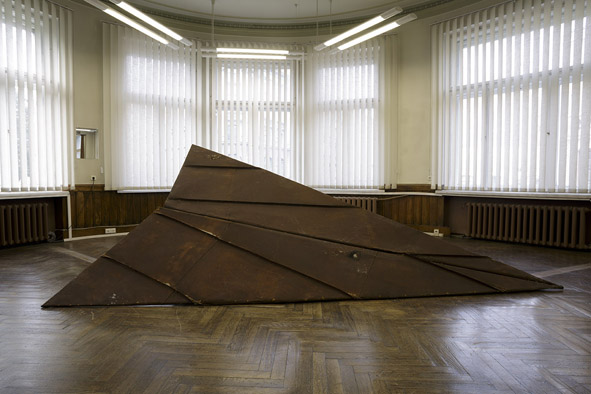
Flo Kasearu
Uprising
2015
installation (roof metal panels from FKM, folded)
“Survival K(n)it” exhibition view, photo by Andrejs Strokins
Courtesy of the artist and Temnikova & Kasela Gallery
Would you say your art is “old school”?
Sometimes, when I look at what other contemporary artists do, I feel very “old school”. But I don’t have any complexes about it. I am simply not interested in weird collages; I am more of a conceptualist. I hardly see any possible dialogue with as it were artificial artworks; I only like it when it’s ironic. I am more interested in contemporary everyday problems. True, I have used video in my works and that’s considered “so nineties” nowadays. Anyway, I am using Facebook, for example, for my performance “House Music” (2015). I understand it is necessary to keep an eye on it, but there is also too much noise in it.
Do you think your art could be described as “post-socialist”?8
I don’t think in those terms, but some people have recognised it in my work. I was born in 1985, but I don’t remember anything of the Soviet time and nobody in my family talks about the past.
In 2014, you organised the exhibition “White Tank Top” at the Tartu Art Museum. How was that experience as a curator?
I did curating in the same way I work as an artist. The big thing is to think of a concept, which was to include artworks where a white tank top was depicted. The rest was done mostly by museum’s workers. I enjoyed the opportunity to play freely within the museum collection. It was a shame that we did not get support to publish a catalogue.
And what could be your artistic referent, if any?
I would not like to say any specific names because when I make art I don’t think about artists… but if you insist, I admire Ahmet Ögüt and Pilvi Takala.
Francisco Martínez is a doctoral student at the Estonian Humanitarian Institute, Tallinn University. He has worked as a journalist in Germany, Turkey, Russia, Portugal and Spain.
1 Also see: Maarin Mürk, Freelance Artist Blues. – KUNST.EE 2013, No 3, pp 42–53.
2 For example, “Uprising” (2015) or “House Music” (2015) in collaboration with Riina Maidre.
3 “Collection of Rental Ads” (2013) or “Collection of Artefacts” (2013).
4 “Estonian Dream” (2011), “We Are on the Way” (2012).
5 For instance, “Estonian Dream” (2011); “Re-enacting a Revolution” (2010) in collaboration with Tanel Rannala; “Coast to Coast” (2012); “Grown Out” (2013).
6 For instance, “Holy High-Tech” (2012) in collaboration with Epp Kubu; “O” (2011) in collaboration with Andra Aaloe, Aet Ader, Grete Soosalu, Kaarel Künnap; “Riga Runaway” (2011); “Vabaduse plakatid” (Freedom Posters, 2008) in collaboration with Andra Aaloe, Tanel Rannala, Juhan Teppart; “Artificial Queue” (2010) in collaboration with Andra Aaloe, Aet Ader, Grete Soosalu; “Hula Hoop in Ostkreuz” (2007).
7 “Holy Night” (2014), in collaboration with Oksana Tralla, Veronika Vallimäe, Marianne Männi and Riina Maidre.
8 I have in mind, “Basic Navigation for Chisinau” (2010), “Unemployment Will Tear Us Apart” (2010) or “Artificial Queue” (2010), for instance.