14. IV–4. VI 2023
Contemporary Art Museum of Estonia
Artists: Aliaxey Talstou, Elo Liiv, Holger Loodus, Kateryna Lysovenko, Kirill Tulin, Paulina Pukytė, Svitlana Biedarieva
Curator: Tanel Rander
I don’t often shop in museum shops that sell souvenirs related to the exhibition programme and stuff like that, but indeed, recently I bought a T-shirt for myself. Curiously, I purchased it at the Contemporary Art Museum of Estonia (EKKM) – yes, out of all the cultural sites in Tallinn succumbing to gentrification and commercialisation, it was this exhibition venue, which initially emerged as a squat full of institutional critique (and therefore perhaps also critique of capitalism?) in the early 2000s, that ignited an insuppressible consumeristic urge in me. The T-shirt features a single word – “narcisseast” – printed in a slightly scribbled handwriting. It’s a pun (if you note the last syllable). A piece of (self-)irony.
This wordplay also took the form of a dazzling neon sign affixed to the wall in a work created by artist Tanel Rander. More precisely, it was one of two text works shown in the group exhibition he put together, “Farewell, East! Farewell, Narcissus!”, in which other artists from Estonia, Lithuania, Ukraine, which is resisting Russia’s full-scale invasion for the second year, and Russia’s vassal state Belarus, also participated. On the curator’s tour before the opening of the exhibition, Rander rather modestly called this pun his “curatorial comment”, and that is also how I will interpret it. So, let’s be clear, I’m wearing a T-shirt with a curatorial comment right now. A separate genre, not so much a reproduction of an artwork.
It is also a strange feeling to be writing a basically positive review about an exhibition where, to be honest, there was nothing much that had not been seen before: a work that documented a performance based on a simple gesture (Aliaxey Talstou), a sand installation on the floor symbolising shadows (Paulina Pukytė), a couple of pseudo-medieval death dance motifs printed on the wall (Svitlana Biedarieva), a contemporary painting and a socialist-realist picture frame in a rather comical combination (Holger Loodus), correspondence between an artist (Kirill Tulin) and the curator, some figurative compositions with brushwork that at first glance seems nondescript (Kateryna Lysovenko), yet another artist’s documentary about Soviet monuments, and mass-produced crystal vases found probably in every home during the Russian era. Perhaps only the exhibition’s largest installation (by Elo Liiv) was the one work with above-average affective impact as an audio-visual stimulus, with a certain “Instagrammable potential”, but an impatient visitor would have spent no more than 10 or 15 minutes at this exhibition.
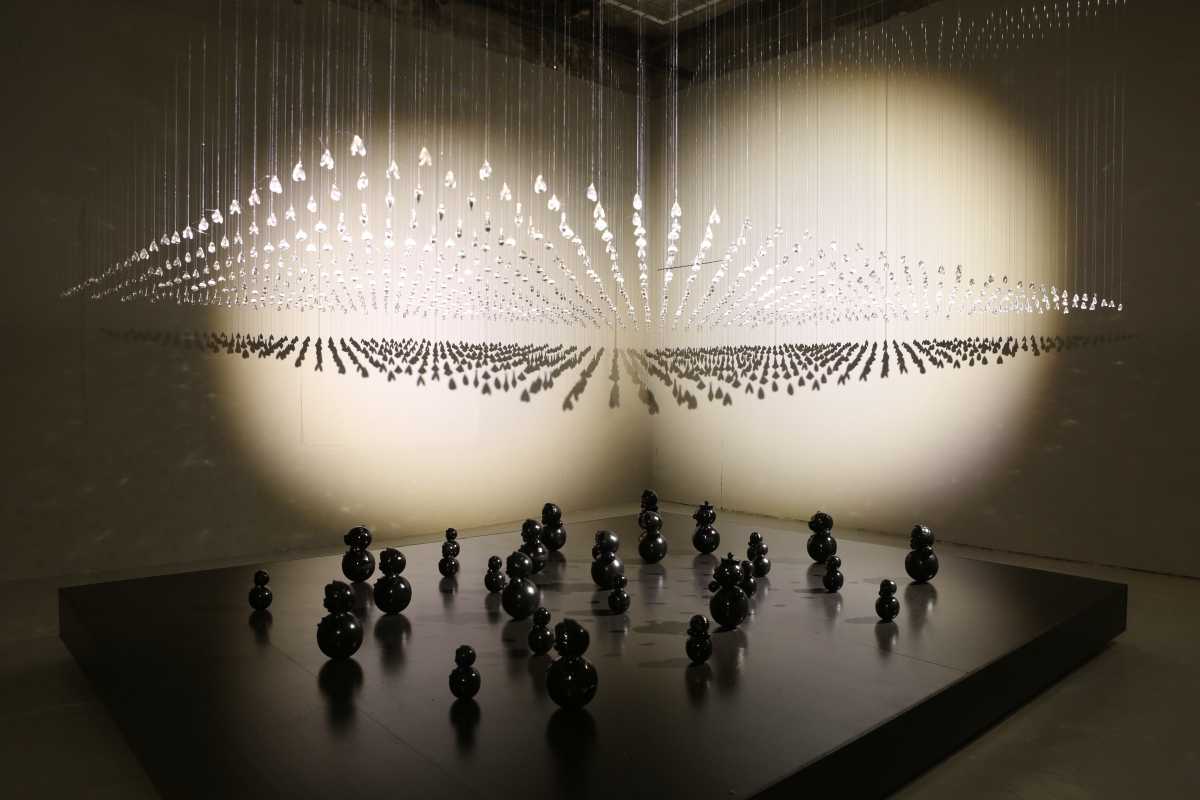
Elo Liiv
Dream
2023
Installation
Exhibition view at the EKKM
Photo by Annika Haas
Courtesy of the artist
It is only Rander’s curatorial text in the exhibition’s catalogue that ties up all the loose ends, leaving the reader with a sense that all the exhibited artworks, which one hurriedly passed by in the exhibition hall, in fact exemplified the curator’s thought process with awe-inspiring coherence. Here, Rander essentially continues from where he left off at his last solo exhibition (“Angelus Novus” at Hobusepea Gallery, 6. IV–2. V 2022). While the artists showcased at EKKM undoubtedly had individual identities prior to the exhibition, it is the curator’s expertise in Eastern European identity and psychoanalysis that imparts a shared agenda, infusing their works with a poetic vision. A curated exhibition as a whole, a curated exhibition as a composition. In other words, it was the kind of art exhibition that relies very heavily on the curatorial text, and those who can’t read, will miss out on the full experience. Again: this is a separate genre, not so much as a judgement.
What Rander was doing in this exhibition is perhaps best summed up in his own words from about a year ago: it deals with the need to “decolonise the existing decolonial movement and Eastern European discourse”, based on the understanding that “the experience of socialism was a colonial experience”.1 The way I understand it is that the curator has decided that if he is about to pick a fight at all, it should be with someone bigger than himself, who can arrogantly accuse him of naivety, national(social)ism, or using double standards. The post-colonial gaze has been characterised for a very long time by the presence of a certain theoretical-intellectual blind spot, which, as expected, causes visual disturbances at the very moment the Soviet Union (and consequently also present-day Russia) comes up. I predict that this blind spot will not disappear for many more years and even decades to come.
So yes, a reaction to the war. This fact is also pointed out by the reviews that have appeared so far. And it is likely the very reason why the exhibition has been hailed as “very radical in its curatorial concept” or an embodiment of the notion that “Pauls are made of Sauls”, to quote a few of those reviews here.2 Indeed, as an artist, Tanel Rander has dedicated most of his exhibitions and artworks to exploring the fluctuating Eastern European identity situated between the “collective West” and “mystical” Russia in the past decade. However, as a curator, he now says enough is enough: “Farewell, East! Farewell, Narcissus!” Wherever an empire turns its gaze, it sees nothing but its own reflection. And why enable this narcissistic disorder?
Rander argues that Eastern European identity is consistently marked by a sense of absence, a void, an insatiable hunger, or an unquenchable thirst. In the exhibition, that image is recurrent, appearing either as an empty crystal vase or its shattered fragments, a victory cup drained of meaning, gaps in the written word, a tribute to the dead, an awaiting grave yet to be dug, or grain stored in a room with metal bars on the windows. In a negative sense, Eastern European mentality has always signified poverty, cheap labour, dependence on the resources of the big eastern neighbour, pervasive corruption and the power of oligarchs who operate outside the law. But what if these are just transitional difficulties that acknowledge the possibility of positive change?
We can never escape the fact that other cultures will always be exoticised. Rather, we must learn to spot the features of Narcissus in our own reflection. Before it’s too late. He will never really disappear. He will always remain there, even if merely as a delicate reflection in the water’s mirror. But he must not be allowed to take over. Otherwise, we risk becoming consumed by an obsession, transforming into “born” Sovietologists and Putinologists, with an indelible stamp of Eastern European-ness imprinted on our foreheads – preferably in Cyrillic script. Like a bad caricature, a mixture of Borat and a random prominent European politician put on hold while trying to get the Kremlin on the phone.
“You know, it’s so exciting that you have had this harsh political history here in Estonia, Soviet censorship and Soviet planned economy! And it’s so strange that you all talk about capitalism here as if it were something tangible,” a foreign colleague said to me recently. “Where I’m from, it’s just so ubiquitous and always there, so nobody even thinks about capitalism. It’s… like the air you breathe – without thinking.”3
Yes, I know. That’s exactly why I bought this T-shirt. To make my small contribution.
1 See: Tiit Hennoste, Linda Kaljundi, Liisa Kaljula, Tanel Rander, Andreas Trossek, Discussion on the cultural identity of Eastern Europe in light of the war in Ukraine. – KUNST.EE 2022, no 2, p 24.
2 See for example: Ketlin Käpp, Traumade kehastumine kristallkausis. Kuidas tegeleda sügavalt mällu sööbinud paneelmajade ja monumentidega? – Eesti Päevaleht 17. V 2023; Martin Luiga, Kas lakata olemast ida maad? – Postimees 26. V 2023; Hanno Soans, Peeglikildudest ärapööratud pilguheit. – Sirp 26. V 2023.
3 Record of the conversation based on the writer’s recollection (the source of the conversation is known to the editors).
Andreas Trossek is the editor-in-chief of KUNST.EE.