2049
I remember Katja Novitskova primarily as a profound, but also introverted person.
2021
One of the most important consequences of the pandemic and the accompanying quarantine and mitigation measures is likely to be investing in memes making its way to the masses and the mainstream. The best-known examples are the ironic investment in Gamestop and Dogecoin, and to at least some extent, the NFT1 trading boom.
Given the sums that have circulated so far – perhaps best exemplified by, for example, US digital artist Mike Winkelmann, alias Beeple – it is clear that art fairs are already looking for ways to integrate NFTs, but for this NFTs must first be integrated with art history. This is not that easy because digital NFT art has emerged as if by itself and from scratch, outside the traditional art world and its institutions.
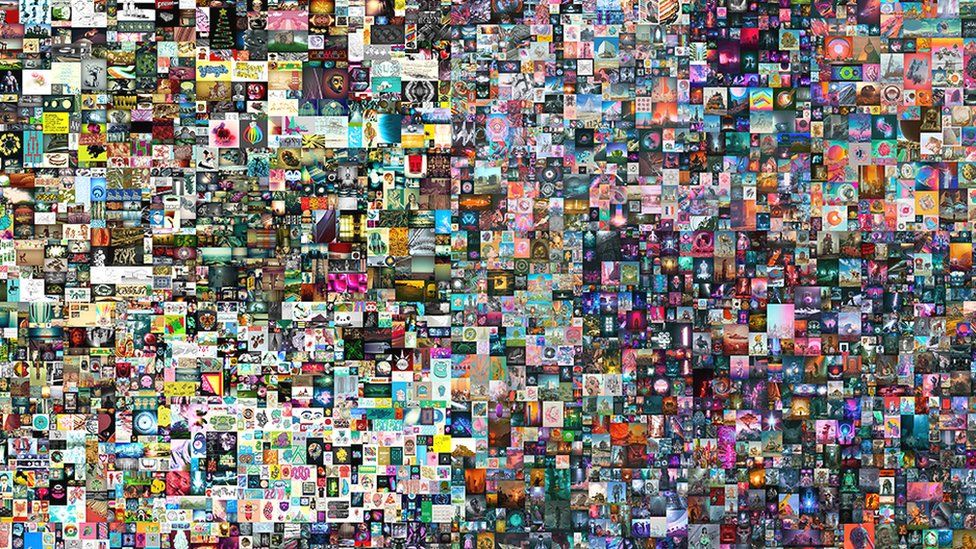
Beeple
Everydays: The First 5000 Days
2021
NFT
21,069 x 21,069 pixels (316,939,910 bytes)
Source: Christie’s
I suggest that the solution could be the post-internet art of the 2010s. Just as the aforementioned was retrospectively associated with the net art movement of the 1990s in the course of its establishment, NFT art could now be attached to post-internet art. The context is different, the artists are different, but the genealogy is identifiable: 1) net art saw the web as a way to escape the dictates of the art market; 2) through post-internet art, the market discovered that the internet can also be commodified through traditional art institutions;2 3) in the case of NFT art, however, the market no longer even needs intermediary art institutions.
This line of descent can certainly be described in more detail. At the same time, it also gives us a reason to dig into the history of post-internet art, which is so close to our hearts.
*
Every discussion about post-internet art is destined to start with the statement that it does not mean what you think: it does not mean that the internet is somehow over, but instead… followed by an ad hoc stream of thoughts. This is a flash of genius that does not allow post-internet to be satisfactorily defined.
According to the curator-philosopher Boris Groys, such a concept could be considered as a paradoxical object,3or, using the vocabulary of the philosopher Graham Harman, as an unparaphrasable object.4 It is not necessary to understand the label “post-internet” correctly (similarly to poetry), but it can be understood fruitfully (I would add here that correct and fruitful are generally opposites in an artistic work, but that would be a longer topic in itself). The term “post-internet” potentially has a broad meaning, but for Estonia, it above all stands for Katja Novitskova.
*
The Estonian Art Museum first exhibited Katja Novitskova’s works in the exhibition “Archaeology and the Future of Estonian Art Scenes” (19. X 2012–30. XII 2012, 5th floor of Kumu Art Museum, curators Eha Komissarov, Hilkka Hiiop, Rael Artel, Kati Ilves ). Nobody wrote about Novitskova’s works in this exhibition, not even me.5 Apart from the artist’s own CV, there is no real confirmation that she participated in this exhibition. This is understandable: the art audience cannot recognise art revolutions in real time because the novelty manifested in them is of an unprecedented nature.6
However, I am still trying remember something and assume that “Post Internet Survival Guide” (2010) was probably on display on the shelf of the so-called Tallinn-Amsterdam graphic design scene, in the shadow of publications by the local publishing house Lugemik, perhaps. Seems likely.
It is as if I even recall something… It is possible because seeing is a selective process and we constantly store information, most of which we are not aware of because at the moment it is irrelevant but later, as the context changes, peripheral information may become actual. If Novitskova were to be a topical name in a few decades, then I will certainly be able to “recall” her works from this Kumu exhibition very clearly. And maybe even the artist herself?
For example, in 1998, a presentation party introducing the biography of Nat Tate, a “prematurely departed painter”, was held in Jeff Koons’ studio in Manhattan. The patron of the evening, David Bowie, asked the audience to share their personal memories of the artist who lived between 1928 and 1960 (who, as it turned out, was a fictional character invented as a practical joke). Decades had passed, but some parties were still able to “recall” that he was primarily a profound person, but also an introverted person.7
2049
I recall that Katja Novitskova was somehow connected to Tartu. She studied at the University of Tartu because she was not admitted to the Estonian Academy of Arts. Or was it in reverse order, I do not remember exactly. In any case, in Estonia there was a cultural dichotomy on the Tallinn-Tartu axis at that time, similar to the Moscow-Siberian axis, for example, in Russia. Those who had fallen out of favour in the capital were “exiled” to Tartu.
But since Lady Luck is a whore, then as in Siberia, Tartu also sometimes had a higher concentration of creativity than the capital. At the beginning of the millennium, the Interdisciplinary Salon operated there, the festival “Eklektika” (Eclecticism) took place, a number of bohemian types hung around the university’s semiotics department, mixing club culture, performative and text art, and a young Novitskova ran in this company.
By the 2010s, the wave of syncretism in Tartu had run out, the leaders had either been kicked out of the university or had moved on with their lives. Novitskova was one of the latter because at some point the Estonian press began to publish reports along the lines of “Russian girl from Lasnamäe is making a successful career as an artist in Berlin and/or Amsterdam”.8
Yes, Katja was a threefold Other for “us”. But at the same time, she was still “our own offspring” from the point of view of Tallinn’s institutional art world, it was not appropriate to leave her alone in the wide world. Katja had to be fished out of her career, brought home, and repatriated in her hometown. This was done, and the first beautiful Estonian words of the repatriated artist were that she had not said that she was not admitted to the Estonian Academy of Arts because she was Russian: “Frieze misrepresented what I said.”9
The rest is history: the spring of 2017 arrived, the Venice Biennale began, the grand opening of the Estonian exposition10 took place. A nice, professionally organised event, congratulatory speeches, a tasteful snack table, cloudless sky and a sunny Estonian Minister of Culture.11 Novitskova was not present at the opening, she had already flown somewhere else, to the next art event.12 And she was right to do so, because “contemporary” art is always elsewhere.
Take, for example, the name of the Estonian Centre for Contemporary Art, the organiser of the Estonian exhibition: the so-called local centre of something indicates that this something itself is based elsewhere. Contemporaneity or modernity, argues the philosopher Peter Osborne, is not a temporal category – as could be intuitively guessed – but a geopolitical one.13 The question is not when the art created is “contemporary”, but where the art on display is “contemporary”.
This thesis should be quite understandable, but it is more complicated than a simple dichotomy of the metropolitan and the periphery because “contemporaneity” itself is a utopian idea.14 For example, UK art institutions, which at the end of the last millennium began to promote the concept of contemporary art (instead of the earlier modern art because modernity had become problematic), were very successful in their campaign, but it was done as a call to “raise” British art to a new global level.15 In one place, therefore, art can never be truly “contemporary”, and the fate of contemporary art galleries and museums is only to manage the archive, i.e. failed utopias.
2021
What we can deduce from the above discussion about the art world, NFTs, the post-internet and Katja Novitskova, is that the less often we meet her in Estonia, the better for her and the more confident we can be that she is doing the right thing on an international scale. And we have all the more reason to remember her in the future.
1 Non-fungible token – Ed.
2 See e.g. Stefan Heidenreich, Freeportism as Style and Ideology: Post-Internet and Speculative Realism, Part 1. – e-flux 2016, No 71.
3 Boris Groys, Art Power. Cambridge (Mass.); London: 2008.
4 Graham Harman, Artful Objects: Graham Harman on Art and the Business of Speculative Realism. New York: Sternberg Press, 2020.
5 See e.g. Margus Tamm, Teeme, teeme uue skeene. – Eesti Päevaleht 28. XI 2012. Not a word about Novitskova!
6 Boris Groys, On the New. Brooklyn: Verso, 2014.
7 William Boyd, The Biggest Art Hoax in History. – Harper’s Bazaar 1. IV 2011.
8 I find it tactful not to add specific article references.
9 Marge Monko, Visual Scanning of the World. Marge Monko interviews Katja Novitskova. – KUNST.EE 2016, No 4, p 22.
10 “I’ve seen things you people wouldn’t believe,” humanoid robot Roy Batty says to the author of his eyes in the science fiction film “Blade Runner” (directed by Ridley Scott, 1982). Katja Novitskova and curator Kati Ilves borrowed this quote as the title of the exhibition of the Estonian pavilion of the Venice Biennale in 2017, referring to the complexity of perceiving the world in today’s high-tech maze. By chance, the sequel to “Blade Runner” entitled “Blade Runner 2049” (directed by Denis Villeneuve), was also released in 2017. – Ed.
11 From the personal memory of the author.
12 Ibid.
13 Peter Osborne, Anywhere or Not at All. Philosophy of Contemporary Art. London; New York: Verso, 2013.
14 Ibid.
15 T. J. Demos, The Tate Effect. – Eds. Andrea Buddensieg, Hans Belting, The Global Art World: Audiences, Markets and Museums. Ostfildern: Hatje Cantz, 2009.
Margus Tamm is a freelance artist and designer and a doctoral student of art and design at the Estonian Academy of Arts.