Anna Mari Liivrand (b 1993), who was named Newcomer of the Year by the Association of Estonian Printmakers in late 2021, has in fact been contributing to local art life for several years, both through solo exhibitions and as a participant in group shows. Her idiosyncratic works are weightless and ephemeral, almost elusive when you first lay eyes on them, yet immediately recognisable, interesting and achieving a solid presence. Liivrand’s art is also difficult to categorise, as she works with a wide variety of techniques and media, constantly taking on new subjects and formats.
While it may seem surprising that a creator of sculptures and installations is recognised by printmakers, the gesture is perceptive and only appropriate – one of Liivrand’s main artistic methods is drawing using different techniques and media, and the graphic quality of her work is one of its principal features, both formally and conceptually. Her work often deals with delimiting objects and situations, using lines to chart the field of view but also to direct the (mental) movement of the viewer.
Functions of ornament
In parallel with delineating situations, Liivrand constantly experiments with materials and techniques, including the traditional – drawing, glass and metal casting, and stained glass – as well as the unusual, even temporary elements. Although the use of cat hair, skin, wool, (flowing) liquids and other materials in contemporary art is hardly surprising, the artist finds unusual and inventive ways to interweave amber, fish oil capsules, marzipan and rose essence into her work, while her use of 3D milling to craft intricate objects achieves an innovative effect.
Liivrand’s mostly traditional drawings, which contain several historical references, experiment with unusual surfaces, such as fine paper or silk. At the group exhibition “Post Winter Mix-Tape” (2019, Temnikova and Kasela Gallery, curated by Alina Astrova and Lilian Hiob), for example, the transparent frailty of her delicate silk drawings accentuated the notion of impermanence, which has become an important theme for the artist.
Both the purely material and the political and philosophical question of impermanence, which is so relevant in a world constantly balancing on the brink of catastrophe, is addressed in Liivrand’s art practice by highlighting the aspect of preservation: temporary materials are seen through their potential for preservation in the symbolic as well as practical sense. As such, several objects in her solo exhibitions “Unshatterable” (2017, Hobusepea Gallery) and “Beds and Ripples” (2019, Draakon Gallery) lent themselves to the realm of soothing meditation and protective talismans but did so in a way that was artistically convincing – being fluently abstract and conceptual, never too literal. Another common motif in Liivrand’s work besides the fluid line is the water basin, which acts as a more general cohesive principle. The artist has moved on from materials and (magical) talismans, arriving at situations and symbols, which, in addition to providing a poetic description of the world, are engaged in attempts to make sense of it through establishing her own system of metaphors and signs.
The graphic nature of Liivrand’s work has thus given way to the intrinsic ornamental quality of her art, the desire to create graphic structures that are aesthetic and semantic. It should be noted that the functions of ornament have changed repeatedly throughout history. The original ritual and even sacred significance of ornament that was characteristic to archaic societies, where it had the role of conveying the symbols and mythological narratives relevant to the community’s perception of the world, was later replaced by its magical function, which carried protective and superstitious rather than religious significance. However, in the demythologising and desacralising modern age, it was the decorative function of ornament that attained dominance. You could say that in attending to the symbolic and ritual aspects of ornament, Liivrand is seeking to re-establish its original function but is doing so by focusing on the small rituals of everyday life.
Without any pretence to a grand narrative, Liivrand is honing in on everyday activities that often go unnoticed. These could be thought of as everyday rituals; for example, picking up a box of sweets could be seen as taking time to enjoy yourself, and window shopping in the souvenir district could be seen as getting to know the world around you. Her installation at the group exhibition “Wet Hearts of Everyday Thoughts” (2021, Gallery Mikhail, curated by Brigit Arop) was dedicated to linnupiim (“bird milk”, a popular chocolate-covered soufflé), one of the artist’s favourite sweets, which she explored using a ritualistic and even mythological approach, trying to find the connection between the delicacy and a make-believe substance not found anywhere in nature.
At the Lasnamäe apartment-turned-gallery, where the dimension of the private lodgings was palpable and skilfully utilised by several participating artists, Liivrand’s work created the atmosphere of a cabinet of curiosities or a reliquary. Her installation “Thorny Enchantment from the Field”, on the other hand, which was exhibited in the urban space of Tallinn as part of the Artishok Biennale “COPY” (2020, curated by Laura Linsi and Roland Reemaa), acted as a will-o’-the-wisp attracting visitors to a store that wasn’t really there, accentuating, among other things, the eerie atmosphere of the Old Town, which had been left very dark and empty in the absence of its regular tourists during the pandemic.
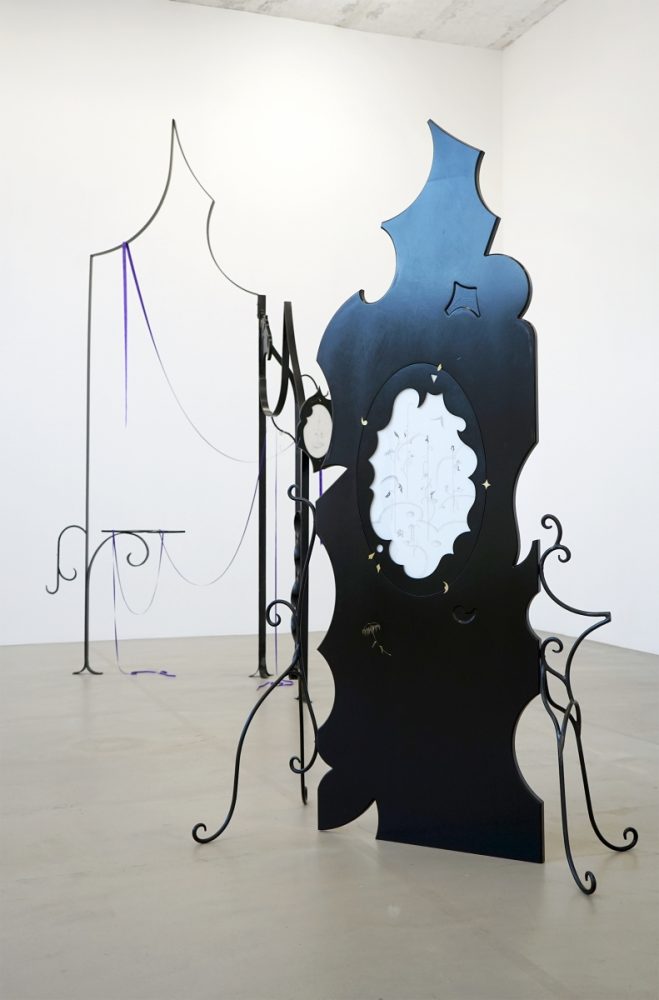
Anna Mari Liivrand
Prick of a Daisy
2021
Exhibition view at ARS Art Factory
Photo by Roman-Sten Tõnissoo
Courtesy of the artist
Aesthetic allegory
Anna Mari Liivrand’s most recent solo exhibition, and still her largest to date, was “Prick of a Daisy” (2021, ARS Art Factory), which explored, among other things, the anxiety caused by the pandemic and the interruption of daily activities. The artist borrowed the key image of the exhibition from the mutated flowerheads of plants affected by the disaster that took place at the Fukushima nuclear power plant, extending the notion of anxiety to incorporate various situations in the world today, but also the contemporary situation in general.
As a counterbalance to the uncontrollable situation and to the inscrutability of the nature of the changes taking place, Liivrand offered an ornamental installation, which could structure not only the viewer’s visit to the exhibition but also everyday practices more broadly, instilling them with deliberate, meaningful actions and intermissions. Using references to historical ornaments – arabesques and grotesques, the strange patterns of Mannerism and Rococo, William Morris’ lush motifs, stylishly “pre-Art Nouveau” in the context of 19th-century Victorian eclecticism, and Ernst Haeckel’s early-20th-century scientific illustrations in their search for “art” forms in nature – the artist mainly works within the bounds of her own distinctive ornament, which is spontaneous rather than regular.
Anna Mari Liivrand’s ornament diverges notably from traditional ornament – it does not follow the regular repetition of a motif or the symmetry of the composition, which form the basis of most ornamental systems. Yet it is recognisable as an ornament, both in its decorative and symbolic potential, creating an aesthetic allegory through the use of mutually compatible graphic elements and signs.
The artist intends to revive the ornament in the here and now, in a form suitable for our rhizomatic way of thinking and acting. Her ornament is not cyclical and compact like the archaic perspective of the world but instead branches out unpredictably, much like the situation in the world today. Containing symbols and stories like the oldest of ornaments, Liivrand’s offer an emotional experience but also the opportunity to go through contemporary situations ritualistically – in a more meaningful way, delving deeper into the world around us.
Elnara Taidre is an art historian, critic and curator. She works as head of the graphic art collection at the Art Museum of Estonia.