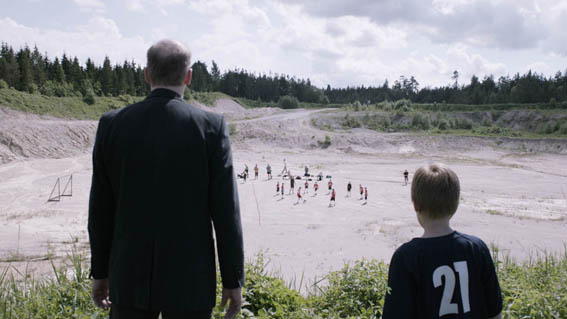
Premiere: 2. X. 2014 Coca Cola Plaza
Screenwriter and Director: Jaan Toomik
Starring: Hendrik Toompere Jr.
Supporting Actresses: Jaanika Juhanson, Maria Avdyushko, Garmen Tabor
Allfilm, 2014, 77′
At the end of the 1980s, Jaan Toomik vigorously entered the Estonian art scene as a painter and a performance artist, but he soon broadened his repertoire to include installation art. By the mid-1990s, when video art had become mainstream internationally, Toomik had reached a Zen-like neutral level in his video installations, and the gates of the international art scene began to open up for him. The artist, who dealt with the inevitable cycles of life and death in parallel with the cycles of nature and the fragility of the psyche and the flesh, now travelled to all of the famous biennales with his works. From this time, despite the “bad boy” reputation that dogs him in his home country, he can be considered, along side Ülo Sooster, as one of the most influential artists in Estonian art history.
Of course, this is all very well known to KUNST.EE readers – I just wanted to emphasize that in light of this it is hard for me to remain neutral about the screening of Toomik’s “Landscape with Many Moons” this autumn. Inevitably, expectations were high.
Metaphysics contra everyday reality
The title “Landscape with Many Moons” is a reference to one of Toomik’s earliest painting exhibitions at the beginning of the 1990s. The film tells us of the mono-manic state of mind of a depressed middle-aged individual, and the implications of the Real that have pierced through the psyche of a “cornered” man. In the film, these reveal themselves as visionary bouts of irrationality, which increasingly interfere with his “normal” way of life, which is based on routine.
Similar to his video works, Toomik tries as economically as possible to reach the metaphysically construed border states of the holy and profane, unclean and routine, ordinary and irrational; in other words, to balance simultaneously the two different registers of perception which mutually cancel each other. In reality, the dream world is not a parallel world in this film, but rather the relationship between reality and unreality suggests that some sort of oily liquid has been sprayed into reality, and its bubbles immiscibly float around in an unfamiliar environment, intruding into the life of the protagonist, breaking and doubling the everyday narrative during the most unexpected moments.
Yet unlike his videos, where the slips from reality are amplified by a looped viewing regime, forcing even an emotionally lazy viewer to recognize some apocalyptic moment, the irrational moments in the film are strung on a structure of linear narrative. From the perspective of the story, they could have arbitrarily unravelled in another sequence, and consequently, they keep nullifying one another. Here they have the effect of anomalies that have crystalized around the everyday life of borderline situations; they are uncanny fittings, a patchwork quilt of metaphysics covering the dull reality of everyday life.
There are no answers and there is no one asking
The main weight of the film is placed on the sufferings of the protagonist Juhan; in this sense it is a one actor (Hendrik Toompere Junior) performance. The expressive qualities of his face in close-up frame is what the film is mostly based around. And he carries his role well. But what do we really get to know about Juhan? He is defined through three tangled relationships with women, his role as a father and more briefly through his friends – a dead friend Jaan and the slight drunkard Alari, who is prone to mysticism. Juhan’s whole network of relations is characterized by dedicating his life to others through a grumpy and depressed self-positioning, as if he is doing it all against his will, through grey stone.
What normally defines an average middle-aged man… is still his job. Therefore, it seemed strange to me that Toomik does not give the slightest hint about the main character’s job. The social marker is his SUV – which seems to be the only safe place that he has all to himself – and a house with “a million-dollar view” at Merivälja, so one can only suspect that he is probably some sort of middle level manager. However, in the film he is rather defined by his social free-fall, his helpless and absent commute between different women and by his somewhat strange and uncanny role as a self-proclaimed psycho-energetic engineer.
The opening scene of Juhan playing with a football in his living room is interrupted by a phone call from the other side, a call from his dead friend Jaan, who was buried two weeks ago. This discharges a visionary moment where deceased Jaan assures him that things are a lot different to what is often thought on this side, and that “there are no answers and there is no one asking”. There is some discussion of Jaan with Alari, but basically Jan Kaus is right, when he emphasizes that this fragment is like a gun on the wall that no longer shoots during the course of the film.1 And this would be okay, if the same thing had not happened with the many dream-like episodes of the film – Anu (Jaanika Juhanson) sinking into the bog in front of our indifferent protagonist, a parachutist falling from the sky, a rabid hitchhiker in the review-mirror, a thug behaving strangely when telling the protagonist that he can pay for him at the supermarket, etc.
One of the most characteristic episodes of the film, which depicts bums arguing about metaphysics, also finds no other grip than a cryptic reference from Alar suggesting that Juhan is the man that comes and explains it all. But he doesn’t. Rather he shrugs and moves on, declaring that he doesn’t have time or patience for this.
The narrative of the film is primarily carried by the rather misogynist relationships with women – his total indifference for his wife (Garmen Tabor), the helplessness and addiction of Maria (Maria Avdyushko) who the main character seems to accept and despise at the same time, and the more spontaneous relationship with Anu, who is occasionally there for the main character, yet playfully slips away from his dominating mono-maniacal nature. Anu has a relationship with a Finn, Sven, and the almost apathetic and forced conversations between Anu and Juhan indicate that they are drifting apart. And it’s only the raw sexuality with filthy rituals (the very frank scene where they are frying sperm and eating it, which could be compared to the memorable post-coital scene in Toomik’s short film debut “Communion” in 2007) that undoubtedly keep these two hooked on each other.
*
Although Toomik is said to be thinking about his next full-length film, I personally feel sorry that the short films have inevitably lacked appreciation – there is no appropriate financing for them and no one comes to see them in the cinemas. Unless they are screened at a festival dedicated to short films, like for example the Oberhausen Short Film Festival where “Communion” was awarded in 2010. Then there would be no reason for Toomik to make a full-length feature – all of his best works thus far have been short pieces characterized by an exceptional economy in transmitting the message.
1 Jan Kaus, Maastik allee ja võsaga. – Sirp 17. X 2014.
Hanno Soans is an art historian, critic and curator who lives and works in Tallinn.