19. III–1. V 2016
Tallinn Art Hall
Curator: Tamara Luuk.
The intrigue of Tiit Pääsuke and Kris Lemsalu’s joint exhibition “The Beauty and the Beast” put together by Tamara Luuk is as obvious as it is multi-layered. The first, a leading figure of late-Soviet aestheticism, one of the most refined and intellectual Estonian painters of the last 40 years, the author of “Poiss viiuliga” (Boy with a Violin, 1980) and a gentleman of respectable age. The second, a rising superstar of Estonian contemporary art in recent years, a ceramic artist operating in an interdisciplinary “open” field, an extravagant young woman, whose greatest success so far was when she became the centre of attention at a US art fair (lying under a ceramic turtle shell).1
Pääsuke and Lemsalu inhabit different continents in our small art world, ones that usually exist in sovereign self-sufficiency. Each has a background in art ideologies and sensibilities from different epochs and probably also have their own viewers and admirers. Three years ago I entitled my review of a retrospective exhibition of the ANK ’64 group (also put together by Tamara Luuk, as it happens) with some pathos – “A yearning for communicative unity”2. By successfully balancing artistic “contemporaneity” and “conservatism”, the present exhibition curated by Luuk approximates that ideal as closely as possible. An attempt at establishing a dialogue between artistic expressions that according to some lack common ground is in any case worthy of recognition.
A bold concept would not be enough were it not supported by a suitable format (The exhibition is designed by Neeme Külm and installed by Valge Kuup. – Ed.). “The Beauty and the Beast” combines a rather extensive retrospective of Pääsuke’s work with more recent works by both artists (from the perspective of the old master’s oeuvre, all the work by Lemsalu is “recent”). The gallery of well-known or slightly less well-known paintings by Pääsuke extending over several decades lends an air of timeless aesthetic value to the exhibition, something that a segment of the public certainly look for in art. Interestingly, however, the maestro’s dignified and admirable exposition also proves a suspenseful setting for Lemsalu’s madcap works. Despite seeming completely unaware of Pääsuke’s universal categories, Lemsalu’s “things” (which is what the artist herself calls her installations), swarming with references to pop culture, work fabulously in this space.
Postmodernism vs. postmodernism
Among other things, this unusual but surprisingly effective format allows us to notice the established formats through which most of our art life works: the solo show of recent work by an artist, the retrospective of the lifework of an experienced master and the thematic curated show. In an article published in 2015, Fredric Jameson points out that events have taken the place of works of art as meaningful units in contemporary art, which is why art is not so much work, style or the expression of something deeper any more as it is a strategy or recipe for producing events. According to him, instead of unique works created by an original artist we encounter unclassifiable combinations out of which the curator as the embodiment of an institution puts together new intellectual spaces.3
Tamara Luuk’s curated show seems to be a successful illustration of this definition, and in what follows I will attempt a closer analysis of that intellectual space. With that in mind, let us once more return to the format of “The Beauty and the Beast”. The structural mechanism of meaning creation in a two-artist exhibition is a relationship, a fact that is indicated by the very title of “The Beauty and the Beast”. This involves questions of whether it is the similarities or differences that dominate, whether it is a dialogue or a conflict, who dominates and who gives way, and so on. A relationship is a powerful semiotic grinding mill and if the wheels are such strikingly different elements as Pääsuke and Lemsalu, the flour it grinds deserves attention.
In relation to the differences and similarities of the participants, the end product of “The Beauty and the Beast” is somewhat paradoxical. On the one hand, it turns out that the sharp contrast between the careers, mediums and methods of the artists gives them both sovereign freedom to present themselves as they are. This can probably work provided that the participants are strong artistic personas confident in their aesthetic identities. Pääsuke and Lemsalu in Tallinn Art Hall are like a boletus and a viper in a mushroom hunter’s bucket – although one would not easily get them mixed up; in a way, one might want to say, they both give off the same smell of the forest.
On the other hand, the combination sets up a situation where both artists necessarily represent more than just themselves. And this “more” is nothing short of an epoch in our artistic culture. The “traditional” artistic approach represented by Pääsuke involves consistent work within the limits of a means of expression and a stylistic idiom chosen for expressing one’s persona (while gradually extending these limits through new invariants). By comparison, Lemsalu’s “contemporary” method is much more abrupt, consisting in inventing a one-time device with which the artist performs a trick of singularity. The exhibition is made up of a series of celebrated paintings by Pääsuke and a handful of things by Lemsalu not only because Pääsuke has managed to do more over a longer period of time, but also because a singular “postmodernist” work of art in fact resists being subsumed, like a building block, under a whole oeuvre.4
This paradigm shift encompassing the entire Western art world finds elegant expression in “The Beauty and the Beast” – simply by virtue of the fact that Pääsuke provides the mass, so to speak, while Lemsalu packs the proverbial punch. Regardless, both modes of intensity have their proponents among the public – to the admirers of painting galleries à la Pääsuke, the installation and video formats may seem pretentious, sketchy, arrogant and hasty, while those who enjoy conceptual objects à la Lemsalu may find the former conventional and old-fashioned. As a complete exhibition experience requires both mass and energy, the crossover from Tamara Luuk works exceptionally well in this respect.
In addition to the fruitful differences, the Lemsalu and Pääsuke exhibition also brings out the somewhat surprising common ground between the artists. In an attempt to categorise artists who have entered the art world after a 40-year interval, the first notions that suggest themselves are the good old “modernism” and “postmodernism”. In fact, a demonstration of the limitations and conditionality of this pair of categories is yet another free supplement to the Pääsuke and Lemsalu exhibition, leaving viewers with the choice of either giving up this dichotomy altogether or, should they wish to do so, admitting that the two come from different generations of postmodernists.
In a way, the failure to apply the categories of modernism/postmodernism helps us hone in on the important common ground shared by the artists. According to Jameson, the last feature distinguishing postmodernism from modernism is the disappearance of “anguish and pathos” (God is not missed and there is a fatalist attitude towards capitalism and alienation).5 In this light, “modernist” features can be found in the work of both Pääsuke and Lemsalu; “ideas” that in some cases may also involve a personal or social sense of drama often, or perhaps always, underlie the work of both artists. However, both are also characterised by a rather vague and ambivalent manner of expressing the ideas that have served as the original impulses for their works. The creative method of each of the artists imposes strong filters on the original idea, filters that sometimes distort the idea beyond recognition and, what is more, in their turn become the subject matter of the works and an emblematic feature of the artists themselves.
For Pääsuke, this filter consists in a refined culture of painting and symbolism bordering on self-mythology. In Lemsalu’s case, the filter is more difficult to define without sounding offensive, but I would describe it as Dionysian, creative madness. This condition characteristic of Lemsalu is also highlighted by Tamara Luuk in her text for the exhibition guide: Lemsalu exists in the extreme present, art and life are hopelessly entangled for her and her art is carried by “the flight of free associations that does not seek to be read in any specific way, but first and foremost provides a liberating occasion for laughter. Those who find the strength to go further may reach another galaxy.” (What is interesting is that while Luuk contrasts Lemsalu’s irrational method with Pääsuke’s “contemplative aesthetic code”, Lemsalu herself thinks, in contrast to the typical calculating contemporary artist that “neither I nor Tiit have a choice. Such people do not exist anymore”.)”6
Affects vs. effects
The artistic charm of “The Beauty and the Beast” as an exhibition consists in mutually reinforcing the interaction of the self-effacing filters used by the two artists (which also spare the viewer from anguish and pathos). There are, of course, a considerable number of strategies for looking at art, compared to those for creating it, but one way of looking, which is rather under-represented in recent art, might be called affective. Lemsalu and Pääsuke’s joint exhibition also grants the viewer an indulgence for giving up the obligation to interpret and rationalise. Another aspect that is likely to encourage this approach is the measure of humorous irony perceptibly present in the works of both artists. Lemsalu’s art in particular is characterised by the fact that although her works contain an invitation to interpret (through the titles), there is reason to leave the artist’s thoughts to the artist herself for the sake of an affective, Dionysian experience. The “galaxy” hidden in Lemsalu’s work is not revealed by reducing them to a verbalisable content; that kind of “reading” would simply make the works worse. The compensation for giving up hermeneutics is, to use Susan Sontag’s coinage, the erotics of art7 – an opportunity to plunge into a world of connections, affects and effects evoked in an unpredictable way by form. At its best, this kind of experience may affect the viewer by stimulating their subjective sense of freedom. The same way of looking is also implied as an option and in a more subtle (less intense) form in Pääsuke’s paintings. In short, the Pääsuke-Lemsalu exhibition is fun, and that is damned refreshing in an art world suffering from delusions of seriousness.
In this way, another equally important element enters as an essential feature of Lemsalu and Pääsuke’s joint exhibition alongside the relationship between the artists – the relationship with the viewer. This is an aspect that seems to place Tiit Pääsuke’s part of the exhibition in particular in an interesting light. “The Beauty and the Beast” appears to embody Mieke Bal’s account of the history of art as changing in accordance with the subsequent viewing conditions. According to Bal, each subsequent viewer brings new cultural baggage to a work of art. The codes of viewing applied to a work of art in new contexts allow it to travel away both from the author and the original context, giving a historical work an unpredictable afterlife.8
Seen this way, the joint project with a cutting-edge young artist is not merely a compliment to the mature master, but also a substantial intellectual experiment. Above all, “The Beauty and the Beast” opens one’s eyes to the flexibility and openness of Pääsuke’s work – to the fact that, compared to that of his great contemporaries (Olev Subbi, Enn Põldroos, Jüri Arrak, Peeter Mudist and Toomas Vint), Pääsuke’s work is much less anchored in specific themes, motifs, existential moods or ideas. This fact, astutely recognised by Tamara Luuk, makes Pääsuke an ideal partner for Lemsalu. To once again briefly return to the relationship between the exhibition participants, it seems that the exhibition owes its well-balanced effect to the ability of Pääsuke’s paintings to absorb Lemsalu’s rather intense and aggressive objects. This probably speaks of the older artist having more self-confidence and flexibility, but it is precisely he who takes a step to meet the younger colleague halfway, rather than the other way round. One of the undoubted gems of the exhibition is, therefore, a wonderful pair of portraits of Lemsalu by Pääsuke (and let these be the only individual works out of this integrated set of works that I am going to refer to separately).
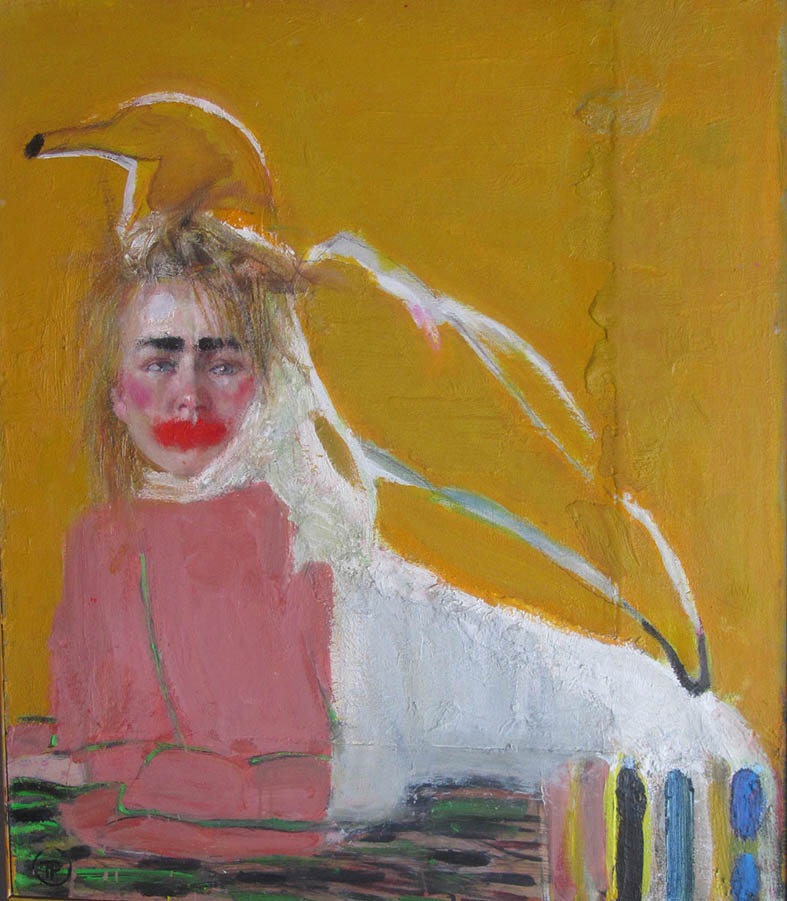
Tiit Pääsuke
Kris & Kris II
acrylic, oil on canvas, 90×77 cm
2016
Photo by Peeter Sirge
In addition to the above, the works of Pääsuke and Lemsalu share a series of obvious, external similarities: attention to colour and surface effects, an interest in archetypical and symbolic motifs, an ironic and reflective relationship to one’s means of expression, a staged-ness and a sense of humour with a hint of the absurd. But the reason why “The Beauty and the Beast” worked so well were the filters incorporated in the rhetoric of each of the artists, which happily make foregoing an interpretation that requires verbalisation possible. And it is this fact in particular that I see as Tamara Luuk’s greatest success.
Tõnis Tatar is an art historian and critic working at the University of Tartu, where he defended his doctoral thesis “The Third Discourse in Estonian Art of the Soviet Period: Between Collaboration and the Avant-garde” last year.
Quote corner:
“Kris Lemsalu’s extravagant ceramic-based installations force one to conclude that successful contemporary art is turning back from the illusoriness of video to materiality. It is as if the artist’s sculptural forms appeared before us through a back door – while in previous decades monumental ceramics confined itself to decorativeness, the ambition now is to combine that with performance and installation and join the ranks of mainstream artists. [—] Kitsch is for her a completely natural means of communication among others. Evidently, the 1980s kitsch boom was for her a native tongue picked up somewhere in her childhood, a language in which to tell her visual story. [—] Tiit Pääsuke’s twin paintings “Kris & Kris” (acrylic and oil on canvas, 2016) continues the artist’s by now considerable series of portraits depicting beautiful female artists starting from the 1970s. This time, the same Kris has been painted in two versions that are different beyond recognition. The concept of beauty (beautiful women, make-up, poses) comes to the fore here. In the Soviet-era portraits, it was a weapon in a fight against the then programmatic ugliness. The current concept of beauty (whose function it is to do everything opposite to what is suggested by advertisements) is a weapon against the capitalist beauty industry. Superb portraits. During the opening of the exhibition, Tallinn Art Hall was packed with people; the friends of each artist had shown up and, although for the most part not mingling with each other, blended into a buzzing crowd.”
Heie Treier, “Kaunitar ja koletis” purustatud katedraalis. – Eesti Päevaleht 11. IV 2016.
1 Karin Laansoo, Oivaline Eesti gootika. – Vikerkaar 2015/12, pp 91–93; Karin Laansoo, Haip or not to haip. Lemsalu kilpkonna juhtum. – Uus Number! Kunstiprojekt-ajakiri. Tallinn: MTÜ Uus Materjal, 2016, pp 85–88.
2 Tõnis Tatar, Igatsus kommunikatiivse ühtsuse järele. – Sirp 12. XII 2013.
3 Fredric Jameson, The Aesthetic of Singularity. – New Left Review, March, April, 2015, pp 107, 110.
4 Ibid., pp 112–113.
5 Ibid., p 125.
6 Tamara Luuk, Kole kaunis Tiit Pääsuke. Kaunis kole Kris Lemsalu. – Tiit Pääsuke & Kris Lemsalu, Kaunitar & koletis. Tallinn Art Hall 19. III–1. V 2016 [exhibition guide].
7 Susan Sontag, Against Interpretation. – Susan Sontag, Against Interpretation, and Other Essays. New York: Picador USA, 2001, p 14.
8 Mieke Bal, Norman Bryson, British Historian of Art and Visual Culture. – Key Writers on Art: The Twentieth Century. Ed. Chris Murray. New York & London: Routledge, 2006 (2003), p 16.