SUMMARY
As part of Tallinn Photomonth, Tanja Muravskaja’s photo series “Gardens” (2024–…) was shown at the Saarinen House, with Elnara Taidre acting as exhibition consultant. Taidre’s curatorial instinct had already led her to organise the 2019 Kumu exhibition “Garden Exile. The Tuglas Home Garden Through Tanja Muravskaja’s Camera Lens” (17. V–27. X 2019). There, Muravskaja photographed the garden in the Tallinn suburb of Nõmme that writer Friedebert Tuglas and his wife Elo created as a private refuge in the late 1940s, after he was ostracised under Stalinist repression.
Muravskaja first established herself in the 2000s as an artist charting the cultural fault lines between Estonian nationalism and the local Russian-speaking minority, guided by the belief that mutual understanding and peace were achievable. Yet for the past fifteen years – beginning, in fact, with her solo exhibition “Split Mind” at the Tartu Art Museum (22. X–28. XI 2010) – she has been searching for sanctuary, an escape from a world split by ideologies that leave no third path, the very path she once hoped for. She expressed this realisation strikingly in her 2015 video “Three Sisters”, completed after the outbreak of war in Ukraine, where her two cousins – one living in Belgorod, the other in Kyiv – described the root causes of Russia’s aggression against Ukraine that began in 2014. Both sides speak in the video, but the artist herself, unwilling to take sides, had no choice but to remain silent behind the camera.
When inviting Muravskaja to photograph the Tuglas garden, Taidre – who knows her work intimately – understood how an artist of Russian mother tongue and Ukrainian heritage would, in her own personal and unique way, experience what had once been a place of refuge for the Tuglases. The shock of encountering the Tuglas garden is evident both in the fact that “Gardens” is already Muravskaja’s third solo exhibition built around this specific motif, and that a photographer long celebrated for her portraits has made none since, instead moving further into an increasingly abstract visual language.
Muravskaja transformed the glimmering light she encountered in the Tuglas garden into the solo exhibition “Abstract Garden” at Kogo Gallery (12. XI 2021–22. I 2022). The play of sunlight in the treetops gave way to the rippling surface of the sea, and the monochrome geometric forms used in the exhibition design created – not accidentally, but fully in keeping with the artist’s intentions – parallels with suprematist compositions. “Abstract Garden” was an exercise in the vocabulary of analytical abstraction.
Compared with the images of “Abstract Garden”, the much larger photographs of the sea surface in “Gardens”, shown at the Saarinen House, did not feel analytical at all. The directional light and the sharply pointed attic window frames created a decidedly sacral atmosphere in the exhibition space. The tall, emphatically vertical photographs rose towards the ceiling like altarpieces. The sea began to resemble a starry sky. Analysis had given way to poetics. The sea as a medium – as an uneven mirror enabling analytical experiments with light – suddenly became a political allegory. In this exhibition, the sea became a kind of mirror for our desires, on whose surface our longing for peace seemed to materialise – the exhibition as an eternal prayer.
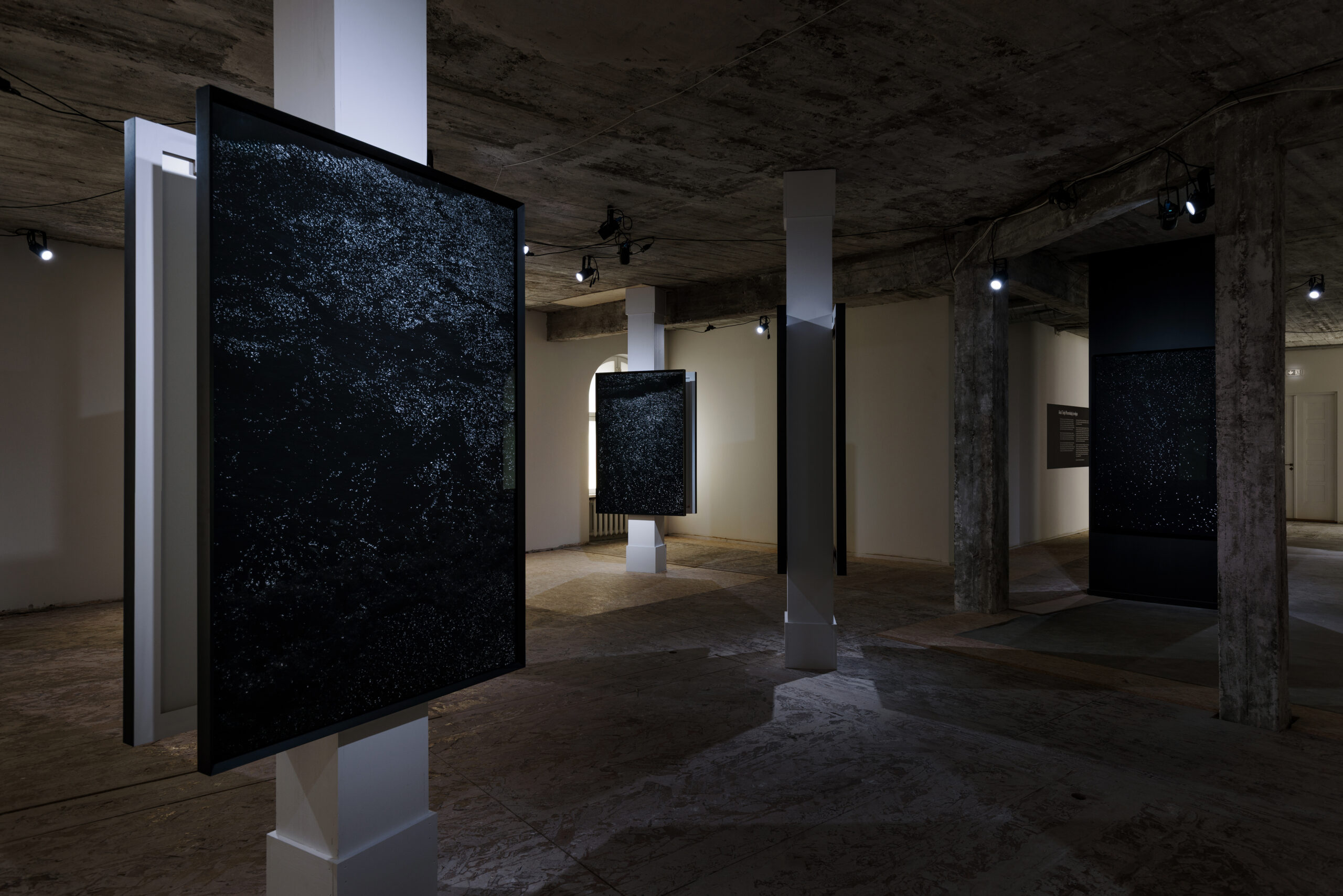
Exhibition view at the Saarinen House