SUMMARY
The Viscosa Cultural Factory is a picturesque place. Its sprawling limestone buildings show little sign of decay, surrounded and infiltrated by encroaching greenery. The more distant buildings seem abandoned, still untouched by art and culture. On the wall, the first posted warning reads: “Watch your step if you don’t want to die.”
A thrill of curiosity stirs. What kind of exhibition might this be, set in the midst of this post-industrial ruin-romanticism? Could it really be imaginary? The title “Phantom” (Fantoom) does suggest so, derived from the Greek phantasma, meaning an appearance or apparition (etymologically tied to the idea of “fantasy”). A place like this might well be haunted – but in broad daylight?
All thirty artists engage with the theme in one way or another. The exhibition hall is unusually wide, and the first things to draw the eye are several large works, pieces that could each fill a small gallery on their own. The most figurative is Art Allmägi’s “Pallbearers” (2017), a larger-than-life composition in polyester resin and fibreglass. Six uniformed men carry a coffin, and a seventh walks ahead holding a portrait of the deceased. All seven faces are identical. Kati Kerstna’s “Values” (2022) is also monumental – two enormous glass hands trying to cradle a swarm of bees.
The other works aren’t small either. They feel restless, agitated, as if itching to move – but where to? Towards a time when bombs and bullets run out? A sense of unease sets in. Near the door, a few pale limestone objects stand on black pedestals. Might they offer some sense of calm? But up close, security camera lenses jut out from the stone – sometimes singly, sometimes in clusters. This is Kirke Kangro’s “Secure Eternity” (2023), a kind of monument to the surveillance state. Do you know anyone who finds comfort in being watched?
The dominant tone of “Phantom” is one of unease, angst and eeriness. Some works convey this directly. Tim Daniel Suvi’s “Veteran of Psychic Wars” (2023) is pure anxiety and fear: a ghostly naked figure missing one leg and both arms, its head fully bandaged, with circular peepholes in place of eyes. Ivan Zubaka’s “22” (2022) needs no commentary: we don’t want to know what’s sealed inside those four black boxes. Ahti Seppet’s “Memory I–II” (2005–2025) is abstract but utterly grim: a burned, charred recollection. Silja Truus’s “Through the Thin Crust of Civilisation” (2024) presents a creature wearing a human-faced mask but clearly not of this world. Lembit Onton’s “Decrepit Phantom” (2025) is a frozen silver cocoon – hidden for now in the hollow of a tree, but only for a time. That much is certain.
Since the show brings together several generations of artists with no shared school or style, the question arises: Where does this eerie, apocalyptic mood come from? The phantom that appears to these artists in so many forms is distinctly deathlike. It belongs to the beyond, it provokes anxiety – or is perhaps the embodiment of anxiety itself. This phantom can also be read as a projection of anxiety. It has become the precarious subject of our time, one whose world is shaped by war, displacement, extinction events, genocide and ecocide. And it is this very phantom that dances through the green ruins of the Viscosa Cultural Factory’s cathedral hall.
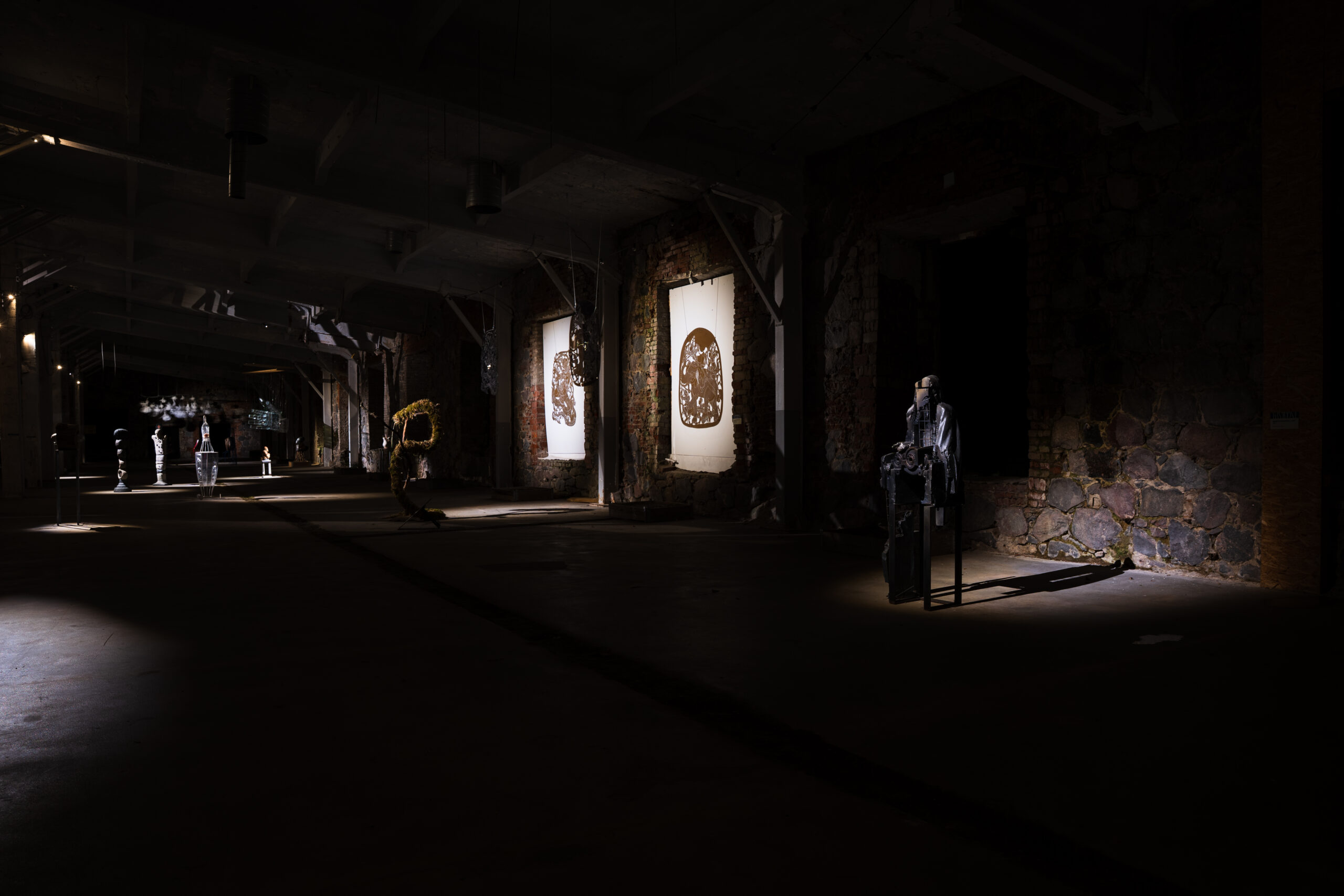
Exhibition view at Viscosa Culture Factory
Photo: Viive-Kai Rebane