SUMMARY
Tõnis Tatar (TT): What was your relationship to the artistic expectations of Soviet rule?
Olev Subbi (OS): I actually found myself in a rather special situation, without any effort on my part. In Moscow, exhibitions of Soviet art were regularly organised for foreign audiences. Works were selected from all the republics and shown abroad. These international exhibitions needed to demonstrate a high professional standard, which is why art from the Baltics had a certain value even for Party officials. I happened to be one of the artists whose work was regularly commissioned – Moscow would order one or two paintings from me every year.
I had no complaints about the terms. They simply said, “The exhibition will be on this date, please send the title and dimensions of your work, and we’ll forward you an advance.” I was never tied to the exhibition theme. I didn’t have to produce something that explicitly matched the title. Not once did any of my works brush up against the political themes of the exhibitions.
For whatever reason, they valued either the painterly quality or the general attitude of my works. In any case, they were happy to include it among other works. These commissions arrived every year, and never once was I criticised.
I still have the catalogues from those major Soviet exhibitions, as well as magazine features. The exhibition titles may have been grandiose, but my paintings were always my own. That was what everyone aspired to, and I somehow managed it quite effortlessly.
It was actually better than the situation in Estonia. The Ministry of Culture or the Central Committee’s culture division here would exert more pressure – they clearly wanted works with more assertive messages. Dealing with Moscow was much more relaxed.
TT: Who were those clients in Moscow?
OS: Usually either the Ministry of Culture or the All-Union Exhibition Committee – essentially the Soviet equivalent of our Art Foundation. They would order paintings, assemble exhibitions, show them in Moscow and send them abroad. These were people I didn’t know, who I had never met, and who had never seen me, but they still ordered one or two works from me every year. That’s why I can honestly say I’ve never made a painting I didn’t want to make. Every commission gave me space to carry out a personal idea, to paint the image I already had in mind.
TT: And self-censorship? Were you ever tempted to address social or political topics but held yourself back?
OS: The thing is, ideologically driven themes were so clearly off-putting, and we all knew what kind of results they produced. So I had no desire to create protest images or works with a political message. I wanted to engage in painting for its own sake and keep it as free as possible.
That’s still my position – I don’t want painting to be assigned tasks it’s not equipped to handle. You can’t darn socks or plaster walls with it. Painting has its own aims, and the further removed it is from ideology, the more likely it is to remain on a genuinely artistic path.
Yes, there have been great developments after 1991, and I’m happy about the Republic of Estonia every day, but I’ve never painted anything specifically in its honour. That’s simply not what art is for.
TT: Did you sense divisions among artists on this issue?
OS: Some artists were comfortable working with ideological subjects – like Evald Okas, with his large series of Lenin portraits – and they were good professionals. Okas is a lively and spirited man, a great colleague. Sometimes he had a sharp tongue, but he never tried to push others aside unfairly. He used to say, “I’m a professional – I do what I’m commissioned to do. I know how, I do it, and I sell it.”
If an artist sets out to fulfil commissions, I’ve no objection to that as a professional. Only if he starts thinking like his clients – that’s when I personally start to find him disagreeable. But a cool-headed professional who completes a job, pockets the money and lives off it – well, art is a profession, and people can make a living from it.
TT: Were you ever criticised by openly dissident artists, such as Raul Meel or Leonhard Lapin?
OS: No, because they pursued their own path. Both are significant conceptual artists in our context.
Conceptual art has always felt quite distant to me. I have a rough idea of its goals and methods, but I don’t consider them close colleagues. Classical painting and conceptual art are entirely different disciplines. They deal with different concerns and pursue different objectives.
TT: Would your art have looked the same if Estonia had been a free country?
OS: It’s hard to say. There was ideological pressure from the state here, enforced by an entire apparatus. But resisting that pressure also carved out a kind of free space – by refusing to internalise it, I could say: this is mine.
Had I ended up working in a European art capital, I might well have reacted strongly against whatever the local mainstream happened to be – most likely, yes.
TT: To what extent was your art connected to its time and social context?
OS: Very little, actually. People tend to think of me as an optimist, and I suppose they’re right. I also have the kind of memory that remembers the good things and easily forgets unpleasantness. That’s probably why the past seems rosier to me than it does to some others. My work is mostly about positive emotion and seeks to affirm something.
Without it ever being a conscious decision, my art has unintentionally ignored its own era. You could even call it escapist, in a way.
TT: Many of your paintings show rural summer scenes. Why is that?
OS: I was a city boy, but I had lots of relatives in the countryside. From the age of four, I was sent each summer to stay with my aunt, who had a large farm with all the animals and chores that come with it. We also had a garden in the city, where we stayed year-round, but the countryside felt freer and grander. A four-year-old could take a cart and wander off a kilometre into the distance, and someone would eventually find him and bring him home. What a great way to spend a day!
TT: And the buildings in your paintings – are they real?
OS: Sometimes I think the most beautiful trace a person can leave is in nature, and good architecture is part of that – buildings that were truly needed and put to use and that therefore became natural and beautiful within the landscape. So for me, architecture is a human imprint in nature, and that’s what I try to depict.
TT: And the people in your works – to what extent are they idealised, and to what extent are they specific individuals or contemporary figures? What do you look for when painting a person?
OS: Luckily, there are several possibilities when it comes to painting people. A portrait, for example, can be an attempt to establish a connection. At least half of a portrait is a psychological study, an attempt to understand another person. The other part is painting itself. In fact, you could divide it into three parts: one-third psychology, one-third painting and one-third self-portrait – because the person being painted is seen through my eyes, and the artist always participates in the portrait of another.
A figure in a natural landscape may also serve to make the structure of that landscape more legible. When there’s a person in the scene, it’s easier to grasp it. The figure becomes a stabilising element.
In a nude, the human form can represent an ideal of beauty – and at the same time, it presents an extremely demanding painterly task. And third – let’s say a female nude painted through the male gaze – it becomes a pointed perspective on the world, turned towards the viewer. It invites close attention. It has impact.
TT: Is it important to you that art has a life-affirming and positive effect?
OS: I enjoy painting, and that pleasure might be what gives a work a positive feel. If I had a good time making the picture, the viewer might also find joy in it, if they’re lucky. But there’s no agenda behind it. The works come as they come – I don’t try to cater to the viewer.
When people talk about creative torment, it’s a puzzling concept to me. I really enjoy painting, and if a work “gets stuck” from time to time, that’s just part of the game. I deal with it patiently and try to work through it. The idea that painting could cause me real mental anguish – I simply can’t imagine it. It’s what I want to do.
TT: Have you ever felt the need to express negative feelings or moods through painting?
OS: No, I don’t think that’s good material. Negation is generally worth less than affirmation. Negation subtracts; affirmation adds.
Back in the day, when I served on art juries, we developed a sort of understanding: no one would criticise a work directly – instead, the person who liked something would speak. If someone didn’t like it, maybe they just didn’t understand it. But if someone could point out what worked, then they could speak.
A critic knows less than an affirmer. A denier achieves less than an affirmer. Negation is possible, of course, but it’s not particularly powerful material for art. I simply don’t use it.
TT: You’re often regarded as continuing the Pallas painting tradition. How do you see that association?
OS: Pallas produced very fine painters and excellent colleagues. If people count me among them, I take it as a compliment, and I’m glad…
But strictly speaking, I don’t really belong there. The idea of painterliness has changed; working methods have changed. And Pallas itself was never a single, unified art movement.
TT: Presumably people associate your work with Pallas because your colours are pure and vibrant and the mood idyllic – which seems to fit that tradition?
OS: I do have one firmly held conviction about colour, which emerged not right after art school but gradually over time. The main expressive tool of painting is colour. That’s what distinguishes it most clearly from sculpture and printmaking. Even among the visual arts, it’s painting where colour matters most. In the applied arts, colour is shaped by trends, textiles, confectionery wrappers and countless other factors. But a painter has the freedom to use colour exactly as they choose.
TT: Do you have any guiding principles or rules of thumb when choosing and combining colours?
OS: No. And I’d even say that when people talk about a painter’s colour palette, you have to be cautious. If “palette” just means repeating a favourite colour, then I start to doubt the artist’s imagination and professionalism.
To me, a painter who relies on a favourite colour is a primitive one. My classmate Efraim Allsalu once had a good remark: if you notice that one colour is being used too much in a painting, take it off the table.
TT: In your later years, you have also started painting abstract works. Why is that?
OS: Actually, I’ve always worked in different modes. Portraits (though rarely, and only when I feel like it), imagined landscapes, cityscapes, classical still lifes and abstract works have all been part of my work in parallel.
I don’t draw a strong distinction between abstract and representational images. Everything comes down to composition. In earlier years, it simply wasn’t the custom to use abstract forms, so one relied on recognisable motifs.
Artists were often accused of “formalism” during the Soviet period, but I’ve never really understood what the term means. Formal beauty has always had its place in art. Art is bound to pursue it, no matter who is in power or what movement is in fashion. So what is formalism, then? It’s part of the profession.
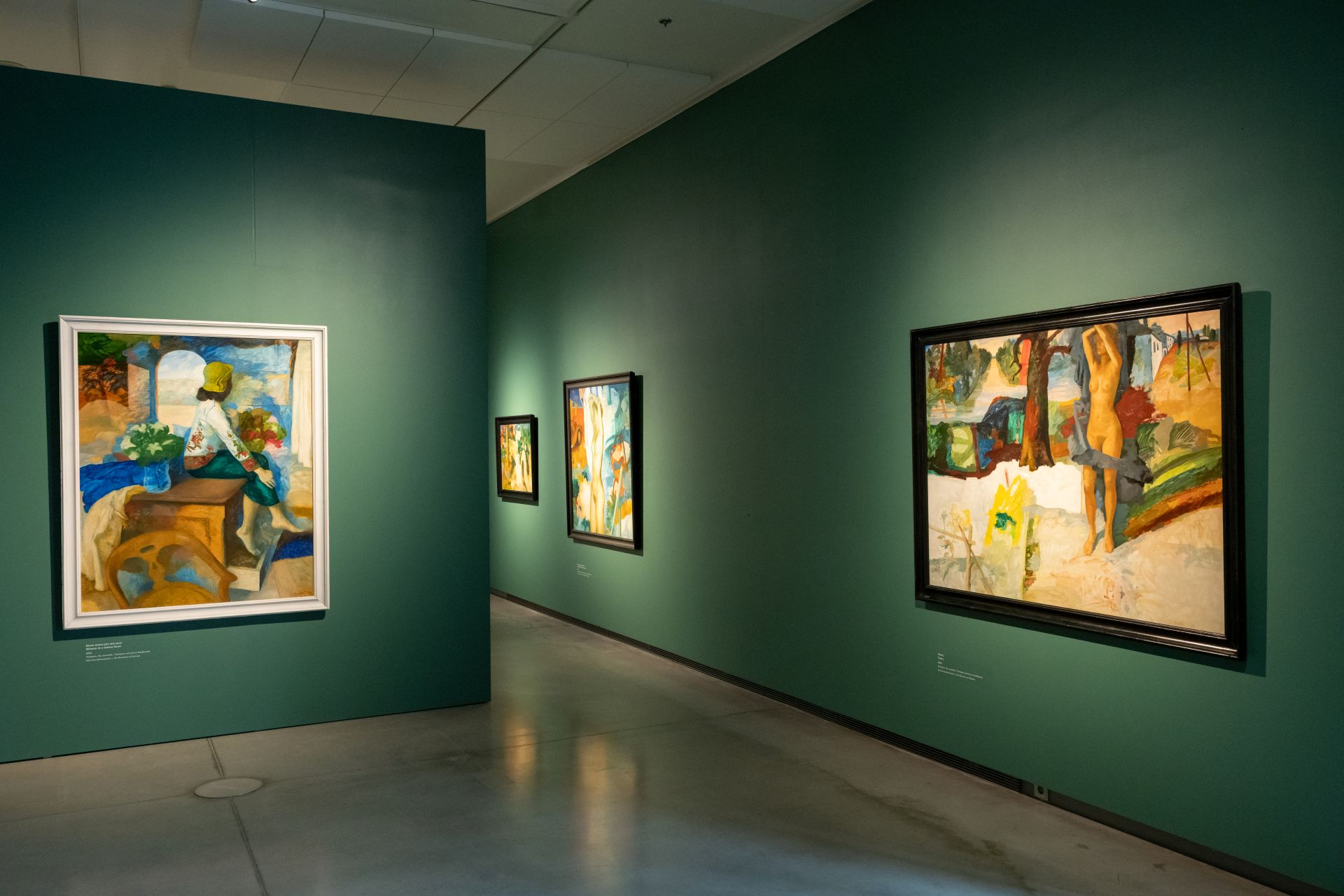
Exhibition view at the
Estonian National Museum
Photo: Arp Karm