SUMMARY
If an artwork holds any meaning at all, it stems from its context – either the cultural framework in which it exists or the artist’s specific background. Perhaps this is why we are still uncertain about the function of Venus figurines in the Stone Age – we simply do not know enough about the people of that time. But the same can happen when looking at objects created by our contemporaries.
When I visited Kris Lemsalu’s solo exhibition “DONATELLA. Spiral of Life” at the Tartu Art Museum last summer, I became acutely aware that Lemsalu and I come from different worlds when I could not grasp the meaning of her work. Yet, despite my confusion, her art still spoke to me. So I asked myself: how is it possible that I am drawn to Kris Lemsalu’s work?
Although Lemsalu often dresses in strikingly extravagant costumes that obscure both her gender and even her species, beneath her costume, she can still be considered a woman – just like me. I say this because I found pieces in her work that figuratively convey existential experiences unique to women. These are experiences tied to female fertility and reproductive function, such as ovarian ageing and pregnancy.
One example is the installation “Rot’n’Roll” (2020), which Lemsalu unveiled in 2020. The piece consists of an egg carton placed on a white pedestal, with only a few eggs inside and flies crawling on some of them. Both the flies and the title refer to decay. In medical science, it is well established that a woman’s egg count declines every year, and by around the age of 35, egg quality begins to deteriorate more sharply – in other words, the eggs begin to rot. “Rot’n’Roll” symbolically and vividly illustrates this reality, and notably, Lemsalu herself was 35 in 2020.
Another work where I see the theme of ovarian ageing is “Whole Alone 2” (2015), an installation Lemsalu presented at the Frieze Art Fair in New York. The piece depicts a woman lying face-down on a waterbed, covered by a ceramic object reminiscent of a turtle’s shell. Around her, towers of egg cartons filled with eggs rise up, with additional ceramic turtle shells resting atop them. In front of the bed, there is a ceramic tiger-like creature. The woman’s arms and legs are sprawled out, as if she has been flattened beneath the shell.
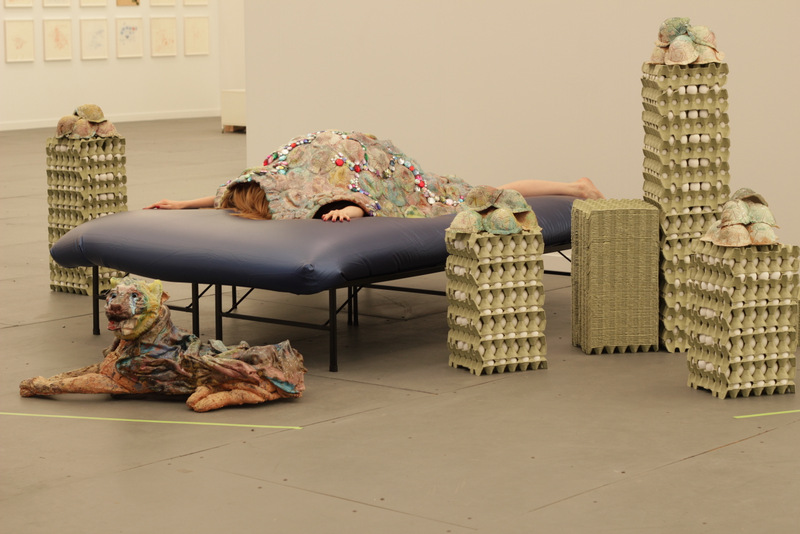
Kris Lemsalu
Whole alone 2
2015
Performance, installation
(porcelain, egg cartons, waterbed,
metal, eggs, gemstones)
at Frieze Art Fair New York
13.–17. V 2015
Foto: Piibe Kolka
I interpret the “eggs”, placed within the carton towers and hidden under the shells, as a reference to the technology of egg freezing. I believe the context of this work is rooted in events of the previous year, 2014, when several major US corporations began offering egg freezing as part of employee benefits packages – encouraging women to delay family planning in order to focus on their careers.
Anyone familiar with Lemsalu’s work knows that she has created numerous ceramic vaginal forms complete with limbs. As a reproductive biologist, I see this as a powerful image of the uterus not as a passive organ but as an active agent. After all, for a successful pregnancy, the uterus must be prepared for embryo implantation and placenta formation.
Another topic Lemsalu has tackled in her own way is infertility. In the installation “Biker, Bride, Builder, Businesswoman and Baby” (2018), ceramic birds hold up empty garments. The most striking and brutal symbol of infertility is an empty baby onesie in a pram – the desire for a child has materialised, but the child itself is absent. It is unclear whether the birds are “bringing” life or “taking it away”. What they seem to convey, however, is that life is not something we can “take” – it is something we are “given”. By the way, according to current medical knowledge, infertility affects men and women equally.
When I began writing this essay, I had never met Kris Lemsalu in person. By the time I reached this final paragraph, I had. When she came to visit me, she was wearing a deerstalker and holding a pipe like Sherlock Holmes. “I will figure things out,” she said. “Me too,” I thought to myself, “I will figure things out.” Perhaps we both experience and make sense of the world simultaneously but in our own ways – I largely through the lens of science, and Lemsalu through her art.