SUMMARY
In the beginning, there is no shame or fear. There is only an innocent child with a trusting smile and an empty basket in hand. A little boy setting out on his journey. This is a photograph of Jevgeni Zolotko’s father, but it might just as well be me or you. Zolotko has said that in difficult moments, he always returns to this photograph. It is an image that grounds him and offers him perspective.
This is how a human being’s journey in this world begins. It is also the start of Zolotko’s “longest sentence yet”. Although his works are distinct, each piece holds equal weight in this continuous sentence. In the grand scheme of life, nothing is less important.
Zolotko’s faith is alive. He dares to engage with, and challenge, even the Scriptures – not with the defiance of the highest and mightiest angel who sought to become God, but with deeply human humility. He bears witness to human suffering in all its height and depth, breadth and width, fully embracing what it means to be human.
Zolotko’s worldview “is not black and white but rather grey and warm. If you are gentle, accepting.” What a person needs, above all, is compassion. Perhaps only compassion can truly cover a person’s nakedness and shame.
This compassion is echoed by the Mother, whose constant knitting resembles a ceaseless prayer. She knits tirelessly, but small mistakes creep in, repeating again and again… until they form a pattern, and the “warm cover” begins to unravel. Unlike machines, humans will always make mistakes. These errors may be fateful, but they are never fatal.
Parallel to the Mother is the Watcher – a figure observing the little boy, N (who could just as easily be me or you), on his journey through life. The Watcher is a scientist: analysing, measuring, and passing judgment. The Mother teaches N that everything in this world has a name and tirelessly answers his questions when he points with his little finger: “This is a doll, this is a thread, this is a spoon, this is you-know-what…” N begins to speak, naming objects, forming an endless list in many languages, even “dead” ones. Scientists strive to help and guide N’s development, to keep it within the bounds of “normality”.
The roles of the Mother and the Watcher have interesting connections to femininity and masculinity. Although men are no less carriers of Eros than women are of Logos, the exhibition evokes archetypes: the Watcher is portrayed by a female actor, but her voice is male. Zolotko does not pit the Mother and the Watcher against each other. Instead, he embodies both perspectives with empathy, ultimately bringing them together in a shared space and a single frame, allowing them to touch.
To save her child from a fire, the frightened Mother must let him go, allowing him to fall into the darkness from which a voice calls: “Throw him to me, I am here. I am here.”
Clusters of beeswax church candles bear the imprint of hands holding them. Zolotko’s candles burn at both ends. Again, there is no up and down here. In dialogue with the candles are three childlike bodies illuminated on coffin-shaped bases. Straight as church candles, they are made of pure, fragrant wax – soft enough to be moulded by a hand or burned by flame. Delicate, yet sacred enough to inspire reverence.
The way objects are named in Zolotko’s exhibition echoes humanity’s longing to be recognised and called by name. Every hair on a person’s head is counted, and every object belonging to Uncle Sasha has its small but precious place. Zolotko rejects a dichotomy between language and matter, refusing to choose sides. For some reason, it mattered to God that His Son had a body – that He was born into this world physically, embodied, walking through every imaginable and unimaginable place that we, too, must travel.
Objects are a kind of trace of life. Evidence that someone existed and lived. We see a kite built by the Mother, which shattered after soaring high. We see N’s (now a traveller’s) reflective vest, shoes, a piece of plastic wrap, and a fragment of the Mother’s flawed but warm cover.
“Go away. I will now live in the grass,” says the small N to the Mother after the kite crashes to the ground. Another step toward becoming fully human – a being whose life “is like grass: it flourishes like a flower of the field; the wind blows over it and it is gone, and its place remembers it no more.” (Psalm 103:15–16)
People’s hands are crossed over their chests. In the Orthodox Church, this posture signifies submission to God during communion and depicts saints whose lives were marked by humility and suffering. Zolotko highlights this spiritual presence in the most unassuming places – in the daily lives of “ordinary working people”. It brings to mind Annika Laats’s idea that one cannot turn to God while turning one’s back on humanity. Zolotko never turns away from humanity – he remains with us in our struggles and yearnings.
The human longing for closeness is perhaps most directly expressed in the exhibition by personal ads from a 1990 newspaper. These sentences, written with trembling hands, reach into the unknown, offering tender, vulnerable hearts. Men and women stand before each other, their initial awkward nudity radiating a great innocence.
The wind carries kites and eventually casts them down. Grass grows, flourishes and withers away. Time erases names from gravestones, but the stone remains. In the grave, there is no person; only love remains, which does not fade.
Somewhere, N walks along a path, repeating the words once heard from the darkness outside a window during a fire: “I am here… I am here… I am here…” Perhaps these are the most beautiful words we can offer each other in the darkness.
“A nonverbal experience is what I seek to achieve. That is where we are together,” Zolotko says. And while he goes so far as to articulate Adam’s mystery, it remains unspeakable. Here, the logic of icons applies: the light around Christ is not depicted with the brightest white but with the darkest blue – light impenetrable to the eye. Light that is always wholly other – totaliter aliter.
In the end, Zolotko takes us out into a beautiful, soothing landscape, gently rocking us on a village swing under a golden sky. This is a lullaby for humanity, “like an orphan in a world where our conception of God divides us into black and white”.
If a father welcomed us at the beginning, Zolotko sends us forward with his son – a little boy running through a grain field, stumbling, picking himself up with joy and continuing on his way, now and forever.
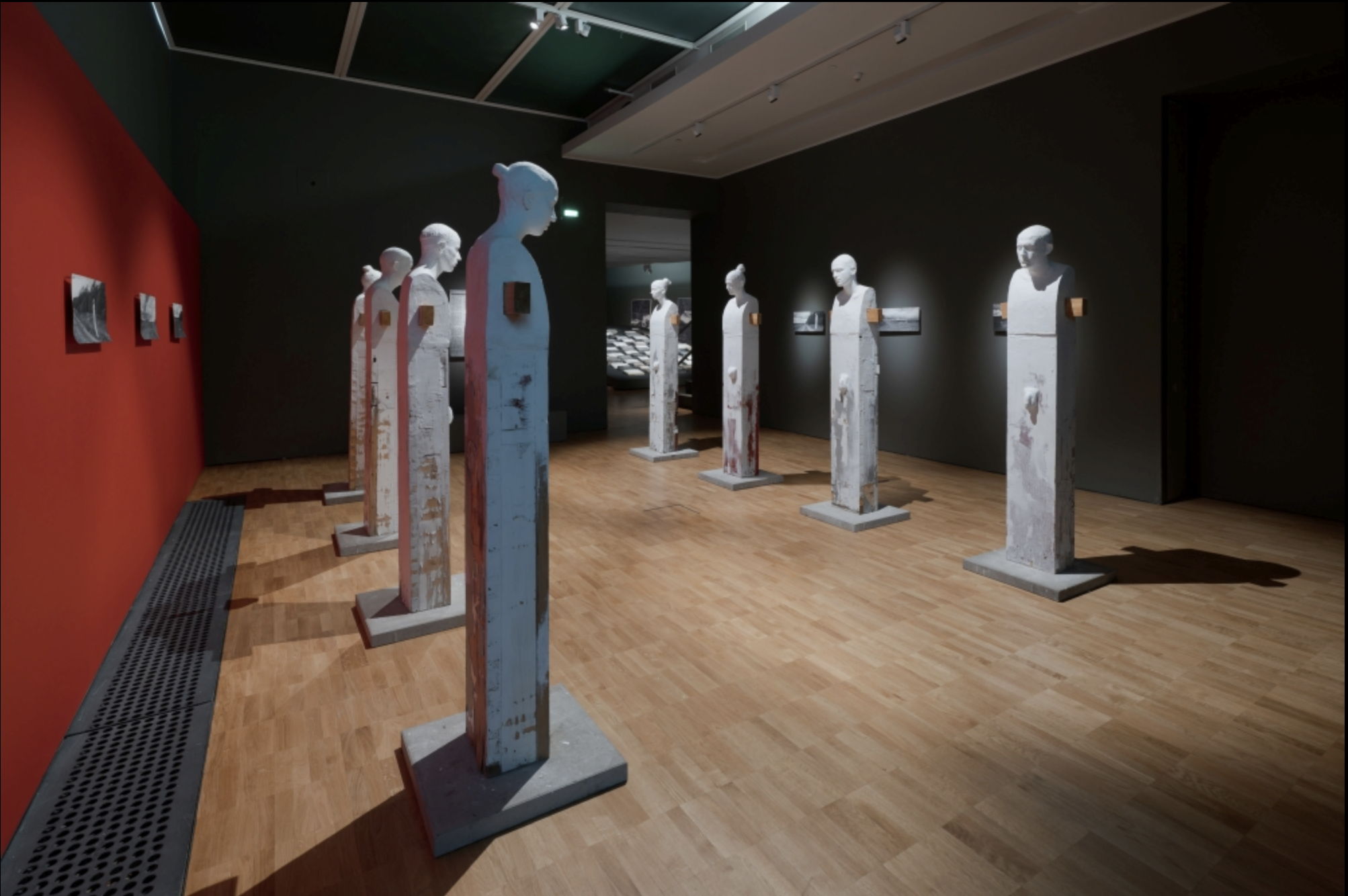
Jevgeni Zolotko
Love
2021/2024
Installation
Exhibition view
Photo: Stanislav Stepashko