This autumn, the Art Museum of Estonia opened two exhibitions that approach the interpretation of history in radically different ways, yet both begin with a shared premise: the past as a complex interplay of facts and imagination, where truth is in constant flux. Eero Epner’s “The Life and Death of Mr. N: Bourgeois Spaces by Urmas Lüüs” at Kumu Art Museum captivates the viewer with a haunting, psychological thriller-like atmosphere, commenting on historical events through the dramatised inner world of a fictional protagonist. Meanwhile, Merike Kurisoo and Pia Bengtsson Melin’s “The Unicorn in the Magical Forest” at the St Nicholas’ Church Museum gently guides visitors towards historical knowledge by exploring the evolution and interpretations of the unicorn motif as a lens through which societal beliefs and attitudes over the past 500 years can be understood.
“The Life and Death of Mr. N” feels like a natural extension of the permanent exhibition “Landscapes of Identity” on Kumu’s third floor, bringing the themes of cultural self-discovery from the 18th to the 20th century into the context of the early 1900s and onto a more personal, intimate plane. Urmas Lüüs’ largest exhibition-installation to date immerses visitors in the fragmented memories of the fictional Mr. N to narrate a story of societal trauma linked to the brief period of independence and subsequent loss of freedom in Estonia.
True to Eero Epner’s curatorial signature, the exhibition combines elements of both personal and group shows as it creates a dialogue between contemporary and historical art (yet with a focus on Lüüs himself). Lüüs’ characteristic deconstructivist aesthetic, which dismantles familiar ideas and reassembles them into something unsettling and new, is set in the atmosphere of a house museum, where past and future merge, and the structure of time and space gradually dissolves, opening a path to a dreamlike, nightmarish world.
Visiting “The Unicorn in the Magical Forest” on a weekend at 4 pm, when the organ recital begins and powerful sounds draw us into the mythical world of the unicorn – shaped in symbiosis with time over centuries – is a truly extraordinary experience. The small chapel at St Nicholas’, adorned with velvet, pearls and deep green hues, surrounds the exhibition’s protagonist with a mysterious and sacred dimension while preserving a childlike sense of play and a feeling of endless possibilities in the vast world it evokes.
Medieval texts described the unicorn as an exotic creature whose existence was deemed as plausible as that of animals living in distant lands. A similar air of enigmatic uncertainty fills the exhibition, exemplified by a 17th-century damask cloth with a mirror motif: a woven scene featuring a unicorn appears only when the fabric is viewed from a certain angle. This underscores the creature’s elusiveness and mystical nature, reminding viewers that truth always depends on perspective.
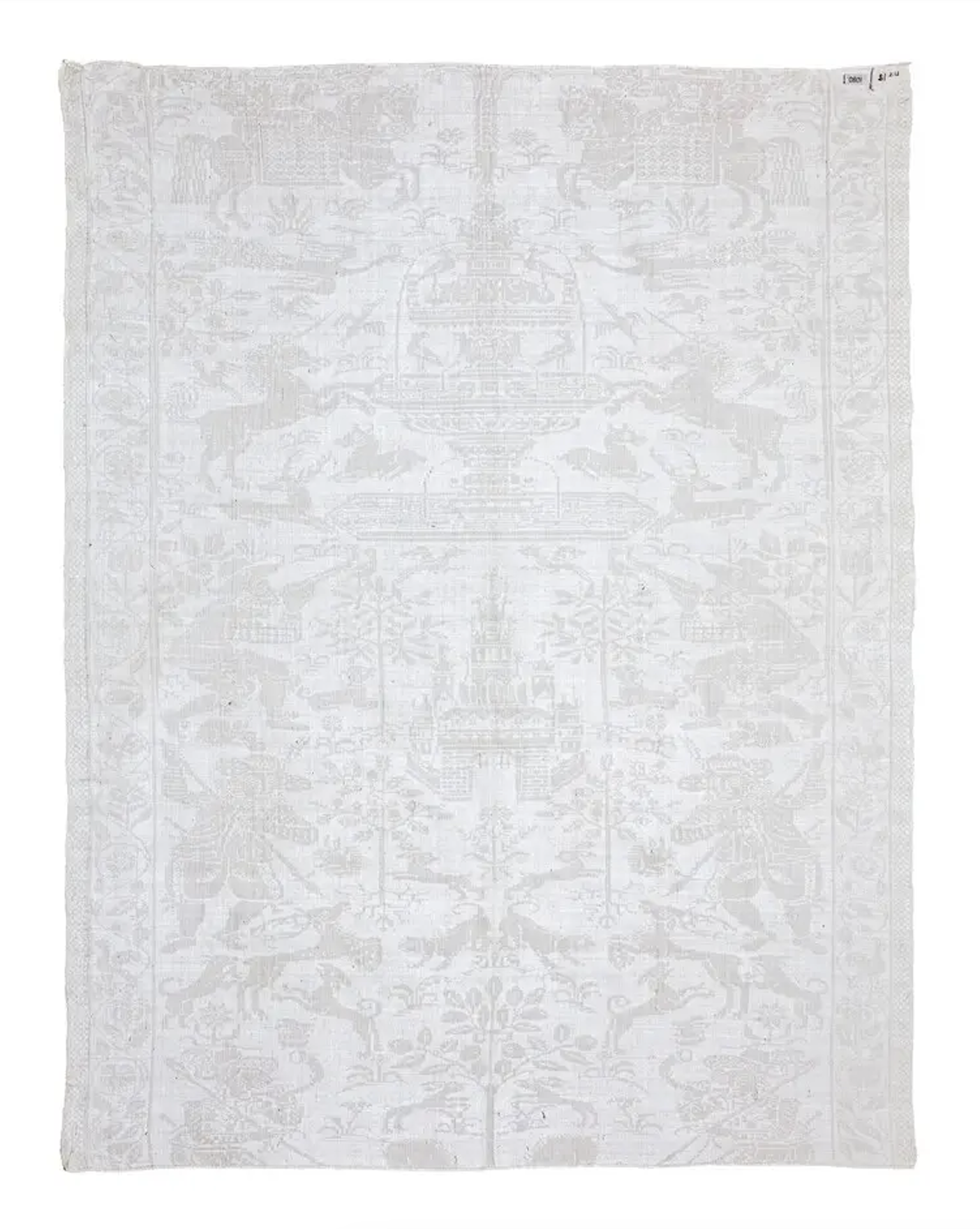
Napkin
17th century
Damask 96 x 92 cm
Skokloster Castle
Photo: Helena Bonnevier
The ground-floor display in the chamber focuses on the visual culture of early modern Estonia, Livonia and Sweden. The second section, housed on the upper floor of St Nicholas’ small chapel, traces the unicorn’s journey in art from the early 20th century to the present day.
Despite their diametrically opposed approaches – one plunging us into nightmarish memories, the other guiding us gently along nostalgic paths – both exhibitions explore the intersections between history, belief and individual memory, illustrating how fantasy can fill the voids born of pain and uncertainty.