SUMMARY
Lately it seems that nearly every exhibition I’ve attended has revolved around either modern technology or the environmental crisis. Whether in Tartu, the small town of Tõravere, the primaeval forest in Järvselja or the village of Neeruti, the exhibitions I visited this year all fit in one or the other category (or both). This also applies to the two large projects I’ll discuss here – “Missing” and “Enter Woodland Spirits”.
It’s not as though I’ve gone out of my way to seek out such exhibitions over the past months. The reality is that almost nothing else is on offer – either in terms of subject matter or in the form of art exhibitions. And this is understandable: technology and environmental issues shape our not so distant past, present and future.
The international group exhibition “Missing” at Tartu Art House tackled extinction – specifically, the extinction of species. According to broadly accepted estimates, over 99.9% of all species that have ever existed on Earth are now extinct. This framing, especially within the context of the ongoing human-driven wave of extinctions, felt undeniably relevant.
Kristina Õllek and Kert Viiart’s video installation “As the Earliest Carrier Emerges” (2024) proposed a hypothetical figure: a perfectly transparent jellyfish, likely made of silicone or another artificial material. The meditative video presented underwater footage of drifting jellyfish, juxtaposed with shots of a hand-sized silicone orb filmed and manipulated along the shoreline – including moments of it being squeezed in someone’s palm.
My top pick, however, was Katrin Gattinger’s installation “Hiding Amidst the Blossoms” (2019). This piece featured an antique display case – beautifully weathered, its fabric lining mottled by divine moths – draped in a purple cloth. Peering under the fabric revealed a “series of anthotypes, created with poppy and black pelargonium, depicting the Breton octopus”, as described in the accompanying text. The overall impression was one of meticulous detail and thoughtful composition, deepened by the hazy, antique-style images set against the warm wood tones of the display case.
As part of Tartu 2024 European Capital of Culture’s art programme, the somewhat eclectic international group exhibition “Enter Woodland Spirits” was held in two adjacent buildings: the Estonian Literary Museum and the University of Tartu Natural History Museum. The exhibition cast its thematic net wide, touching on technology, the environmental crisis, nature, folklore and familiar topics. The choice of venues – sprawling across seemingly random places and even non-places like corridors, foyers, reading rooms, auditoriums, staircases and attics – resulted in a highly site-specific exhibition.
The most striking venue was undoubtedly the Literary Museum’s attic, filled with stone wool insulation. The mysteriously titled installation “Cilium Self” (2024) by Icelandic sound artist Þorsteinn Eyfjörð featured an intricate network of wooden walkways and ceiling-mounted speakers emitting ambient music. I even returned to this space for a second visit.
Another site-specific work, drawing from its location and arguably even more effective as a piece than “Cilium Self” (though situated in a less intriguing space), was Johannes Luik’s installation “Transition: The Unknown (Contact with the Wooden Floor)” (2024). This installation, set in a windowless room, invited visitors to engage with a high wooden platform. Depending on whether one walked barefoot, in socks or in shoes, it offered varying degrees of tactile connection.
In summary, site-specificity, which was the other most important keyword alongside thematic eclecticism, emerged as both a strength and a weakness of “Enter Woodland Spirits”. While it enhanced certain works – like those described above – it faltered in spaces that felt too arbitrary, such as corridors and stairwells.
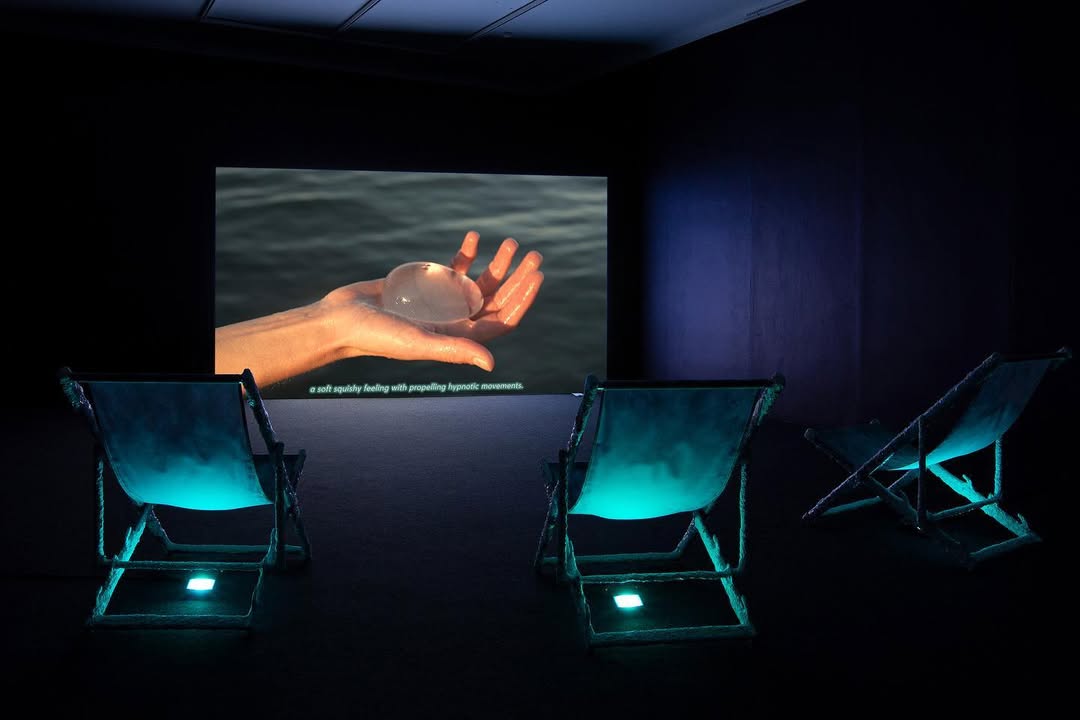
Kristina Õllek and Kert Viiart
As the Earliest Carrier Emerges
2024
Video installation, 10’ 10’’, beach chairs,
digital prints on textile, clay, silicone,
blue LED-lights
Exhibition view at
Tartu Art House
Photo: Kristina Õllek