SUMMARY
Kristina Õllek and Tuomas L. Laitinen’s joint exhibition “Cyanoceans” at Kai Art Center tells stories of the underwater world. But let me begin by describing what this exhibition is not – and thankfully so. It is neither didactic nor does it rely on overly simplistic messages or symbols.
A rather specific example of the opposite comes from the major exhibition “Diversity United” in Berlin (9 June – 10 October 2021), where Goshka Macuga’s piece, “Make Tofu Not War” (2018), included the image of a polar bear holding up a sign with the English text “It’s hot in here”.
The polar bear and its sign were clearly intended to convey an unmistakable message: the icebergs are melting and the Earth’s climate is warming. But since encountering the piece, I find myself pondering before any environmental-themed art exhibition whether there will be another “polar bear with a sign” or if the artists have employed more multi-layered and complex solutions – ones that would allow the viewer more space for interpretation and lead them to new discoveries.
If one takes a too straightforward path, the likely result is an exhibition that merely draws attention to problems. Even though, from an individual perspective, simple solutions to problems of such massive scale as environmental pollution and climate change are notoriously hard to find.
So what can an artist do in the face of such problems? Convince people that environmental pollution is a catastrophe that must be addressed at the societal level? Or appeal to the individual’s conscience, even though the bulk of the damage is caused by large corporations?
For me, Õllek and Laitinen’s exhibition avoids falling into that category of over-simplification described above because the display functions as a strong and aesthetically enjoyable visual whole. Õllek has worked with themes of marine ecology for years, consistently drawing attention to the fact that the Baltic Sea is one of the most polluted on the planet.
Maybe the Baltic Sea appears healthy and clean at first glance, and this is why it is difficult for us to grasp how polluted it really is. But does pollution really need to happen right before our eyes for us to finally realise that something is seriously wrong?
Õllek’s series of metal panels affixed to a metal lattice and Laitinen’s series of small glass pieces, “A Proposal for an Octopus” (2019–2024), are each charming in their sequentiality. And the dim lighting visually enhances both the translucent forms of the glass vessels and the videos.
In a small video room separate from the main exhibition hall, Laitinen’s video “Protean Sap” (2020) is displayed. The narrative makes this piece seem the most ambivalent in the exhibition. But, personally, I saw in it a somewhat surreal cycle of evolution, where various creatures transformed and morphed into fantastical new forms.
The video works featuring octopuses along with small blown glass objects are the strongest part of Laitinen’s work in the exhibition. The newest of the two octopus videos, “Pattern Recognition” (2024), was created in Japan at the Okinawa Institute of Science and Technology, where the artist filmed the colour changes of octopuses.
Seeing the octopus quietly living its life in the gentle video and discovering the glass form as a new home makes one think about the different ways in which all of us inhabitants of this planet adapt to the new environments we find ourselves in. If adaptation were a competition between octopuses and humans, who would prevail? As a human, one might naturally want to answer “humans,” but I wouldn’t be so sure about that now.
“Cyanoceans” prompts us to ask whether and how we, as a species, can adapt. I am reminded of the recent heatwave in Brazil, where temperatures reached 62 degrees Celsius, pushing even the locals, who are accustomed to the heat, to their limits of tolerance.
What will the world become when regions that were already hot become unbearable? How will we cope then? These are complex questions for which, so far, nobody seems to have simple answers. Yet “Cyanoceans” certainly gets one thinking about how to find them.
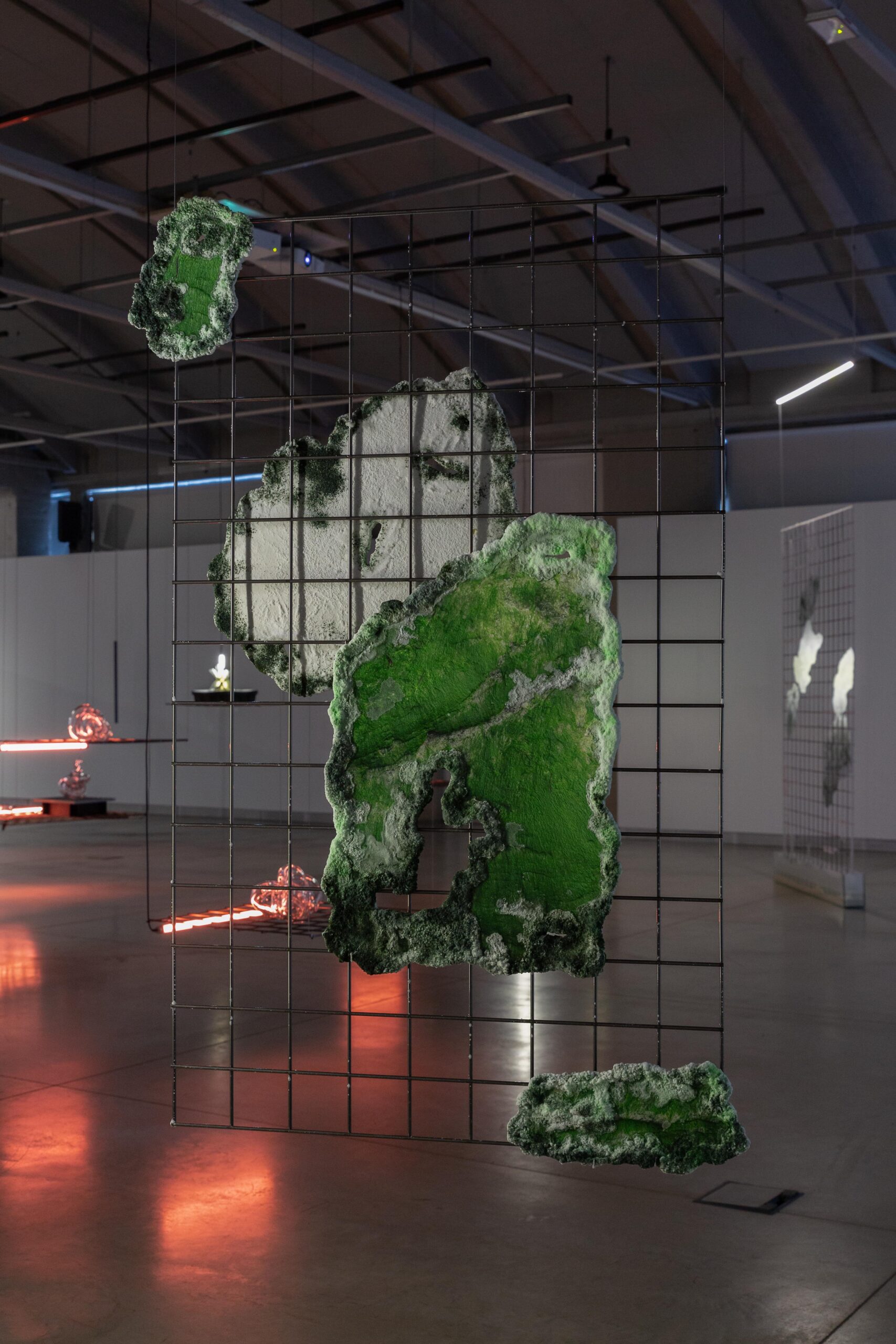
Kristina Õllek
Converting Energy and Oxygen (Grid No. 3)
2024
Metal grid, 150 x 90 cm,
pigment ink prints with grown sea salt crystals,
cyanobacteria and green fluorescent pigment
Exhibition view at Kai Art Center
Photo: Hedi Jaansoo