SUMMARY
In the early spring of 2022, we lost Jaak Adamson (1938–2022), a painter, printmaker and sculptor whose prolonged absence from the Estonian art scene overshadowed his rightful place in our art history. This was not Adamson’s first departure. In 1980, urged by the local branch of the Soviet Committee for State Security, or KGB, he left for Czechoslovakia with plans to escape to the “real” West. His departure was perhaps not entirely politically motivated; there were personal reasons as well. However, in the surveillance society of the time, any misstep – especially just before the Moscow Olympics and the Tallinn Sailing Regatta – was seen as a political gesture. Any “suspicious elements” were to be eradicated, and Adamson was given a way out.
The artist had already been labelled undesirable in 1973. My correspondence with his son, Andres Adamson, suggests that the reason was likely an incident on a Tallinn-Vilnius flight in 1973, on which Adamson was headed to the opening of Jüri Arrak’s (1936–2022) solo exhibition in Kaunas. During the flight, Adamson and Arrak, who had joined the passengers directly from the Kuku Club, audaciously chanted something about the independence of the Baltic States. Upon landing in Vilnius, KGB officers were already waiting for the artists, but no sanctions followed the interrogation at the time. Emboldened, the artists repeated their performance on the return flight to Tallinn after the exhibition opening, though with tiredness setting in, this time with somewhat more restraint. Despite the lack of immediate sanctions, later Adamson faced a sudden denial of a number of professional opportunities and benefits. By contrast, with Arrak, the authorities apparently hoped to ideologically re-educate and integrate the artist back into the system.
Before the Olympic year, a beleaguered Adamson suddenly received free travel vouchers to friendly socialist countries, which could only be interpreted one way: “Get out!”. In 1982, he was expelled from the Estonian Artists’ Association; exhibitions ceased, reviews vanished and the entire affair threatened to tarnish even the records of his close relatives who remained in Estonia – all of which only added to Adamson’s personal disagreements with the key figures of the Estonian art scene at the time.
During the Singing Revolution of the late 1980s, Adamson was reunited with Estonia. In 1990, the Tallinn Art Hall Gallery held a major solo exhibition of the artist’s drawings, and in 1997, his membership in the Estonian Artists’ Association was reinstated. This was followed by a small solo exhibition in 1998 in Kärdla, Hiiumaa, and another at the Kastellaanimaja Gallery in Tallinn in 2003. Nonetheless, all this was not enough to bring him back into the folds of the broader art scene. Today, however, more than twenty years on, Jaak Adamson appears before us once more, and this time, he is the central figure in a retrospective exhibition at Vaal Gallery, fittingly titled “Two Departures”.
Between the two departures, there were many returns. The artist always kept his Soviet Estonian passport despite “betraying his homeland”, and his connection to his childhood home in Hiiumaa established an annual summer routine and ongoing travels between Estonia and Slovakia. Of course, the painter did not sit idle all this time; the recurring motifs from Hiiumaa that appear in his work make us wonder how much he actually felt a sense of distance in his heart.
As the son of a Hiiumaa sea captain, Adamson naturally found the landscapes of his spirit here early on, and by the 1960s, they began to appear in his paintings. These included sun-drenched coastal meadows, harbour views and net sheds, bays, islets, lighthouses, fishing spots, and the characteristic colours of the clouds and sunsets, along with the expansive tranquillity of the calm sea.
Now, in the capital – the Garden of Eden where all these apples of discord once were scattered – the retrospective at Vaal Gallery presents a selection of paintings that confirm Adamson’s place in the art history of mainland Estonia, too. It also affirms his place in the global context of late modernism, characterised by growing scepticism about progress and ironic questioning of when the promised bright future would actually arrive.
In later years, Adamson became a lecturer at the Kremnica School of Applied Arts in Slovakia, settled into family life in a small town at the foot of the Low Tatras and continued his work as an artist. The Vaal retrospective emphasises works the artist created in his new home after his departure, alongside occasional works produced in Soviet Estonia.
Adamson’s entire body of work forms an aesthetic whole, which the retrospective captures well. There is no artistic divide between the works created in Estonia and those created in Slovakia. And indeed, he was fortunate enough to remain true to himself as an artist until the very end, likely aided by his ability to return to his homeland, which he eagerly embraced. The exhibition paints a cohesive picture of Adamson’s oeuvre – one that emerged from a single brush and from an era when originality was a fundamental imperative.
Adamson matured as an artist during a time when the Space Age optimism of the 1960s, artistic innovation, and futuristic visions of other planets and extraterrestrial life forms were petering out. The horrors of the Vietnam War sobered the flower children, the Soviet tanks that invaded Prague in 1968 shattered hopes for freedom in Eastern Europe, and the student riots in Paris failed to bring about a more accessible system of education or a more liberal society.
Being creative in such a social climate was undoubtedly painful. Jaak Adamson found his solution in social escapism and cultural internal exile. We can assume that the isolation of a small sea island like Hiiumaa, alongside childhood nostalgia, also offered some protection from Kremlin pressure and a more apolitical atmosphere, away from the ideological minefields of the Cold War and the capital city.
Adamson did not sacrifice the painterly character of his works to make room for linear design or storytelling. Colour, vibrant palettes, thick and powerful colour contrasts, juxtapositions of light and dark, warm and cool would always be central to his endeavours and pursuits. As a tribute to local folklore, a few recognisable motifs from folk tales also make occasional appearances. These paintings possess a fairytale-like brightness, a golden glow of a paradise lost, and a longing for cultural authenticity, purity and continuity.
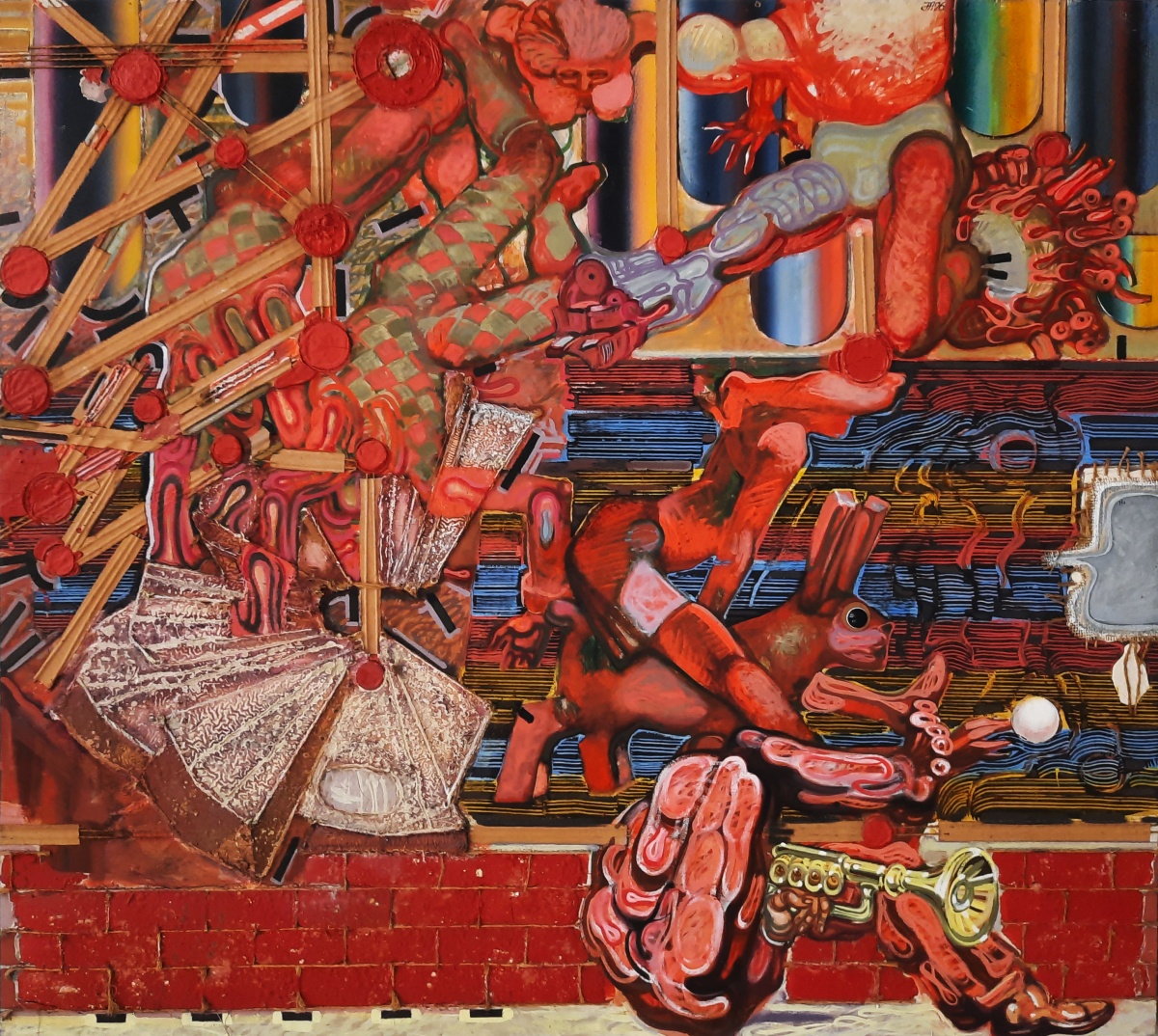
Jaak Adamson
Red Circus
1996
Author’s technique, 125 x 140 cm
Private collection
Setting aside heritage, the artist was far more critical of contemporary civilisation, especially one that, while flirting with the rhetoric of progress and a bright future, imposes a rigid authoritarian regime and thought control. It would be all too easy to reduce such criticism to narrow-minded anti-Russian sentiment and political dissent, but to do so would be to take a leaf out of the former KGB’s book and effectively exclude Adamson from Estonian art history. Who wasn’t anti-Russian at that time? All the art of that era cannot be reduced to such opposition, nor does anti-Russian sentiment define its complex nature. Worse still, such politicisation forces a restrictive, black-and-white interpretation of Adamson’s art, allowing the viewer to think only in antagonistic terms.
True, Adamson was as straightforward in his art as he could be within the confines of the Aesopian language of the time. Yet, he also succeeded in subtly pointing out the currents that twist historical narrative into a matter of religious belief, a sermon from a political commissar. Understandably, such criticism of historical consciousness did not sit well with official Soviet doctrines.
But what about Adamson’s place in Estonian art history – within the panopticon of styles and isms? Where is it? Where does Adamson fit in? A generalisation worth considering might be that it was the soft tone of the Estonian surrealist movement that provided the fertile ground in which Adamson’s painting could grow, take shape and gain meaningful expression. And this was not only true in his homeland but also later in Slovakia.