SUMMARY
Muzeum Susch in Switzerland has gathered around forty works from the oeuvre of Estonian artist Anu Põder for the exhibition “Space for My Body”, probably the most important retrospective dedicated to an Estonian artist outside their homeland.
In order to see Anu Põder’s work (1947–2013), you would have previously had to travel to such places as La Galerie Noisy-le-Sec Centre for Contemporary Art in Seine-Saint-Denis, which exhibited her work in 2019, or the 2022 Venice Art Biennale, where she was included in the main exhibition “The Milk of Dreams”, which highlighted female artists. This year, the place to see her work is Susch in Switzerland, a village of two hundred inhabitants near St. Moritz in the canton of Graubünden and home to Muzeum Susch, a foundation and museum established in 2019 by Polish collector and feminist GraŌ¼yna Kulczyk.
With this exhibition, curator Cecilia Alemani, who previously brought Põder to Venice, has undoubtedly organised the most important showcase of the artist’s work outside Estonia. And, for anyone who has not seen the two earlier exhibitions, the work on display may be somewhat shocking. Since Estonia was occupied by the Soviet Union until 1991, Põder was protected – or hidden, depending on your perspective – by the Iron Curtain for most of her career. During this time, she developed a unique body of work that might in some respects be compared to that of Louise Bourgeois (1911-2010), even if, given the political context of the time, it is unlikely that the two women would have been aware of each other’s existence.
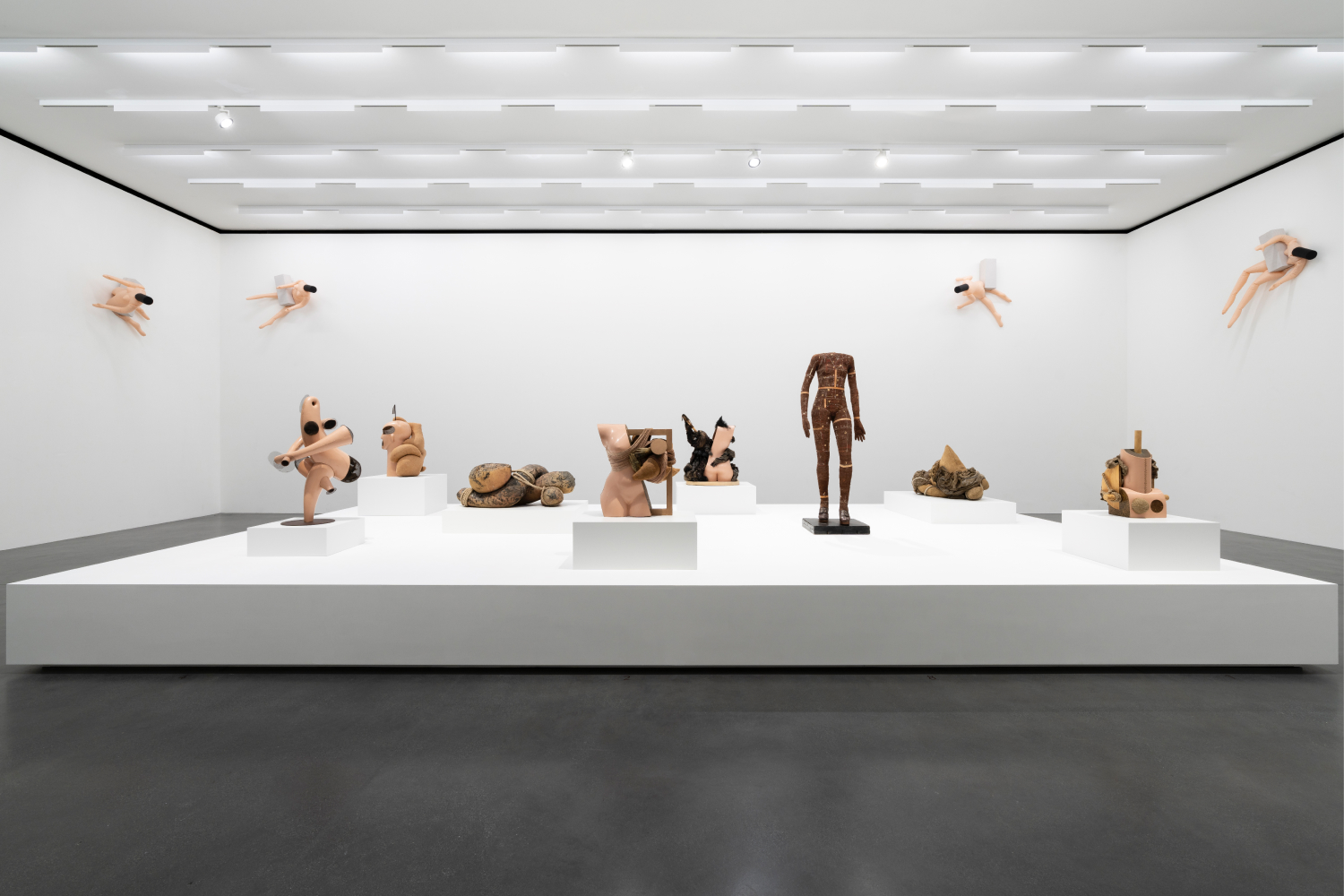
Exhibition view
at the Muzeum Susch
Photo: Federico Sette
Just like Bourgeois, Anu Põder received an academic art education, but in Põder’s case this was founded on the dictates of socialist realism, as can be seen in the two or three sculptures preserved from her early work. The most moving of these is “Traveller” (1978) – a woman sitting with a suitcase in her lap, waiting for a train that will not take her very far, representing how the artist and her fellow citizens were forbidden to leave the country. Like Bourgeois, however, Põder was able to break free from the constraints of her environment and composed a body of work equally as feminist as that of her New York counterpart.
Põder’s sculptures feature fragmented, distorted bodies. Alemani draws a comparison with the dolls of Hans Bellmer (1902–1975), which is not entirely out of place. However, this French-German Dadaist’s way of looking at women’s bodies was inspired by the fantasies of Marquis de Sade, surely quite different from Põder’s perspective. Alemani believes that Põder used herself as a reference point. This seems evident in one of her most important works, “Before Performance” (Enne etteastet, 1981), which resembles a female mannequin covered in brown fabric and is about the same size as the artist, who was not so tall herself. Like a tailor who makes a sewing pattern after taking measurements, Põder has painted white lines on the figure, dividing the body into segments, which remind one also of the diagrams of the different cuts of meat marked out on the animal’s body familiar from the butcher’s shop.
What little remains of Põder’s work, which is mostly preserved in museums in Estonia, shows that the artist was inspired by the body, especially the female body, and the twists and transformations – even torments – that it can go through. The felt, peculiarly rolled up and then twisted at both ends into spirals, resembles a person curled up on the floor as if to stave off another person’s blows. Another, more massive work, is shaped like an inverted U, like an arch standing on the ground. Above, a gigantic hand caresses what we dare not call a crotch but which the whole cannot help but resemble. Despite the black paint and the ropes that are trying to restrain it, this is surely the most fun work of the exhibition.
It is certainly more cheerful than Põder’s plaster self-portrait from the 1970s – a death mask with two hands clasped around the neck as if she were trying to suffocate herself. Clearly, the lives of Estonians, and especially Estonian women, could not have been so happy during the Soviet occupation.