SUMMARY
Four art exhibitions dedicated to surrealism are an exciting part of this year’s cultural calendar in Tartu, Europe’s Culture Capital 2024. The major exhibition “Surrealism 100. Prague, Tartu and Other Stories…” (4 April – 8 September 2024) at the Estonian National Museum (ERM) is complemented by concurrent exhibitions at the Tartu Art Museum, Tartmus: Ilmar Malin’s retrospective “The Glow of Eternity”, an exhibition of work from the Tallinnfilm surrealists and cartoonists, “Initiative from Below: Estonian Caricature in the 1980s”, and Kris Lemsalu’s solo exhibition “DONATELLA. Spiral of Life” (all three exhibitions are open 16 March – 21 July 2024).
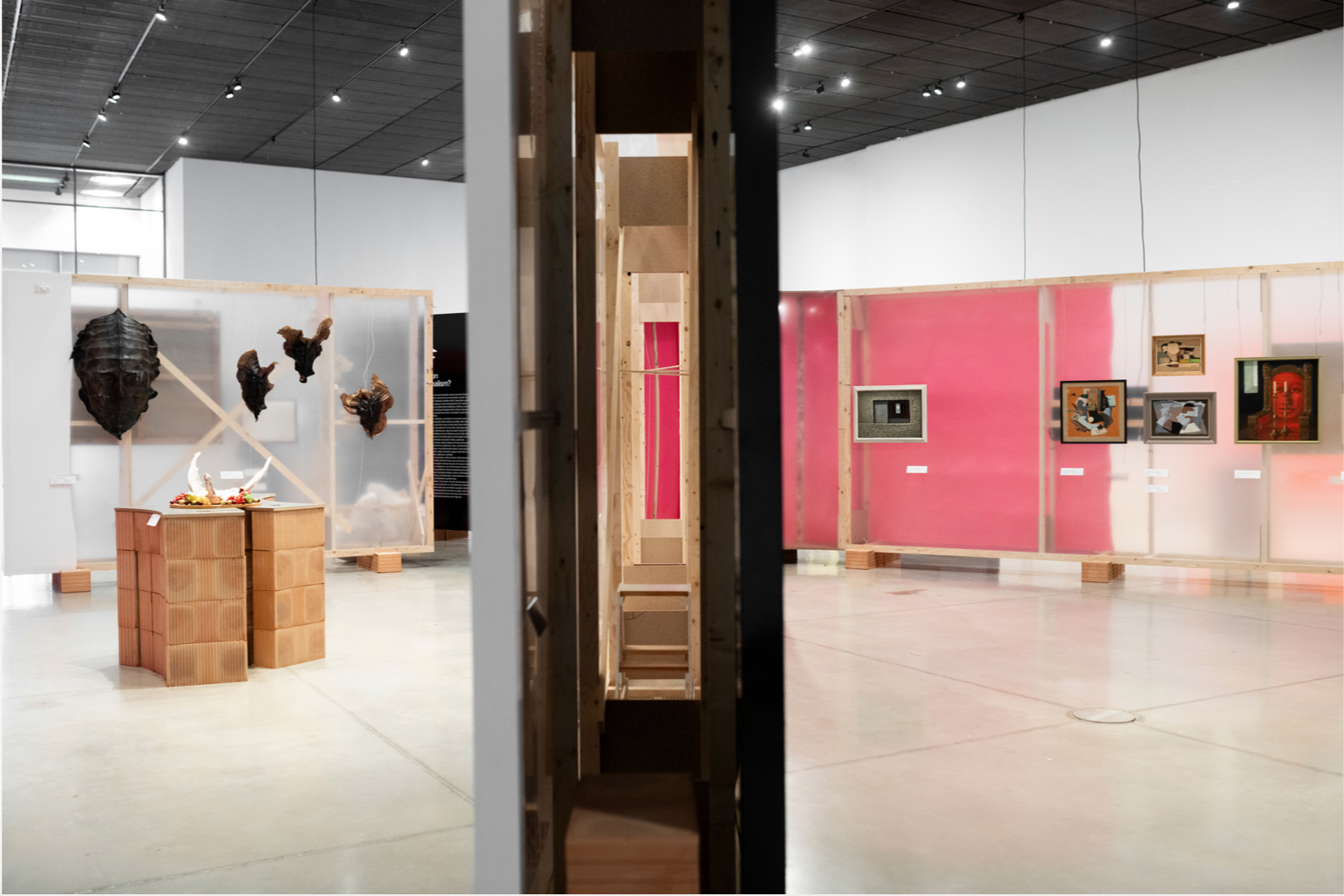
Exhibition view
at the Estonian National Museum
Foto: Patrik Tamm
Surrealism has recently become prominent again due to several major exhibitions, as well as this year’s anniversary of the first Surrealist Manifesto (Manifeste du surréalisme, 1924). Particularly significant was the main exhibition at the 2022 Venice Art Biennale, “The Milk of Dreams”, which drew inspiration from Leonora Carrington’s 1950s surrealist book of the same name and, notably, featured Estonian artist Anu Põder (1947–2013). Surrealism undoubtedly resonates with practitioners from various cultural fields, including, among others, writers, poets and artists. On 14 May 2024, ERM brought these various fields together at the international conference “Surrealism 100”. Yet, while the origins of surrealism are more closely associated with literary circles, visual art, which transcends language barriers, played a significant role in its coming to prominence.
As a fan of surrealism, I can only commend the curators of “Surrealism 100. Prague, Tartu and Other Stories…” – Joanna Hoffmann, Kristlyn Liier and Anna Pravdová – for offering a new perspective on the works of those Estonian artists who were influenced by surrealism. The combination of Estonian art inspired by surrealist methods and Czech surrealism is a playful and creative move. Moreover, it reflects the curators’ conceptual approach and serves as a clever strategy to anticipate and deflect criticism.
In Estonia, there was no artistic movement paralleling surrealism, whereas, in comparison, artists in Prague were personally visited by André Breton (1896–1966) himself. Where Estonian art has been influenced by surrealism, it has been enriched as it establishes a connection to the authentic thing. For this, we can thank the increased ease of international communication, probably the sponsors, too. Of course, such large-scale exhibitions are primarily born out of a curator’s creative enthusiasm. And why shouldn’t Prague art professionals be a little interested in phenomena with indirect yet substantive connections to their own work? Why not foster dialogues between cultures? Compared to Estonians, Czechs are closer to the centres of Europe. But while this was an advantage in the first half of the 20th century, today, one and a half thousand kilometres is an insignificant distance.
Of course, one could critique the preceding remarks and suggest an end to this self-deprecating discussion, arguing that it doesn’t matter whether there were real-time reflections of surrealism (or any other movement) in Estonia. After all, art creation is not an international sports competition or other such thing. However, the route to international engagement still follows the same well-trodden paths: work close to major art centres and metropolises, interact with the art world’s decision-makers, and study at renowned institutions. These form the launching platform for creators with international ambitions today, just as they did 100 years ago.
As a visual experience, encountering the works of the Prague surrealists in their original form is extraordinary for any enthusiast of art or surrealism, and in person, the aura of these legendary works is both exhilarating and moving. The names of the Czech artists – JindŌ™ich Štyrský (1899–1942), Toyen (1902–1980), Jan Švankmajer (b. 1934), Mikuláš Medek (1926–1974) and others – have made their way into art history and are frequent inclusions in surveys of surrealist art.
The catalogue includes two articles by Joanna Hoffmann: “On the History and Nature of Surrealism” and “Surrealism in Estonian Art – Is… Isn’t… It Still Is!” In these pieces, Hoffmann acknowledges the intermittent presence of surrealist influences in Estonian art. As she writes: “The bending of reality, games with the subconscious, dreaminess, and the reliance on instinct appear and disappear in local art history time and again. Surrealism in Estonian art is like a guest who occasionally returns in one way or another but never quite becomes a real family member.”
Anna Pravdová provides an overview of the history of surrealism in former Czechoslovakia, which is educational to read and raises the question: how many of our art experts are familiar with the names from that region? Still, the situation for the Czech surrealists was quite different to our artists’, as they operated practically in sync with Paris – the local surrealist group was founded in 1934, and Breton visited Prague in 1935 to give lectures. The renowned Polish art historian Piotr Piotrowski (1952–2015) also referenced Breton’s statement from the 1935 lectures that surrealism was developing along two parallel paths – one in Paris and one in Prague.
Surrealism has been debated in Estonia for good reason, as it is difficult – if not impossible – to apply stylistic criteria to this movement as it developed in the visual arts. Estonian art offers no true parallel to the international surrealist movement. We know Eduard Wiiralt’s “Hell” (1930–1932), and the “Surrealism 100” exhibition introduces compositions by Karin Luts (1904–1993), which Joanna Hoffmann describes as featuring a “fantasy-rich, uncanny pictorial world”. And from the 1920s, we can associate the Group of Estonian Artists with constructivism and the painters of the Pallas School with a belated but not too delayed reflection of post-impressionism. Yet, since the 1960s, all other Western art movements have entered Estonian culture as if squeezed through a keyhole. It wasn’t until the 1990s that Estonian art began to move in sync with international art, when, for example, a figure like Katja Novitskova (b. 1984) was among the pioneers of post-internet art. Here, one can only speculate about what could have been if Estonia had been free throughout the entire 20th century, without the interlude of Soviet occupation. How many Estonian names might we see in international art today?