27. IV–31. V 2023
Gallery on the first floor of the Tallinn University Academic Library
In April of this year, the small solo exhibition “In a Room with Pink Wallpaper” by Sirja-Liisa Eelma opened in the first-floor gallery of the Tallinn University Academic Library. Rather than adding significantly to the artist’s previous series of solo exhibitions, which have been a foundational aspect of her doctoral thesis over the past five years at the Estonian Academy of Arts (working title “Paradox of Emptiness: The Practice of Painting, from Exhibition Space to the Transformation of the Surrounding State”), this exhibition seemed to subtract, further limiting the potential for constructing a narrative from her artworks that could be easily told. Eelma is aligned with the tradition of Estonian conceptual minimalism, a movement led by artists such as Raul Meel, Mari Kurismaa, Mall Paris, Neeme Külm, Krista Mölder, Dénes Farkas, among others, which primarily explores art’s capacity to evoke spatial illusions, serene mental states and abstract still lifes – elements that inherently defy simple translation onto written paper.
*
As the artist revealed during the exhibition’s opening, her current artistic choices find their origins in her painting studies at the Estonian Academy of Arts in the 1990s, particularly rooted in the “working logic of monumental painting”. This logic exhibits a certain inflexibility in separating design from execution. Once the design is finalised and the work is underway, impromptu alterations or seeking a more exciting solution become unfeasible. On a monumental scale, the “learning by doing” approach would prove prohibitively expensive – in terms of both the financial investment necessarily involved in realising your concept and the even more substantial cost of making mistakes and rectifying them.
So you must adhere to the initial concept and approach the work with craftsmanship – hands diligently at work while the mind detaches, free to wander. This demands a meticulously detailed, exhaustive, foresighted and conceptually mature plan to rule out any deviation from the chosen trajectory. Eelma successfully achieves this level of precision, evident in the visual rigour, repetitive motifs and mechanical routine characterising her paintings. Furthermore, these qualities form a recurring motif in her current body of work, discernible from a distance, like a panoramic view, a hallmark of monumental art.
Adding to this, it was noted during the opening that Eelma owes gratitude, among others, to her first painting instructor Ants Viidalepp (1921–2012), who introduced young students to Johann Wolfgang Goethe’s (1749–1832) colour theory. Viidalepp’s teachings shed light on the way a red object casts its warm radiance on a green backdrop, while the latter reciprocates by infusing green into the crimson hue. Such combinations give birth to a third colour. Colours remain “broken”, defying pure primary definitions, which are imperceptible to the eye anyway, perpetually transitioning from one tonality to another. The light surrounding a painting constantly changes; the artwork itself dissolves into a spectrum of distinct perspectives, views and a plethora of opinions.
And that’s exactly what was needed. Sirja-Liisa Eelma’s minimalist artworks constitute a fundamental choice within a world saturated with noise, visual chaos, excessive discourse, narrative intrigue, an incessant influx of news and an unending competition for audience attention. In this world, voices blend, cancelling each other out, and the perpetual endeavour of repainting one’s own image day after day, marketing oneself as a desirable commodity in a market economy brothel prevails. This fundamental choice signifies a departure from the ecstasy of storytelling, from a world enamoured with one’s own voice, to enter a realm of silence, vacuity, monotony and repetition. This signifies relinquishing any trappings that might label her as a barricade artist, a canary regurgitating acute societal issues or an avant-gardist hacking her way through a complex maze of societal challenges. No, there are no such claims to heroic grandeur in her actions. Yet, there is an inclination towards a retreat into monasticism, an oath of silence. And there is also meditation in her work, which contemplates painting as a succession of renunciations, a journey through the brilliance of luminous days – light and reflections, gleams and echoes, patterns, arabesques, delicate tonal variations, and an almost inaudible whisper of shades.
*
Some paintings shun the viewer’s gaze, eschew representation, and least of all mirror the observer’s own reality. They neither reflect it nor linger like a beggar’s hand, eagerly anticipating the viewer’s generous gaze. Yes, the line between these paintings and interior design elements is tenuous – they can be passed by as if they were wallpaper. With scant interest in the spectator’s state of mind, these artworks assert their decorative presence, compelling one to comport oneself “as one does at an exhibition”, engendering an unsettling sense of guilt –what does all this mean?
These paintings (a rarity in an era dominated by content creators and influencers) renounce content, embracing their form as a defence against imposed interpretations and meanings. Yes, they are devoid of meaning, withholding the comfort of meaning’s assurance from the viewer, abstaining from catering to the viewer’s needs. They are paintings that have, borrowing a term from Charles Baudelaire (1821–1867), abandoned the quest to be a “book”, to tell a story. These are paintings composed solely of line and colour, a characteristic that Baudelaire highlighted (unwittingly foreshadowing the emergence of abstractionism half a century later).
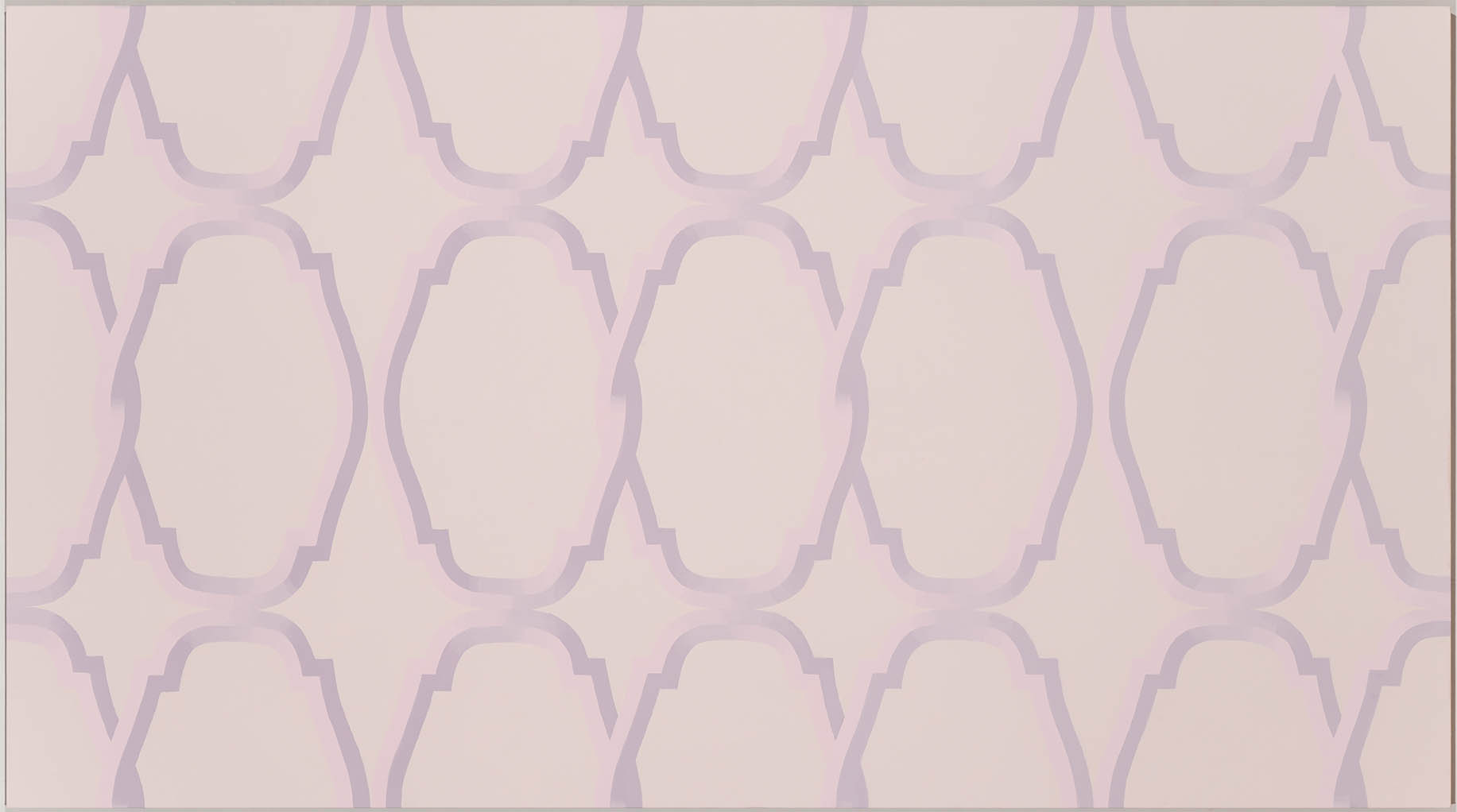
Sirja-Liisa Eelma
Seven Views of the Surroundings. View VII
2022
oil on canvas
100 x 180 cm
Courtesy of the artist
Photo: Stanislav Stepashko
Eelma’s earlier foray into the radical realm of minimalism and abstractionism now assumes a more philosophical dimension. Two decades ago, she endeavoured to strike a balance between figurative and abstract art. A dozen years later, she conjures illusions of stylised sunsets – or perhaps they are distant blue mountain ranges or lotus petals unfurling like a scroll – and deciphering them has become impossible. Reality has been left behind, replaced by monumental contours against a mist of lilac and pink. These nearly monochromatic paintings stand as remnants of reality after a prolonged fast, now merely a self-representation.
*
Time will tell whether this immersion will yield a theoretical framework for her doctoral thesis, but the overarching theme clearly revolves around the dematerialisation of painting. It signifies a departure from tangible, representable objects and a passage into boundless realms of spatial imagination. Through insights gleaned from the philosophies of emptiness in the Far East and the Catholic worldview of renunciation, Eelma’s works encapsulate elements from both forms of asceticism. If nothing else, they offer a trickle to quench the viewer’s thirst for meaning, a quest for life’s essence. The spectator might come to terms with the concept of their own mortality, but surely not the notion of its futility.
Oscar Wilde (1854–1900), sensing death’s imminent arrival on his deathbed, reportedly shifted his focus to the shabby floral wallpaper adorning his solitary boarding house, murmuring: “Well, one or the other of us has to go.” Whether truth or legend, the human inclination to confer significance upon death, to transform it into an aesthetic gesture, is poignantly evident in this fragment of folklore. Sirja-Liisa Eelma’s paintings are likewise “dead to this world”, residing in the deepest recesses of the monastery cloister, governed by their own self-imposed formalistic principles.
Johannes Saar is an art historian, critic and lecturer.