Born in collaboration with the Mystetskyi Arsenal, the exhibition “Futuromarennia: Ukraine and Avant-Garde” was more than an adjustment of the exhibition that took place in Kyiv from late 2021 to early 2022 for the Kumu spaces and Estonian audiences for the summer of 2023; it was also a radicalisation of the entire concept, as Russia’s full-scale invasion prompted an ad hoc engagement with questions of the national self-determination of the Ukrainian avant-garde, which was quite cosmopolitan by nature. By shedding light on Ukrainian futurism and its broader avant-garde movement, the exhibition accomplished the important feat of introducing a previously little-known yet multifaceted and distinctive phenomenon to Europe and the world, but also of decolonising it. Without negating its links with the Russian avant-garde, the exhibition decidedly challenged the monopoly of the latter, highlighting the Ukrainian background of several well-known artists, and their various dialogues with – influences from and contributions to – Ukrainian culture, warranting a discussion on multiple identities that is particularly relevant today.
A good example is Kazymyr Malevych (1879–1935), who was born in Kyiv to a Polish family, studied in Moscow, formulated his theory of suprematism in St. Petersburg (named Petrograd at the time), but also had contact with Ukrainian folk art at various stages in his life: as a boy, for example, he created traditional stove paintings for village houses in Podolia, and already as a mature artist he contributed to the Verbivka craft artel. According to more recent research, suprematism was first presented to the public not in the series of paintings featured in the legendary exhibition “The Last Futurist Exhibition of Paintings 0,10 [zero-ten]” (December 1915 – January 1916, Petrograd), but in the embroideries displayed the month before at the “Exhibition of Contemporary Decorative Arts of Southern Russia” by the Verbivka artel in Moscow. At the end of the 1920s, when avant-garde artists in Russia were already facing increasing restrictions imposed by the Soviet regime, it was in the more liberal Kyiv that Malevych was able to work without hindrance, teaching at the Kyiv Art Institute, known as the Bauhaus of Eastern Europe, and contributing texts to the magazine Nova Generatsiia. At the same time, learning about the experience of Ukraine inevitably leads to thoughts about Estonia’s avant-garde legacy, with a new-found awareness of its similarities and differences to that of Ukraine. All this is the starting point for fascinating processes of self-reflection and research, especially on the vector of “horizontal art history”.
For example, researchers of the Ukrainian avant-garde have highlighted the role of pattern structures and colour schemes used in folk art – embroidery, painted Easter eggs (pysanka), etc. – in the development of the new aesthetic. The essential trait of the Ukrainian avant-garde that sets it apart from that of Russia, including others, is the lack of irony and exoticism, an approach that respected the traditions of folk art and saw itself rooted in its fertile soil. In an attempt to define the specificity of the Ukrainian avant-garde, one could highlight the dynamically synthetic search for form, which is often difficult to narrow down to a specific -ism or artistic medium, and also the expressiveness of both form and colour. This is especially true when considering the work of the Estonian Artists’ Group (1923–1940) , the flagship of the Estonian avant-garde, which seems particularly laconic and restrained in comparison. Of course, this might be an interpretation of the constructed gaze, which immediately starts seeing connections with the national temperament or the characteristics of the local natural landscape, because dynamic forms and colours are also found in the avant-garde art of Estonia and minimalism in that of Ukraine.
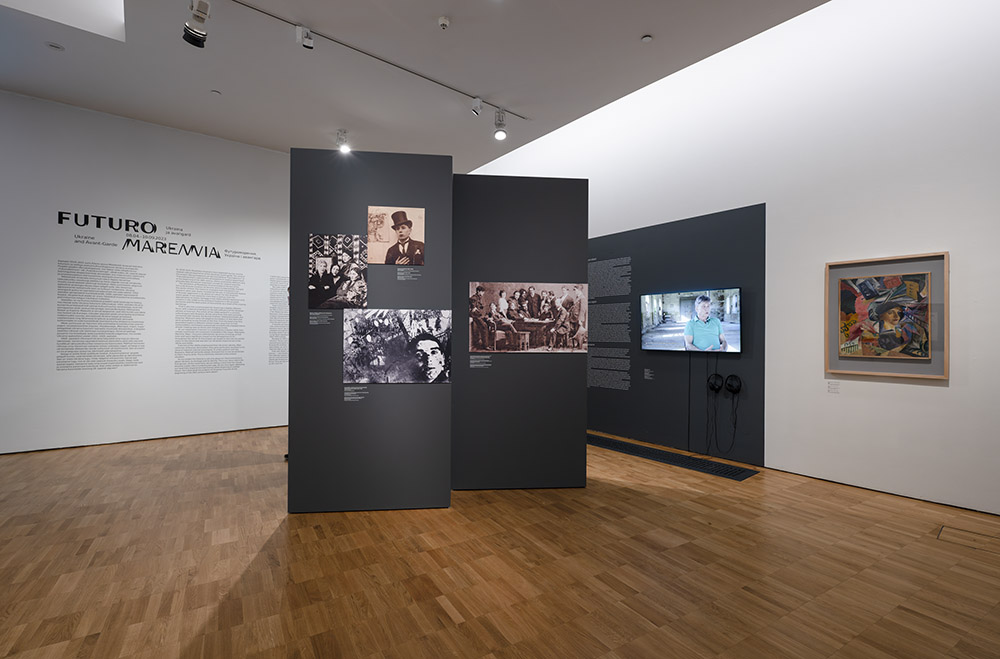
Photo by: Stanislav Stepashko
Ukrainian roots, connections, self-determination
The Ukrainian art scene of the early decades of the 20th century presents a dizzyingly dense kaleidoscope of names and collectives, art movements and exhibitions, venues and dates. The 1906 exhibition of Volodymyr Burliuk (1886–1917) and Davyd Burliuk (1882–1967) at the Kharkiv Noble Assembly and the 1908 exhibition of the art collective Zveno (Ukrainian: Lanka or The Link, consisting of Oleksandra Ekster (1882–1949), Oleksandr Bohomazov (1880-–1930) and the Burliuk brothers) in Kyiv were among the first exhibitions of innovative art in the entire territory of what then constituted the Russian Empire. In 1909, Volodymyr Izdebsky (1882–1965) hosted an exhibition of international modern art in Odessa, where local artists – the Burliuk brothers and Ekster – displayed their works alongside prominent international artists such as Georges Braque, Henri Matisse, André Derain, Wassily Kandinsky, Gabriele Münter and others.
In addition to the cities, rural “places of power” have played a defining role in the Ukrainian avant-garde, serving as creative oases in their own right – especially in the context of the hardships of the First World War, which began in 1914 and saw far more food shortages in the cities than in the countryside. One of these locations, a manorial estate managed by the Burliuks’ father in the village of Chornyanka, was often visited by Vladimir Mayakovsky and other members of Hylaea, the group considered to have founded Russian futurism, so there is reason to speak of the Ukrainian roots of the Russian avant-garde. Another “power base” was the home of the legendary Syniakova sisters in the village of Krasna Polyana, which attracted the crème de la crème of cultural figures from both Ukraine and Russia, including Davyd Burliuk, Velimir Khlebnikov, Boris Pasternak and others, and where Mariia Syniakova (1890–1984) developed her highly idiosyncratic, naïve or neo-primitivist style of painting, which was inspired by Ukrainian folk art and traditional Central Asian textiles. All of this implies that Ukraine in the early 20th century was not a province, but an important cultural centre of the former Russian Empire, and also a socio-economic environment conducive to art and culture.
In parallel with the events described above, Ukrainian artists also participated in exhibitions in internationally renowned art centres of the time – sometimes Ekster and Burliuk exhibited with Natalia Goncharova, Mikhail Larionov and others in Moscow or St. Petersburg, other times Ekster took part in major international exhibitions of modern art in Paris and Rome, accompanied by Sonia Delaunay (1885–1979) and Oleksandr Arkhypenko (1887–1964), two prominent Ukrainian artists who had emigrated to Paris. While Alexander Rodchenko’s workers’ club, with its comprehensive design, has become an icon of the international avant-garde – it won a silver medal at the 1925 International Exhibition of Modern Decorative and Industrial Arts in Paris, subtitled “Art Déco” to mark the birth of a new art style. The gold medal was awarded to Vadym Meller (1884–1962), lead stage designer at the Berezil Artistic Association, for his set for the production of “Secretary of the Labour Union”. It seems that in the cosmopolitan art world of the time, art pioneers from different countries knew each other well, and new ideas spread almost as quickly as they do now in the digital age – of course, Soviet dominance cast a shadow over some of the most prominent artists of the time, leading them, undeservedly, to become forgotten, with their work only now being rediscovered.
A significant presence in the Ukrainian avant-garde, Oleksandra Ekster played a crucial role in propagating novel concepts within Ukrainian art circles, occasionally even returning with the originals of innovative works of art from her trips to Paris, Rome or Moscow to share these with her companions in Kyiv. Ekster knew Pablo Picasso and George Braque, and Fernand Leger had reproached her for bringing too much colour into cubist painting, something that Ekster considered fitting her identity. Her palette, as well as her use of form, has been greatly influenced by Ukrainian folk art, especially its colours, forms, structures and ornamentation. As the founder of the Ukrainian school of Constructivist stage design, she was also a major influence on international Cubo-Futurism and Art Deco. Although as a cosmopolitan Ekster did not associate herself with any nationality, the study and promotion of Ukrainian folk art traditions, as well as efforts to further develop them, played an important role in her work, even after her emigration to Paris in 1924.
Next to the systematic Ekster, always elegant and sophisticated in her artistic expression, Davyd Burliuk comes across more as a restless trickster, whose role as a capable organiser of both meaningful and provoking art events is perhaps even more significant than his naïve style of painting that approaches the grotesque. Although Burliuk himself has stressed his Zaporizhzhian Cossack ancestry and called himself a Tatar- Zaporizhzhian futurist, others have called him the father of both Russian and Japanese futurism. Meanwhile, Burliuk’s paintings are said to have been inspired by the colours of the Kherson steppes, the palette of Ukrainian nature. In this way, Ukrainian roots, connections and influences were highly individual for each artist, coming together to form a captivatingly intense and multi-layered narrative at the “Futuromarennia” exhibition.
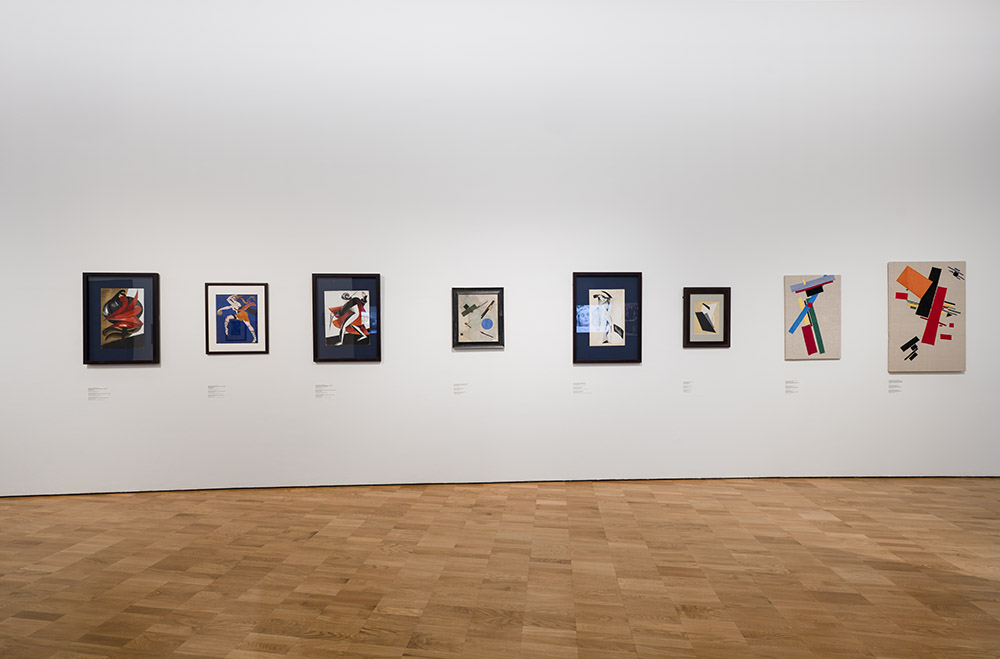
Photo by: Stanislav Stepashko
From dissecting the foundations of art to creating a total work of art
Two tendencies characteristic of avant-garde art stand out in the Ukrainian avant-garde: on the one hand, a return to the foundations of the specific medium and its means of expression, thoroughly exploring these to construct an individual artistic language, and, on the other hand, the ambition to create a total aesthetic with the potential to transform the world. An outstanding representative of the first trend in Ukraine is Oleksandr Bohomazov – an artist, educator and exceptionally discerning painting theorist. His treatise “Painting and Elements” (1914) is one of the earliest theoretical writings on abstractionism in the history of art, born in parallel with texts as canonical as “Point and Line to Plane” (1912) by Wassily Kandinsky and “From Cubism and Futurism to Suprematism: The New Realism in Painting” (1915) by Malevych.
Bohomazov identified line, colour, form and the picture plane as the basic elements of painting, using them to discuss the possibilities of conveying both the physical environment and the dynamics of human emotions. His theoretical legacy encapsulates the method of preparing the base elements of painting, with examples of successful and unsuccessful executions of this task. Bohomazov concluded fascinating “laboratory experiments” on the interaction of colours and forms to test his hypothesis on the different effects of a form filled with different colours and the possibilities of expressing the dynamics of one colour using another colour and a different form. Thinking about Bohomazov’s ideas, the writer of this piece cannot help but recall the work of Kristi Kongi, a painter in present-day Estonia who focuses on the expressive yet conceptual potential of abstract forms and colours.
In addition to experiments on the micro level of the art medium, there were major explorations on the macro level. New aesthetic systems were being applied both in the visual-spatial domain – noteworthy examples apart from the paintings and drawings presented in the “Futuromarennia” exhibition including the monumental painting and graphic design projects of Vasyl Yermylov (1894–1968), the costume and stage design projects of Vadym Meller, Anatol Petrytsky (1895–1964) and others, and examples of Kharkiv constructivism in architecture – and in synthesis with other art forms. Illustrations of the latter include the poezomaliarstvo or poetry-painting of Mykhail Semenko (1892–1937), the innovative theatre of the Berezil Artistic Association and director Les Kurbas (1887–1937), the experimental film of Dziga Vertov (David Kaufman, 1896–1954) and Eugene Deslav (Yevhen Slabchenko, 1898–1966).
A unique phenomenon in this respect is the craft cooperatives or artels established in the early 1900s in the villages of Verbivka and Skoptsy, which were briefly mentioned earlier on in the article. Nina Henke (1893–1954), who became the art director of the Verbivka artel in 1915, invited artists from the Supremus group led by Malevych, including Oleksandra Ekster, to collaborate with the cooperative. After familiarising themselves more closely with folk handicrafts, the avant-garde artists came up with designs for traditional objects: bags, rugs, belts, pillows and other items were decorated with abstract compositions, the results nothing short of ornamental. The aesthetics of the avant-garde was thus able to enter the sphere of everyday life, as a step towards the realisation of the utopian total work of art encompassing all aspects of life.
One of the key ideologists of the total work of art was Richard Wagner (1813–1883), who in the mid-19th century developed his concept of Gesamtkunstwerk, which envisaged a synthesised spectacle of music, dance, drama and visual art that would have a ritually transformative effect on the audience. Wagner is also featured in the “Futuromarennia” exhibition – through Oleksandr Khvostenko-Khvostov’s (1895–1967) stage designs for the production of “Die Walküre” (1929), its concise geometric solution proving a surprisingly good fit for Wagner’s ideas. Wagner’s innovative music and experiments in stagecraft took place against a backdrop of rather conservative stage design: although he included electricity and mechanisms for various effects in his productions, he still considered traditional illusionistic landscape painting to be the ultimate form of visual art. One could argue that Khvostenko-Khvostov succeeded in finding a visual form worthy of Wagner’s innovation: the archaic-mythological opera from the “Ring” cycle is set in a world of geometric shapes as if to emphasise the archetypal nature of the epic “proto-narrative”.
Making a short foray into the meta-level, one could argue that the entire “Futuromarennia” exhibition was a kind of Gesamtkunstwerk. Lera Guevska’s highly successful and intelligent exhibition design was born from a dialogue between works in different media and spatial domains. Guevska was also the art director of the multimedia installations that offered contemporary visual interpretations to the exhibition. One of these was created specifically for the Kumu exhibition and dedicated to the Slovo [Word] writer’s house in Kharkiv, which lost a horrific number of its inhabitants during the 1930s repressions, and which the installation portrays as a symbol of hope, broken dreams, perseverance and resistance, both in the context of the 1920s and 2020s.
The intoxicating effect and eventual shattering of dreams of the future
The second installation of “Futuromarennia” was dedicated to the synthetic art of poezomaliarstvo or poetry painting, developed by the poet and theorist Mykhail Semenko, an advocate of Kvero-Futurism (“Questing Futurism”), Panfuturism and meta-art. In addition to the syntactic and semantic aspects of verbal text, poetry painting also encompassed other dimensions of perception, more specifically visual and aural rhythm and sound, which are particularly effectively captured through multimedia interpretation. One of the foundational texts used in the installation was Semenko’s “Cable-Poem Across the Ocean” (Kablepoema za okean, 1920–1921), in which he calls out geographical names from all over the world (Alaska, Niagara, Australia, Japan, etc.), praises the revolution and calls for cooperation between the proletariat across continents.
Semenko’s “Cable-Poem Across the Ocean” evokes a parallel with “Multiplied Poet 2” (Multiplitseerit poeet 2, 1926) by Johannes Barbarus, in which the Estonian Futurist addresses not the whole world but Europe, calling on its poets to collaborate: “Hello, between us, a constant line of hearts: chaos is god’s creation, order is ours. Hello, Pan-Europe, hello!” Semenko’s transcontinental cable or Barbarus’s “line of hearts” could work as a reference to telephones or radios, symbolising the new world and encapsulating the exhilaration of the coming future, the unprecedented means of communication and the promise of an open world.
The younger generation’s belief in an open world and their fascination with cosmopolitanism was particularly evident in the painting “Journey Around the World” (1918–1920) by Salomon Nikritin (1898–1965), which shows a young couple travelling in a car holding a small globe in the palm of their hands – to highlight that they have the whole world before them. The work poetically and optimistically reflects the hopes of a younger generation of the intelligentsia who welcomed the October Revolution and Soviet regime, dreaming of a new and better world. As a contrast to the modern worldview of young people, the rural scene in Viktor Palmov’s (1888–1929) painting “Ukrainian Village in Winter” (1920) depicts not the vector of the future, but the way of life of a traditional village community living in harmony with the natural cycle.
The juxtaposition of the traditional way of life and the creed of industrialisation is vividly portrayed in the painting “Dniprelstan” (1932) by Dmytro Vlasiuk (1902–1994), which shows water from a hydroelectric power plant under construction threatening to flood the entire village – with a church in the middle, it reads as an almost explicit representation of the old world. The fielded landscape with its almost Bruegelian curvature could be a symbolic representation of a universe whose dynamics are determined by the inexorable processes of progress. And yet, the construction of the industrial temple remains in the background: the composition is centred around an agricultural scene, in which a lone tractor driven by an exemplary Soviet woman (!) is accompanied by a workforce of men, horses and traditional farming implements. We can also see traditional horse-drawn carriages in front of the state industrial building, a colossus built in the 1930s that looks like a gigantic constructor and makes people appear as tiny ants; what is conveyed is the imposition of a totalitarian ideology through an architectural environment that in its dominance renders the individual insignificant. This stirs up thoughts of the gigantic structures erected using primitive work methods and requiring inhumane effort, the five-year plans, the tightening of the Soviet regime and the repressions brought with it. Not far is the Holodomor (1932–1933) and the brutal extermination of the creative intelligentsia, an endeavour that paralleled genocide.
In conclusion
In this sense, the title of the exhibition “Futuromarennia” was ambiguous, referring to bright dreams, fantasies and visions, as well as to a dangerous delirium, obsession or mania, but also to delusions. In dreaming of a bright future, Ukraine’s avant-garde fell victim to the delusions of socialism, whose initial freedom turned out to be a trap. Ukraine was only independent from 1917 to 1920 – unlike Estonia, there was no “golden age” of even just a few decades that could in the future serve as the foundation for national self-determination.
Yet the first decade of the Soviet period was exceptionally fruitful, as the policy of “Ukrainisation”, introduced to neutralise the national movement, still contributed significantly to the dynamic development of the Ukrainian language and (national) culture. Ukrainian art and culture of the 1920s was a unique phenomenon in the cultural history of the world. By rooting distinguished names and even an entire avant-garde movement in Ukraine, “Futuromarennia. Ukraine and Avant-Garde” established another important pillar in (art) history that can offer people strength and faith in their national and cultural sovereignty.
* In addition to the materials in the exhibition brochure compiled by Olha Melnyk and Ihor Oksametny, the following publications, available in the Art Museum of Estonia Library, have been used in the preparation of these notes: Konstantin Akinsha, In the Eye of The Storm. Modernism in Ukraine, 1900–1930s. London: Thames and Hudson, 2022; Marijan Susovski, Tihomir Milovac, Branka Stipančič, Ukrajinska avangarda 1910–1930. Zagreb: Galerije grada Zagreba, 1990; Oleksandr Bogomazov, Creative Laboratory. Київ: Ðаціональний художній музей України, 2019.
1 The Estonian Artists’ Group (Eesti Kunstnikkude Ryhm, EKR) was founded in 1923. Initially, its core was made up of artists from Southern Estonia, including Jaan Vahtra, Eduard Ole, Friedrich Voldemar Hist and Juhan Raudsepp. Later, the group’s activities expanded to Tallinn, where artists Arnold Akberg, Henrik Olvi and especially Märt Laarman, who became one of the group’s leading theorists, began playing a major role in shaping the group. EKR has been regarded as the first avant-garde collective in Estonian art history, characterised most strongly by their striving towards geometric forms and ideas of a rational and functional art.
Elnara Taidre is an art historian, critic and curator. She works as head of the graphic art collection at the Art Museum of Estonia.