31. III–4. VI 2023
Tallinn City Gallery
Curator: Siim Preiman
31. III–20. V 2023
Kogo Gallery
“Blood, bile, intracellular fluid; a small ocean swallowed, a wild wetland in our gut; rivulets forsaken making their way from our insides to out, from watery womb to watery world: we are bodies of water.”
Astrida Neimanis1
We usually only notice how closely our lives are connected to liquids when something is out of order: when we can’t cool off in the sea in the summer heat due to the growth of blue-green algae or when we get stuck in a piece of plastic while bathing; when the groundwater is brown or the tap water is not drinkable; when excess fluid accumulates in the body due to an organ disorder or we feel a terrible, dizzying thirst. Almost three-quarters of our planet is covered by large, deep oceans and seas, which arouse in us simultaneously both curiosity and fear – we are land animals, and the creatures operating in the ocean darkness and the entire marine ecology seem like a strange and alien world. However, we also have these complex and alien watery systems within us that keep us alive and closely bind us to the external environment: we are porous beings, water is in constant motion within us, our breathing and sweat are also part of the earth’s aquatic landscape.
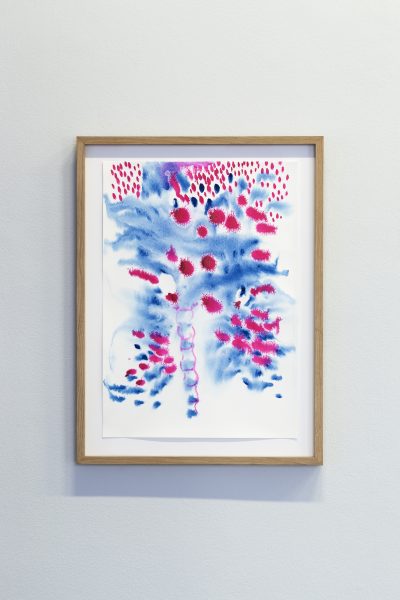
Dična Tamane
Breathing (from the series “The Sea Is You”)
2021–2023
Watercolours and ink on paper
Photo by
Andrus Kannel
Courtesy of the artist
Seas and oceans are powerful metaphors that have been depicted in poetry, literature and painting for centuries. Calm sea, stormy sea, fog rising from the sea, ships driven onto the rocks – seascapes are a traditional art genre in their own right, usually characterised by an emphasised aesthetic distance between humans and nature. In the current Anthropocene era, art seeks to assign more agency to the non-organic and non-human (be it animals, plants, rocks, bacteria or water), in order to understand the surrounding environment as more than a human world and to reduce the anthropocentric gap between nature and culture that dates back to the 17th century. More and more efforts are being made to think2 “with” the surrounding environment – as Dična Tamane and Kristina Õllek do in their solo exhibitions, with an approach to the marine theme that is much more nuanced and sensitive than a seascape depicting uncontrollable “wilderness” from a safe distance.
Dična Tamane’s exhibition “The Sea Is You” at Tallinn City Gallery and Kristina Õllek’s exhibition “Waters of Hypoxic Slime and Tropic Lime” at Kogo Gallery in Tartu deal with the sea in two very different ways. Both artists have a background in photography, but in these exhibitions they have moved quite far from the traditional photographic medium – Dična Tamane’s exhibition consists of watercolours, and Kristina Õllek’s installation-based exhibition focuses largely on combinations of organic and inorganic materials, including the cultivation of salt crystals and algal layers. Both artists have moved from behind the camera directly to the material and in one way or another have come to think with the sea – with water, waves, tides, cycles, rocks, bacteria and algae – and about how humans are involved in these complex aquatic systems.
Dična Tamane’s exhibition treats the sea as a metaphor – as something that, with its ebb and flow, exists as an inner sea in all of us and is both intuitive and meditative. The sea is present in Tamane’s watercolours in an abstract and emotional way: bright and serene colours that remind us of a warm summer day, grains of sand sticking to the body, the lulling rhythmic hiss of the waves, half-opened eyes, the heat emanating from the scorching sand, and the cooling sea breeze. While not the focal point, the sea has been a secondary character in several of Tamane’s previous works: in “You Can’t Have Me for Real” (2014–2018), the artist describes how a body of water is something familiar that she always looks for in an unfamiliar environment and which creates recognition and a sense of belonging. Also, most of her long-term photography project “Half-Love” (2008–2022) was shot at her father’s cottage in Kursīš, Latvia, a stone’s throw from the sandy beach of the Baltic Sea.
“The Sea Is You” relates to water both in substance and in form. Creating abstract watercolours is a bodily experience, of breathing and slowing down and imagining a possible better world. When creating watercolours, Tamane has focused on the relationship between water and breathing – she has connected the spreading of watery paint on paper with a brush to the waves of inhalation and exhalation.3 For Tamane, our inner circulation reflects the sea and vice versa – the sea reflects back to us who we are, our emotions and feelings, fears and joys. Considering that 60–90% of our bodies is water, the idea that we are bodies of water connected to other bodies of water seems quite reasonable and even comforting.
But if we move beyond the abstract level and look deeply at the reflection that lies behind the sea as a metaphor, we reach the material aspect of (sea) water. Breathing with the sea gets stuck because the sea is suffocating. With agricultural fertilisers reaching the seawater, increased pollution, rising sea temperature and slow water exchange, oxygen-poor areas, so-called dead zones, have appeared in the Baltic Sea, which are constantly increasing and threatening its ecosystem. Lack of oxygen, or hypoxia, is the topic that Kristina Õllek deals with in her exhibition “Waters of Hypoxic Slime and Tropic Lime”, where the installations bring together Baltic Sea water, limestone, sea salt, bioplastics and cyanobacteria. Behind the exhibition is years of research on marine ecology, the various aspects of which she has expounded through solo exhibitions in Estonia and abroad. Õllek approaches the sea from a geopolitical perspective of a “price tagging” economy that colonises and exploits the sea. Õllek also imagines the future, including the Silurian past and hypoxic present of our seawaters in her work, but this future is not bright; it is suffocated and blinded by massively growing cyanobacteria.
So how does the sea behind the metaphor – the sea at the molecular level – reflect on us? We could describe this reflection as “toxic sublimation” – a polluted seascape that mostly appears serene and sublime, and only in isolated cases or on close inspection reveals hidden toxins, pollution, garbage and mainly human-caused changes that threaten the marine ecology. Jennifer Peeples has defined the term “toxic sublime” as “the tensions that arise from recognizing the toxicity of a place, object or situation, while simultaneously appreciating its mystery, magnificence and ability to inspire awe”.4 Viewing Dična Tamane’s and Kristina Õllek’s exhibitions in dialogue gives the same effect: on the one hand, the sea as a mystical and magnificent metaphor that reflects our own states of mind, but on the other hand, much more is hidden in this mirror image – centuries of careless and extractivist attitudes towards the surrounding environment, whereby entire ecosystems have been sacrificed for the purpose of making a profit. We are all also that sea.
1 Astrida Neimanis, Bodies of Water. Posthuman Feminist Phenomenology. London, Oxford: Bloomsbury Publishing, 2017, p 1.
2 Thinking with creates an opportunity to reflect on complex and strongly intertwined human and more-than-human relationships, eliminating and blurring the boundaries between “us” and “them”. Or as Karen Barad has said: “We do not obtain knowledge by standing outside of the world; we know because we are of the world.” (Karen Barad, Meeting the Universe Halfway: Quantum Physics and the Entanglement of Matter and Meaning. Durham: Duke University Press, 2007, p 185.)
3 See: https://klassikaraadio.err.ee/1608916160/delta-29-martsil-piirideta-arhitektuur-liina-kalvik-di-na-tamane/1105bfb3b5a89122b190fc47162508d6.
4 Jennifer Peeples, Toxic Sublime: Imaging Contaminated Landscapes. – Environmental Communication: A Journal of Nature and Culture, December 2011, p 375.
Annika Toots is an art historian and curator.