8. IV–10. IX 2023
Kumu Art Museum, 3rd floor, B-wing
Co-organiser of the exhibition: Mystetskyi Arsenal
Curators: Olha Melnyk, Ihor Oksametnyi, Viktoriia Velychko
Elnara Taidre (ET): The exhibition “Futuromarennia. Ukraine and the Avant-Garde” (8. IV–10. IX 2023) at Kumu Art Museum develops the project “Futuromarennia” (15. X 2021–30. I 2022) from the Mystetskyi Arsenal. Can you please introduce the conception for your project, which is reflected already in the neologism of its title, “Futuromarennia”? What are the main differences between the displays in Kyiv and Tallinn?
Olha Melnyk (OM): Undoubtedly, the idea of futurism announced in 1909 by Filippo Tommaso Marinetti (1876–1944) was reflected and interpreted in Ukraine. We understand it as a passionate impulse to create new art which led to the creation of new art forms; for example, cubo-futurism in the 1910s or constructivism in the 1920s. Therefore, we do not limit our story exclusively to the circle of artists who formally identified themselves as futurists. In fact, we try to describe the artistic vision of the future in its Ukrainian version.
The project at the Mystetskyi Arsenal primarily focused on the research and educational components. It was a continuation of several of our previous projects on the historical heritage of the twentieth century. The first of them was “Boichukism. A Project of Great Style” (7. XII 2017–28. I 2018), then “Kurbas. New Worlds” (17. X–2. XII 2018), and finally the third in this series was on futurism.
The postcolonial option is of great importance. In this sense, Ukraine does not fit into the classic “orientalist” framework of Edward Said (1935–2003) because for several centuries Ukraine was an intellectual donor to Russian culture. A very revealing plot is the case of the Russian avant-garde, where there is no shortage of appropriate figures: Davyd Burliuk (1882–1967) or Oleksandra Ekster (1882–1949), for example. Their creative work was formed under the influence of the Ukrainian artistic tradition. Most of these artists lived outside Russia or the Union of Soviet Socialist Republics (USSR).
Despite this fact, they were still positioned as representatives of the Russian avant-garde until recently, when theoretical discussion about the national affiliation of the avant-garde gained renewed intensity with the beginning of the Russian aggression against Ukraine.
ET: How would you define the peculiarity of Ukrainian futurism? I could be mistaken, but I can see here a desire to create a new all-embracing aesthetic system.
Russian futurists, in comparison, come to mind in association with provocative actions. More serious ambitions come already with the individual artistic systems of Kazimir Malevich (1879–1935), Vladimir Tatlin (1885–1953), Pavel Filonov (1883–1941), and others – each of whom claimed supremacy, competing fiercely with the others.
Somehow it seems to me that there was less rivalry among Ukrainian avant-gardists, maybe because there were more common goals, like Ukrainisation?
Ihor Oksametnyi (IO): Regarding rivalry between Ukrainian avant-gardists, I have to disagree with you. Rivalry between Ukrainian artists, groups, and unions was fierce! Sometimes it went beyond any sense of correctness. By the way, this was one of the topics of the Kyiv exhibition (in the section “Discursus”).
Regarding common goals, Mykhail Semenko (1892–1937) and his associates tried to unite innovative artists into a single movement. We can say it was part of their programme.
Actually, the synthesis of various experimental practices was the main idea behind the slogan of futurism in Ukrainian art history. Futurism was interpreted not so much as a certain artistic direction but rather as a generalising theory of culture.
OM: I do not agree with the definition of Kazymyr Malevych and Volodymyr Tatlin as Russian avant-gardists. Considering their practices, which were directly related to their Ukrainian background, it is worth talking – at least – more about multiple identities. And this is the issue that is currently the focus of historical heritage research in Ukraine – how to identify artists who worked in the common imperial cultural space, both Russian and Soviet.
As for scandals and competition, there could be extensive reflections. Controversies about futurists have never been lacking, neither in the 1910s nor in the 1920s. It is well known that the energy of rebellion was inherent to their style, and a scandal or fight was a strong argument in favour of futurist theories. Let us take a look, for example, at the tours of futurists in the cities of the Russian Empire in 1913–1914 organised by Davyd Burliuk. The outrage was fully manifested in this action: Vladimir Mayakovsky’s (1893–1930) yellow blouse, painted faces, grand piano turned upside down, public outrage, scathing press reviews, and so forth.
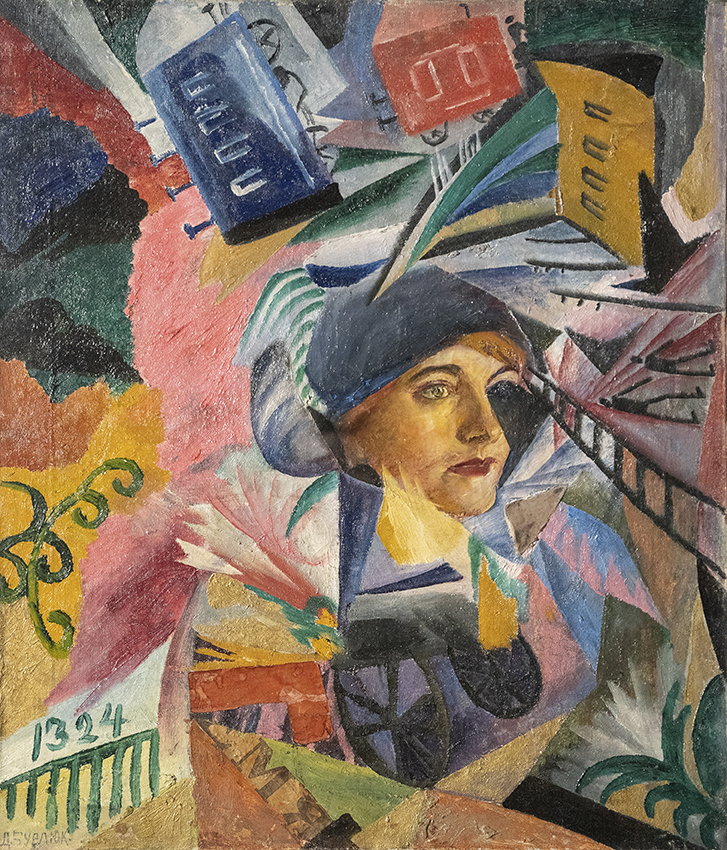
Davyd Burliuk
Time
1910s
Oil and collage on canvas
Dnipro State Art Museum
In the 1920s, there were also plenty of scandals but in a slightly different form. The Ukrainisation you mentioned earlier was the official policy of the communist party of Ukraine. This policy aimed specifically at neutralising Ukrainian liberation aspirations and strengthening the power of the Bolsheviks in Ukraine. It called for the use of the Ukrainian language in all social and political fields, as well as the involvement of Ukrainian personnel in state management.
However, it was a temporary liberalisation, particularly in culture. Its ultimate purpose was not the development of Ukrainian society or culture based on universal values, but the expansion of the ideological influence of the communist party and the final subjugation of the rebellious territory. The goal was quite imperial; it was somewhat of a trap for the generation of the 1920s. They implemented a completely futurist concept of “Destruction and Construction”. The tragedy was that they eventually became victims of the Bolshevik regime, which they had constructed themselves in so many ways.
It is clear that for a short time, the official policy of Ukrainisation created an opportunity for the free declaration of competing ideas and concepts. This phenomenon was most obviously manifested in the literary milieu. Numerous literary groups emerged at the time: Zveno [Link] and Hart [Tempering], VAPLITE [Free Academy of Proletarian Literature], VUSPP [All-Ukrainian Union of Proletarian Writers], Pluh [Plough], Molodniak [Youth], and so forth – I have not even mentioned all the famous names here.
It was quite a dynamic picture; these groups disappeared, and their members or supporters changed their preferences. But each of them had the ambition to assert their primacy in the creation of a new art which personified the Soviet system, the new individual, and the victory of the proletarian revolution. They strongly argued about the place of literature in these processes, its developmental path, and tasks. Sometimes this happened in public discourses, sometimes on the pages of periodicals edited by representatives of these groups.
Undoubtedly, Mykhail Semenko, as an ideologue of panfuturism, actively took part in these discussions. His associates, Heo Shkurupii (1903–1937), Oleksa Slisarenko (1891–1937), Volodymyr M. Yaroshenko (1898–1937), Anatol Petrytsky (1895–1964), and others, gathered around the Kyiv newspaper Bilshovyk [Bolshevik]. Semenko headed the literary department in this periodical. Several futurist groups replaced each other, or more accurately, their names were changed: Flamingo, Komkosmos [Communist Space], Aspanfut [Association of Panfuturists], Komunkult [Association of Workers of Communist Culture] and so forth. Komunkult disintegrated in the mid-1920s, but supporters of futurism united around the magazine Nova Generatsiia [New Generation], edited by Semenko from 1927.
The names of these futurist associations themselves leave no doubt about their ideological direction. Panfuturists, for example, opposed everyone: neoclassicists, symbolists, representatives of revolutionary romanticism. In their opinion, all of these directions were not sufficiently devoted to revolution and were too bourgeois. Semenko openly talks about his claims: futurism should be the only representative and exponent of the proletarian communist ideology. These discussions were purely theoretical and sometimes turned into a joke or hoaxes up to a certain point. Futurist poet, Oleksa Vlyzko (1908–1934), published scathing pamphlets against neoclassicists. Semenko, in turn, became the object of a hoax when Kost Burevii (1888–1934) invented the futurist poet Eduard Strikha, who sent ultra-left communist-futurist poems to the magazine Nova Generatsiia – Semenko believed that Edward Strikha was a real person and published these works, which were a parody of him, in his magazine.
The jokes came to an end when the discussion turned to politics. One of its main figures was Mykola Khvylovy (1893–1933), the head of the Free Academy of Proletarian Literature. In 1926, he published the pamphlet “Apolohety pysaryzmu” [The Apologists of Scribalism] where he protested against the “conducting baton of Moscow”. It was Khvylovy who raised the still popular slogan: “Get away from Moscow!” It was directed primarily against the radical leftist ideas of the Left Front association founded by Vladimir Mayakovsky and the Russian Association of Proletarian Writers.
However, the discussion went beyond the literary field. Joseph Stalin (1878–1953) himself turned to the leader of the Ukrainian Bolsheviks, Lazar Kahanovych (1893–1991), with a decisive condemnation of Mykola Khvylovy. The political label of “Khvylovism” appeared, and political harassment started. On 13. V 1933, Mykola Khvylovy shot himself in his apartment in the Kharkiv writers’ building, Slovo. He left a note in which he referred to everything that was happening as “the shooting of our generation”. It set off a mad vortex of repression against the figures of Ukrainian culture, which ended with its complete defeat.
I paid so much attention to the details of the literary life of the 1920s primarily because literature-centricity is the main feature of Ukrainian futurism. The most distinctly and consistently futurist forms appeared in synthetic artworks, which the Italians called “words at large” and the Ukrainians, poezomaliarstvo (poetry-painting). In this sense, the use of the Ukrainian language was of primary importance.
It is also worth admitting a certain “blurring” of Ukrainian futurism, which cannot be considered a complete aesthetic system or style. In particular, it is impossible to talk about its systematic and consistent manifestations in the fine arts as in Italy; for example, Marko Tereshchenko’s (1894–1982) theatrical experiments cannot be compared with the synthetic theatre of Gran Serata Futurista. At the same time, Les Kurbas (1887–1937), who did not formally identify himself as a futurist, created a new modern Ukrainian theatre – he succeeded in synthesising literary texts, music, scenography, acting and directing skills, and cinema. There were completely organic techniques in futurism.
The futurist idea in Ukrainian art played a provocative role and it incited experiments. Therefore, we should not talk about formal futurism, but about a futurist worldview.
ET: Coming back to the important figures in the field of the visual arts and their practices, I have a question about Oleksandr Bohomazov (1880–1930). He was one of the founders of the Museum Department of the Pedagogical Faculty of the Kyiv Art Institute. What kind of department was that? Were there also other institutions founded that manifested new artistic practices?
ІО: Oleksandr Bohomazov worked at the Museum Department of the Pedagogical Faculty, where future museum workers were trained. This department was founded in 1926 on his initiative. Bohomazov’s contribution to the development of Ukrainian art education was ultimately underestimated. He developed special programmes for this department, and taught drawing and painting there. The first graduation of 13 students took place in 1928.
OM: In 1922, Oleksandr Bohomazov was invited to the Kyiv Art Institute to give his courses there. He worked there until he died in 1930.
I could describe many developments regarding this institution. It was founded in December 1917 by the Ukrainian Central Council (the parliament that proclaimed the Ukrainian People’s Republic) as the Ukrainian State Academy of Arts. Its professors and teachers were the most outstanding Ukrainian artists, such as Fedir (1879–1947) and Vasil H. Krychevskys (1873–1952), Mykhailo Boichuk (1882–1937), Heorhii Narbut (1886–1920), Abram Manevych (1881–1942), and many others. In 1924, the Soviet government changed its “bourgeois” name and the academy was reorganised into the Kyiv Art Institute.
The next few years became a “golden era” for the institute, and its atmosphere was often compared to the famous Bauhaus art school. At that time, Kazymyr Malevych, Volodymyr Tatlin and Viktor Palmov (1888–1929) were lecturers there. The professors and students dealt with a wide range of “isms”: realism, impressionism, cubism, suprematism, expressionism, and so forth.
Professors were sent abroad to familiarise themselves with local practices to implement in Kyiv. They were chosen by way of a professional competition across the country. For example, Volodymyr Tatlin headed the cinema and photography faculty; Pavlo Holubiatnikov (1892–1942) was a teacher of spectral painting; after a trip to Japan, Viktor Palmov moved to Kyiv and remained here for the rest of his life; Kazymyr Malevych arrived here as an honorary professor in the late 1920s and founded his experimental research department at the institute.
There was constant freedom of creative searching at the art institute. Discussions took place about new art, and students could freely choose a course and a teacher. All artistic specialties were taught here: from monumental painting to theatre, photography and cinema.
In 1930, however, the institute conducted a purge of the teaching staff: the most progressive professors were dismissed, and its rector, Ivan Vrona (1887–1970), who was the activist and founder of these innovations at the institute, was replaced. A substantial reorganisation soon took place: it proclaimed the dominance of socialist realism as the only possible artistic method at the institute.
This institution still exists today in Kyiv under the name of the National Academy of Visual Arts and Architecture. However, its purpose is rather educational. The institute collects and stores artworks by graduates which were created during their studies. The academy suffered a lot during World War II, and therefore its collection is mainly from the post-war period.
ET: Do I understand correctly that the Ukrainian avant-garde is a relatively new topic of research? During the 1920s and 1930s it was overshadowed – and also appropriated to a great extent, both in a material and a conceptual way – by the Russian avant-garde, and during the Soviet period it was forbidden, so we can talk about research starting in earnest in the 1990s?
ІО: Not quite so. The “return of the avant-garde”, so to speak, began in the 1960s after Khrushchev’s Thaw. A huge layer of culture, erased for thirty years, sunk like Atlantis, began to re-appear on the surface of cultural life.
In the fifth volume of the series of books about the history of Ukrainian art (published 1966–1969 and edited by Mykola Bazhan, a former futurist, by the way), the authors Ivan Vrona and Borys Lobanovskyi wrote about artists who, it would seem, were forever erased from the history of Ukrainian art. The works of the “formalists” who were lucky enough to survive began to be retrieved from the special funds of museums because not only were the artists repressed, but also their works. Then serious research began to appear in the late 1970s and early 1980s. And this research continues.
OM: Yes, the new arrival of the avant-garde in the public sphere in Ukraine took place in the 1960s during Khrushchev’s Thaw. An avant-garde exhibition was held at the Writers’ Union of Ukraine in 1966 thanks to the efforts of art critic Dmytro Horbachov. Individual works used to be included in group exhibitions. Professor Horbachov, who in the 1960s and 1970s worked at the Museum of Fine Arts (now The National Art Museum of Ukraine), is credited with rediscovering the Ukrainian avant-garde. In 1971, he published a monograph dedicated to Anatol Petrytsky.
There was no issue about separating the Ukrainian avant-garde from the entire background of Soviet art at the time. And Petrytsky, of course, was not a banned artist but the mentioning of his avant-garde past was extremely important.
In 2020, a collection of Horbachov’s articles “Lytsari holodnoho Renesansu” [Knights of the Hungry Renaissance] was published. This book summarises his many years of research on the topic of Ukrainian modernism.
At the same time, in the 1970s, Western scholars became increasingly interested in the Ukrainian avant-garde. The term “impressionist Ukrainian avant-garde” was introduced by the Parisian art critic, Andréi Nakov, for the exhibition “Tatlin’s Dream” (London, 1973). The works of Vasyl Yermylov (1894–1968) and Oleksandr Bohomazov were introduced to the world community at that time.
These developments helped people to rediscover many of the world-famous masters connected with Kyiv, Kharkiv, Lviv and Odesa either by origin, education or national traditions. Take, for example, “the most loyal son of Ukraine” (as he called himself), Davyd Burliuk, Kazymyr Malevych, a Pole who thought he was Ukrainian, Volodymyr Tatlin, a professor of the Kyiv Art Institute and bandurist, Oleksandra Ekster, founder of the Ukrainian school of constructivist scenography, and finally, Oleksandr Arkhypenko (1887–1964) with his archaic art. Studies of Ukrainian art of the 20th century became a separate phenomenon.
I could name several fundamental studies that have become classics. The first comprehensive study of the Ukrainian avant-garde was by the Canadian professor Oleh S. Ilnytzkyj, titled “Ukrainian Futurism, 1914–1930: A Historical and Critical Study” (1998; his PhD at Harvard University was defended in 1983). And professor Myroslava M. Mudrak from the US wrote “The New Generation and Artistic Modernism in the Ukraine” (1986).
At the same time, research on the avant-garde was not popular among Ukrainian scholars. I could even say the reason for this was political support for socialist realism. It appeared as if the avant-garde artists never existed. Scholars, of course, knew about the avant-garde and could write their notes or studies, but only “into the drawer”. They would not be subjected to repressions for writing such materials, as had happened in the 1930s, but their dissertations would never be allowed to be defended and publications would not pass through the official censorship. Finally, only the political changes in the 1990s and a radical reassessment of artistic values brought back the names of Ukrainian artists who have long been recognised abroad.
There has been massive interest in the study of the avant-garde in Ukraine since the early 2000s. In addition, it was notable that the articles and books of the avant-gardists themselves were published as well. In 2020, for example, Dmytro Horbachov compiled the anthology “Ukrainskyi khudozhnii avangard: manifesty, publitsystyka, besidy, spohady, lysty” [Ukrainian Artistic Avant-Garde: Manifestos, Journalism, Conversations, Memories, Letters]. It contains the legacy of 34 representatives of the Ukrainian avant-garde, and it gives an idea of the diversity of views in Ukrainian art from 1910 to the 1930s. In 2016, the literary critic Yaryna Tsymbal started the project “Nashi 20-ti” [Our 20s], within which 15 books by Ukrainian writers have already been published. She is also the author of many internet projects.
Today, I can already admit there has been a comprehensive return to the heritage of the Ukrainian avant-garde. This is important for further interpretation both in terms of European artistic processes and postcolonial studies.
ET: Was the avant-garde tradition totally interrupted in the practices of art and visual culture during the Soviet time or did it still have some influence?
ІО: To some extent I have already answered this question: the reinterpretation of the legacy of avant-garde artists began in the 1960s. This is reflected in artistic phenomena from the years between 1960 and 1980 when people talked about Ukrainian “nonconformism”, “unofficial art” or the “underground”.
OM: Currently there are some artworks from the collection of the National Art Museum of Ukraine on display here in Kumu. In the Soviet period, they were preserved in the so-called special repository. It was a common Soviet practice. Special repositories included works that had to be hidden from the public eye. In the National Art Museum of Ukraine, a special secret repository was formed from 1937–1939. The works of “enemies of the people”, “formalists”, “nationalists” and all of those who, according to communist ideology, “distorted reality” and were a threat to the “new society” were collected in this repository. In that way most of the artists’ names were erased from the history of Ukrainian art for decades.
Works by Oleksandra Ekster, Oleksandr Bohomazov, Davyd Burliuk, Viktor Palmov and many others were hidden in this special repository. Colleagues started to return to these works in the late 1980s and this process marked the return of the forbidden history of Ukrainian art. According to scholars, these masterpieces owe their physical salvation to the World War II, which relegated the fight against “enemy art” into the background. This is quite an eloquent illustration of your question about the rediscovery of the avant-garde. As I would say: hidden, but not destroyed.
ET: What sources would be most relevant for those who would like to learn more about Ukrainian avant-garde? A book titled “In the Eye of the Storm: Modernism in Ukraine, 1900–1930s” (2023) by Konstantin Akinsha was just recently published, but it’s about modernism in general, not about the avant-garde as the most radical art movement.
OM: The edition you mentioned was prepared as part of the exhibition project at the Thyssen-Bornemisza National Museum in Madrid. It offered nearly 80 works from the collections of the National Art Museum of Ukraine and the Museum of Theatre, Music and Cinema of Ukraine. The book also contains, by the way, reproductions of works from the collection of the Mystetskyi Arsenal exhibited in Tallinn. In addition to the catalogue, the edition offers research by Ukrainian specialists. Regarding the concept of the project – modernism or the avant-garde – this is a case of curatorial preference.
Similarly, in the case of our project, the greatest difficulty lies in finding a method of interpretation. Notably, the content has to be relevant to the experience of the audience we are addressing. I think that for Spain, where knowledge about Ukrainian culture is not huge, this is quite a successful move – to act primarily through aesthetic impressions. This was the reason why the curators implemented a broader framework marked by modernism. A conversation to begin with, figuratively speaking. Unfortunately, this dialogue with the foreign audience is taking place with considerable delay.
I have to note the fact of the catastrophic lack of editions in European languages. We have many brilliant, sometimes fascinating studies in Ukraine, but these are aimed, with rare exceptions, at internal audiences.
In addition to the already mentioned studies by Oleh Ilnytzkyj and Myroslava Mudrak, which were intended for a professional audience, I would like to recommend Alisa Lozhkina’s book “Permanent Revolution: Art in Ukraine, the 20th to the Early 21st Century” (2019). It is a fascinating popular exposition of the history of Ukrainian art with the author’s specific point of view.
Regarding the topic of our conversation, I would like to mention the anthology “Kazimir Malevich. Kyiv Aspect” (2019). The importance of online resources, of course, is growing nowadays. Catalogues from some Ukrainian museums could be available, for example on the ISSUU or Google Arts & Culture platforms. I would also like to mention, of course, the bilingual electronic versions of the Mystetskyi Arsenal catalogues.
ІО: First of all, I would recommend two foundational monographs published in English. There is Myroslava M. Mudrak’s book “New Generation and Artistic Modernism in Ukraine” (1986) and “Ukrainian Futurism 1914–1930: A Historical and Critical Study” (1998) by Oleh S. Ilnytzkyj. By the way, articles by these respected researchers will also be published in the “Futuromarennia” catalogue (forthcoming) that we have almost finished.
Elnara Taidre is an art historian, critic and curator. She works as head of the graphic art collection at the Art Museum of Estonia.