30. X 2021–12. XII 2021
Contemporary Art Museum of Estonia (EKKM)
Curator: Eero Epner
Liturgy
The etymology of the word religion is the Latin religatio, referring to how people gather themselves. Later on, the meaning of religion evolved into the adoration of god. In “Return to Innocence”, however, it is rather unclear what divine creature that can be; the show is a labyrinth without a minotaur, a liturgic assemblage made of deformed deities.
This exhibition is more like Dante’s “Divine Comedy” (1308–1321), with each of the floors representing “Inferno” (dark and hot), “Purgatorio” (banal and full of quotidian hazards) and “Paradiso” (cheesy, over-done simulacra) respectively. The allegory of the Tuscan poet tells the journey of our soul on its way towards God, full of punishment, rewards and the recognition of sins.
I come to see the exhibition a second time and notice details I did not observe before, such as the hanging angel in the dark room on the top floor. Then I follow two foreign students (art historians?) and hear what they comment on the show.
For instance, they note the “funny” juxtaposition of organic materials, furs, art objects, religious symbols and banal furniture. “Ugly stuff carefully placed as if accidentally making sense.” I follow them downstairs as they still stroll a bit, talking of the exhibition as “an allegory of disasters” creating a pathos of sanctity and sacrifice.
At the unexpected sound of my own name, “Francisco”, I turn believing that my stalking activity has been discovered… but no, they complete the sentence adding “…de Goya”. In their view, Edith Karlson had to be inspired by Francisco de Goya’s aesthetics of despair, specially by his “Black Paintings” (“The Dog”, “Saturn Devouring His Son”, “Fight with Cudgels”, “Witches’ Sabbath”, 1819–1823) and the series “The Disasters of War” (1810–1820), with humans hopelessly acting like beasts, as if there’s nothing to be done (“Y no hay remedio”).
My accidental tour guides also talk of Kader Attia’s representation of injured individuals. Through different mediums, Attia tries to symbolically repair mutilated faces of World War I soldiers, juxtaposing them with similarly deformed figures in antique sculptures.
The two young ladies go away and I then sit on the third floor (Paradiso) to write down what I heard. Listening to a never-ending song by Enya, I fathom that this exhibition is at the edge of making you laugh or making you cry.
Edith Karlson knows it.
Persona
I meet my date at the Contemporary Art Museum of Estonia (EKKM). “Return to innocence?” she ventures.
“Children learn by playing and adults play by doing art. I gather that art helps us to preserve the capacity to surprise and be surprised – something that we lose as we grow old; that’s why a periodic return to innocence is required,” I reply.
As narrated by Witold Gombrowicz in his masterpiece “Ferdydurke” (1937), to grow old means to unlearn what you discovered during your childhood – to build up social masks, to reproduce adult rituals, to follow traditions, to become alienated, to be patronised. Thus, we only progress in inexperience.
In the view of my date, however, the exhibition is an elegy about how the world is becoming more and more untouchable and ghostly. She goes on to say that the digital order has suspended many of the rituals that gave stability to life.
Mm-hmm… I talk then of Ingmar Bergman’s “Persona” (1966) and the masks that serve to conceal our personality and keep the world at a distance; then of Fernando Pessoa’s heteronyms, and finally of Claude Lévi-Strauss, who suggested approaching rituals as machines for the suppression of linear time – introducing transcendental experiences into the otherwise repetitive nature of cyclical time.
My uncommitted accomplice tells me though not to be that intellectual (a mask like any other). “Instead, let’s talk about what we want to do –and not do– with the rest of our lives.” So, we go inside, back to the second floor of the exhibition, into the chamber that looks like a hotel room in Narva. Under the blanket there is something moving, which makes visitors believe that the whole floor is trembling.
This exhibition is good for going on a date. Edith Karlson knows it.
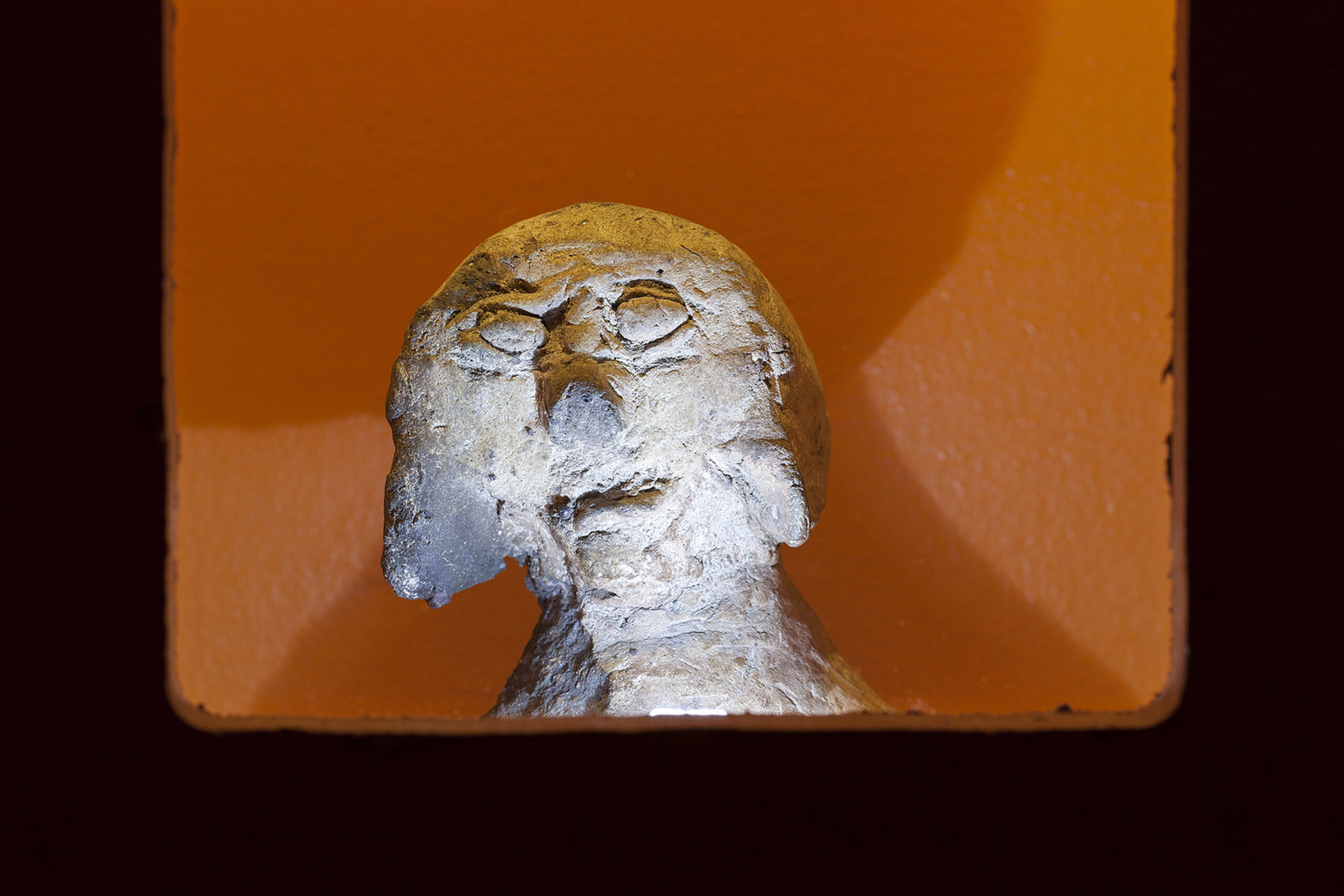
Detail view of an installation in EKKM
Photo by Paul Kuimet
Phantasmagoria
I meet a colleague while visiting the show for a third time. A married redhead designer, to be more precise. She’s trying to clean the floor that she made dirty with her boots, as it was a bit rainy outside. I tell her not to worry, that the dirt, here and there, is also part of the show. She asks what I think about the exhibition and I reply that it reminds me of prehistoric cave art, evoking something that you would like to hunt.
“But there is something more ambivalent here, an estrangement…,” she notes while putting her knee into the darkness. A sense of déjà vu is then triggered. I look to the right and to the left, afraid that a costume party might begin any time, once Chris Isaak starts singing “Baby Did a Bad Bad Thing” (1995). Three, two, one… then a space of secrecy opens up, a cabbalistic ceremony.
In 1926, Arthur Schnitzler published the book “Traumnovelle” (Dream Story) – which Stanley Kubrick made into his film “Eyes Wide Shut” in 1999. Schnitzler tells the story of Fridolin, a doctor in Vienna, who becomes tormented when he discovers that his wife has a perverse, masked life of desire and infidelity, thus realising that his notions of order and security were an illusion, if not a lie. (In Kubrick’s film, the actor Tom Cruise is a Manhattan physician and Nicole Kidman the wife inviting a fatalistic dream-trip into a world of misogynistic decadence.)
In a similar way, the terracotta sculptures, candles placed on brick columns, wooden Christ and alabaster virgin, and white fallen leaves on display create a performative, almost carnivalesque type of world-building. Animal representations also play an important role in constructing a dream-like atmosphere full of disguise (only a unicorn was missing), while inviting us to disclose our repressed fantasies.
“Return to Innocence” is a make-believe play. We are insecure about where to step, where to look, what’s real and what is represented, like in a phantasmagoria. Here and there, the visitor feels as if on a stage, like performing in a subtle total exhibition. I got the same impression from the exhibition “Silent” (2020), the one done by Jevgeni Zolotko and Eero Epner in Tartu Art Museum about traces of silence in memory objects.
Eyes wide open. We live in a turbulent sea of dreams with brief forays into reality. Edith Karlson knows it. Eero Epner too.
Francisco Martínez is an anthropologist who studies material culture through ethnographic experiments. He has also curated exhibitions and published two monographs: “Remains of the Soviet Past in Estonia” (2018) and “Ethnographic Experiments with Artists, Designers and Boundary Objects” (2021).