12. XI 2021–9. X 2022
Kumu Art Museum, 5th floor, Gallery of Contemporary Art
Artists: Kaisa Eiche, The Elfriede Jelinek School of English Language, Dénes Farkas, Minna Hint, Villu Jaanisoo, Sandra Jõgeva, Johnson and Johnson, Edith Karlson, Flo Kasearu, Jass Kaselaan, Alice Kask, Kiwa, Karel Koplimets, Neeme Külm, Marco Laimre, Andres Lõo, Marko Mäetamm, Herkki-Erich Merila, Marge Monko, Eléonore de Montesquiou, Tanja Muravskaja, The Female Artists’ Sing’n’Play Society Sheer Joy, Kristina Norman, Kaido Ole, Taavi Piibemann, Mark Raidpere, Tõnis Saadoja, Jaanus Samma, Ene-Liis Semper, Arbo Tammiksaar, Toomas Thetloff, Jaan Toomik, Anna-Stina Treumund, Sigrid Viir, Jevgeni Zolotko
Curators: Eha Komissarov, Triin Tulgiste
Elnara Taidre in conversation with Eha Komissarov and Triin Tulgiste about an exhibition they have curated, “Art in the Comfort Zone? The 2000s in Estonian Art”.*
Elnara Taidre (ET): How was the idea for the exhibition born? In the case of art phenomena from recent history, the question always arises: has there been sufficient distance, is it already archived history? Are the noughties distant enough for us to be able to talk about them from a historical perspective? Or has this project also been guided by the need to review all the recent additions to the contemporary art collection at the Art Museum of Estonia (EKM)? How many of the exhibits come from the EKM’s collections?
Eha Komissarov (EK): Considering that for decades – since Estonia regained its independence – the Art Museum of Estonia has acquired works of art on a quarterly basis using the funds allocated by the Cultural Endowment of Estonia, there is naturally a need to review our collections from time to time. These works, of course, are featured in very different exhibitions and in very ambitious curatorial projects, but the museum as the owner of the collection also needs its own objective image.
Now Estonian art critics have raised the question: why the noughties – such a boring format for a show? But in a situation in which the development of the art of today is so entropic, where there is no longer any concept of artist or medium, and where everyone perpetually crosses boundaries, this concept, that of the decade, implies a certain objectivity. The museum needs this objectivity. And this is a global trend – if you want an overview of contemporary art, you must pick a decade.
Triin Tulgiste (TT): When it comes to the noughties, I think we have the distance necessary for us to draw initial conclusions. For example, several other museums have shown interest in the developments of the decade, such as the “Nought Mood. Estonian Fashion Avant-Garde 2000–2010” in the Estonian Museum of Applied Art and Design (23. X 2021–27. II 2022, curator Anne Vetik), and the exhibition of digital culture called “Why Estonia? 30 Years from the USSR to e-Estonia” in Vabamu (19. XI 2021–23. X 2022, curator Henrik”¯Roonemaa, concept by Karen”¯Jagodin).
When we talk about the re-evaluation of the collection, it becomes very clear what kind of impact the exhibition programme has on the museum’s collection policy. It is thanks to this exhibition that we have added a number of works from the noughties to the museum’s collection. For example, pieces like “Produce or Die” (2007) by the Elfriede Jelinek School of English Language art group and the documentation of Sandra Jõgeva’s performance “Guestbook of the Heart” (2005/2021).
In quantitative terms, however, only a third of the works in the exhibition originate from the collections of the EKM; another third is loaned from the Tartu Art Museum, and the rest are from the collections of artists or private owners. So the exhibition is an overview of the collection but, on the other hand, also poses the question of what else could be included in this overall picture.
EK: When an institution takes on such a big task, it also takes a big risk, because it is immediately open to criticism. The title of our exhibition has already received strong criticism. And “the noughties” is a very difficult theme to brand. There are just a few specific keywords: the so-called Bronze Soldier and Bronze Night events – the 2007 riots in Tallinn when the Russian-speaking population protested against the removal of a Soviet war monument – and the economic crisis of the late 2000s. And that’s about it.
Inevitably, therefore, the museum had to make an intervention based purely on today’s situation. The title of this exhibition was born last year, when the museum was taking stock of the situation created by the pandemic: exhibitions had been cancelled, audience numbers were decreasing, and all this was resulting in a revenue problem. Against this backdrop, the impression one has of the noughties is of an exceptionally safe period, and then interesting new concepts such as that of the “comfort zone” came into play. So we use the phrase “art in the comfort zone” for this era. Which, of course, creates a lot of tension, because not everyone can agree on the definition of comfort.
One of the problems, for example, is that a very distinct community of freelancers emerged in the noughties who devoted themselves to fighting for artists’ rights. However, their social activism is almost impossible to present and address in exhibitions.
I would encourage these activists to get the artists together and formulate an art project about their struggles, because then they would be in the picture and we could highlight them in an exhibition. Right now, the situation is such that nothing reflects them and they don’t fit into any format. It is really a fairly anonymous activity, but I agree that it was a very strong phenomenon in the noughties. Triin and I have tried to reflect this as much as we can, to highlight what the activists are doing.
TT: One of the defining factors of this exhibition was that we were operating in a “grey area” as curators, between two formats: this exhibition will be open to the public for almost a year – not a very usual length for a temporary exhibition – yet it does not classify as a permanent exhibition either. On the one hand, we had to choose stable pieces that could withstand the time on display. On the other hand, given the task of presenting and reviewing the EKM’s collections, it was important for us to find a balance in the choice of works – if we had concentrated on, for example, documentations of happenings and performances, there would have been a lot less space for other things. After all, the volume of exhibits was limited by the need to summarise a whole decade.
At the same time, I should point out that, for the first time in Kumu’s history, there will be a continuous narrative in displays, where we will get an overview of the history of Estonian art from the beginning of the 18th century to almost the present day.
ET: I did have a moment of recognition in terms of the exhibition title; it is pretty identical with my own perception of the noughties. The nineties were such an angry, awkward time, one of adjusting and learning in a newly independent Estonia. The contemporary art of the noughties, on the other hand, has already reached a plateau, is already functioning at a good level and no longer needs to prove itself. It is a kind of normalised situation.
EK: These keywords are well illustrated by one Finnish project, “Fly, Fly, Fly!”. If you didn’t live up in the air on flights between Berlin and London, you simply didn’t exist. You just weren’t participating in art. You needed to visit exhibitions abroad, look at them and learn through that. And now, suddenly, the lockdown has brought us down to earth.
This freedom to travel was a great convenience, of course. What we miss from that earlier era is precisely that physical freedom.
ET: What are the main thematic sections of the exhibition? Looking at it, I was left with the impression that it is such a pleasant display, centred around each work – a kind of polyphony where each piece is individually displayed. Rather than attempting to subordinate works to a larger theme, it creates smaller, beautiful dialogues between works.
EK: Personally, I was very interested in the discourse created by these works, each one of them. Simply giving the pieces an opportunity to speak, without labelling them with artificially created titles.
TT: One of the partners in dialogue at this exhibition has been the collection of articles published in 2019 by the Estonian Centre for Contemporary Art titled “Normal Noughts. Perspectives on Estonian Art of the 2000s”, which is first of all a sociological study of art. And since we already have a summary of the art of that decade, one focused on the art life and not on the art works, we thought that by adding the art works it could form a kind of complete package. Now people are definitely going to turn to that book more, they are going to read it, and the exhibition will be a kind of a catalogue of images that complements the book.
When creating the exhibition, it was important for us to create dialogues both at the level of the works and at the level of the authors more broadly, and, among other things, the dialogue between the so-called 1990s generation that shaped the look of the decade and the young people who came to art in the noughties. When systematising the material, we have avoided the logic of strict thematic galleries, but we hope that certain themes relevant to the art of the decade can still be identified with sufficient clarity: globalisation, interest in public space, different viewing strategies, interventionist social art, ideas about integration and nationalism, different forms of feminism and developments in body art.
EK: In my opinion, the works selected for the exhibition do not let us down. They do a very good job of explaining the decade. It is immediately apparent that the artists of the noughties created and acted very much in the context of their time, in strong dialogue with reality, and with events, problems and sore points. There is a very strong investigative discourse.
ET: New discourses and themes are at the forefront of this exhibition, and so too are new media, rather than more traditional ones such as painting, graphic art or drawing. Did the display of these works often require special solutions – larger-scale conservation, restoration of the original display (installation)? To me, the art of the period at times seems rather ephemeral, and showing it often requires extensive reconstruction.
EK: Restoration is a very expensive luxury, so we could only afford it in moderation. We chose certain works that we really wanted to see and we restored them.
TT: We had two major reconstruction projects for this exhibition. The first one was Jevgeni Zolotko’s installation “Gray Signal”, which was first exhibited at the eponymous solo exhibition at Vaal Gallery in 2010. Only the videos had survived, so the material part of the installation was completely recreated from scratch. Another large-scale reconstruction was “Vilde Road Case” by Karel Koplimets, which was first exhibited in the eponymous solo exhibition at Draakon Gallery in 2010, and from which only the paper material – various cut-outs, photographs – had been preserved. In addition, Edith Karlson’s sculpture “Peeing Woman” (2007/2021) and Marco Laimre’s installation “Portable Corner of Hate” (2005/2021) were created from scratch.
We haven’t strictly adhered to the principle that if there is no material preserved from the period in which it was created then a particular work is declined. On the contrary, we have been quite liberal and new versions of the pieces are acceptable. For instance, many artists have transferred photography series created in the noughties to Diasec technology. This is a method of face-mounting prints on acrylic sheet and it was not really done in the 2000s.
The noughties were a decade of conceptualism in Estonia. And although materiality is very prominent in certain artists’ work that doesn’t mean that lost pieces cannot be recreated.
ET: After all, back then, works were created from whatever was at hand, which doesn’t mean that they couldn’t be improved upon under current conditions.
EK: I think the fact that we had some works remade was a great way to highlight the opposition that existed in Estonian-Russian integration in the noughties. Kristina Norman’s “golden soldier” in the installation “After-War” (2009) is not the only relevant example. We can see the artists’ interest in working in a “space of hatred”, one that was intolerant and hostile, and where all kinds of combative ideas of resistance were starting to emerge. Laimre’s “Portable Corner of Hate” is a very good example here.
ET: How do we remember the noughties more broadly; and what is the relationship of this decade to the art of its time?
EK: Memories of the period are definitely linked to political events at the time and to very specific economic events. The first half of the noughties was connected to an unprecedented economic boom and I would like to think that this also had its influence on artists. For example, it was very difficult to go and study in the West, but people did – so it was possible. Alongside economic success, the emergence of active feminism characterised the decade.
TT: One phenomenon associated with the noughties more broadly is the success story of digital development. This is not so much the case in our exhibition, however, because the first projects created by Timo Toots and others at the time, which dealt with the transformation of media and the mapping of the whole digital world in art, no longer work today, or it would no longer make sense to restore them. Besides, they were not designed to work for eleven months in a row, and without any additional technical support.
Technology, by its very nature, becomes obsolete very quickly, and art that uses it faces the same risks. So a specific part of the art that dealt with what were then very topical issues is not reflected in our exhibition.
EK: The artists who worked with those primitive digital mediums back then have by now gone so far in their projects that it would embarrass them to show what amounts to their so-called childhood drawings.
ET: To what extent are the issues and media that were topical in the noughties relevant to us today? Has anything become outdated? And vice versa, was anything then ahead of its time?
TT: One of the things that should be noted about the noughties is socially critical art, which was such an important term during that era. It does not work in the same form today, although I am not saying it is outdated.
EK: Many struggles have already moved on to the institutional and even the ministerial level, such as the issue of social guarantees for artists, something that started in the noughties.
Marge Monko’s piece “I Don’t Eat Flowers” (2009/2011) was an absolutely phenomenal event! It declared that the Artists’ Association of the Estonian SSR during the Soviet era, which functioned like an aristocratic club and whose members enjoyed all sorts of privileges, must be forgotten; that today’s artist is essentially a beggar living below the absolute poverty threshold, as the minimum wage in Estonia is higher than the annual income of an average artist; and that artists must now fight for their social rights – fight the state, fight the institutions!
This is a situation where, on the one hand, the artist starts to fight for their personal rights, and, on the other hand, very strong institutional criticism emerges in Estonia: it is the exploiters of artists, i.e. museums and other institutions, who are to blame. As a result, this struggle has now reached the point where museums have started to pay artists to perform. Of course, museums, which do not receive extra money from the state, cannot be expected to solve the problems of national health insurance for artists. Yet the museums have always supported artists’ struggles in the ministry.
The fact that the artist is a beggar who essentially pays the state for art – for the opportunity to make art – was articulated very clearly in Estonia in the noughties by female artists in particular. After that, all kinds of social activist groups started to emerge, and such groups today are quite rightly demanding recognition and that their work is in the general picture.
And then came institutional criticism – artists against museums. This is another trend that is very well documented in Estonia. So I think our exhibition is a very nice insight into what was going on at that time – we don’t cover anything up, we don’t hide anything, all the tensions are exposed and highlighted.
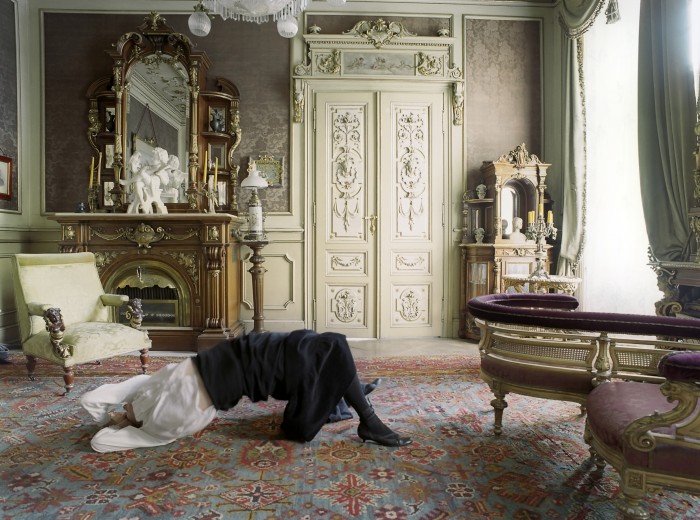
Marge Monko
Tableaux II. From the series “Studies of the
Bourgeoisie”
2006
C-print, 75 x 99 cm
Art Museum of Estonia
TT: After all, the noughties were more of a preparatory stage for today’s art scene than the nineties were. The activities of the photography department of the Estonian Academy of Arts (EKA) and the consequent explosion of photography and installation art – it is the decade of the noughties when all this became the norm. We see no fundamental difference between then and what’s happening today. Yes, themes and focuses change, but the central position of installation and photography in particular was actually already established in the noughties.
EK: Conceptual investigative photographic art – this was the dominant trend under Marco Laimre at the Department of Photography of the EKA. This allowed artists to take up a kind of exploratory position.
TT: Exactly. And it is the impact of documentary film-making that is so important in this decade. For some, the effect has been to start making their own films, like Jaan Toomik. Others use it more as part of their research – films based on archive footage, etc. This is another keyword that has become part of the norm.
ET: Speaking of norms, can you say how far the art of today has come from the noughties?
TT: It is perhaps more centred around form and material. In my opinion, politics, which used to be an important keyword, is more in the background now. There are very few disruptive happenings, very few artworks that raise uncomfortable issues. I think the scene was a lot more varied in the noughties. Those who were at risk of being overshadowed back then would today be completely marginalised. Now, the mainstream dominates.
EK: All these fighting attitudes – in the form of an active, aggressive artist who says, “The hell with it, the Estonian government does not take care of this and this and that!” – formed during that comfort zone period, when there was an economic boom and scarce funding for the arts could be talked about publicly because the state could no longer say, “Oh, I am so poor!” But of course, this was exactly what the state did. Presented their old rhetoric. And missed out on all the advantages it had to normalise our art life.
ET: As an observer, I am reminded of the social art of the noughties: the themes were important, but the tools or methods were borrowed from sociology or other disciplines, and the results were, unfortunately, often neither academically nor artistically convincing. Today, I think it is a positive development that if you want to change something in society, you do it directly – through activism, through intervention. At the same time, more use is made of art’s own tools and imagery, a different way of looking at themes.
EK: After all, not everyone is born to be a fighter, so perhaps there needs to be some professionalization. Artists should be left in peace with their creative discourse – fighting and activism have their own heroes, and that is a completely different subject.
TT: It seems to me that the discourse of critical art has nowadays moved primarily to focus on environmental issues, to the anthropocene and climate change. We can see that there is a very strong critique, more direct engagement with the subject matter – albeit through poetic imagery, as in Kristina Õllek’s work. But the critical arrow has shifted its focus to the environment, rather than to social inequalities and other topical issues that were dealt with in the noughties.
ET: Again, in order to understand Õllek’s environmentally critical works, we need to understand the image, which involves much more subtle and sensitive work with emotions and with visual awareness than does a quasi-sociological work, for example. This does not mean, of course, that Õllek did not do thorough research. But what is the role of Estonian art of the noughties in the Baltic and in the wider international context? Is there anything here that we could talk about on a global scale?
EK: You could say that its role is smaller than it was in the nineties, when our fantastic video artists attracted a lot of international attention. This is the tragedy of local activism: when art focuses on doing its own thing, the larger focus that matters to the rest of the world is lost. For the Baltics, the larger focus was not particularly important, and I’m very much afraid that only a few individual pieces here will have wider appeal.
TT: We asked our colleague Marika Agu from the Estonian Centre for Contemporary Art which works travelled abroad from Estonia most frequently in the noughties. “Loser” (1997) by Kai Kaljo, “Father and Son” (1998) by Jaan Toomik and “FF/REW” (1998) by Ene-Liis Semper – all video works and produced in the nineties. The profile of Estonian art abroad was not really raised at all during the noughties, and what stood out instead was the art from the nineties.
EK: … with grand poetic visions of land, man, swamp and nature. The art in the noughties took a direction towards activism, which was very local and not necessarily interesting for everybody.
ET: Could you choose a work that you think is particularly evocative from the perspective of the noughties?
EK: I would choose Kiwa’s installation “Black Square Fade Out” (2008). In 2015, the entire progressive art world celebrated the anniversary of Kazimir Malevich’s painting “Black Square” (1915), with very prestigious art shows and expensive exhibitions. The criticism at the time was that all this was not showing Malevich’s work, but rather its commercialisation. There were discussions on topics such as the worth of Malevich’s works, the number of “Black Square” paintings out there, their ownership and so on.
The noughties were very important for Tartu as an art city, and Kiwa, who collaborated with the “Tartu semioticians”, has illustrated this situation – the transformations of the black square – in a really fascinating way. He used a very good printer to print the image of a black square, and as he kept printing, the ink slowly wore off. The image became blurrier and blurrier, more and more invisible, and finally there was a white square on a white background with the black square completely disappeared. The devaluation of the “Black Square” as the most cryptic image takes place in front of the viewers’ eyes: they see how the square fades, simply collapses in time and space.
I always show this work with immense pleasure because it is one of the few cases where the activism of Estonian art engages with global art issues and goes further than just asking how much someone earns in the Estonian art market, who is supported and who is bullied. Kiwa’s work really is such a generous gesture – just look at what’s going on out there in the world, how they are flaunting the “Black Square”!
TT: I would highlight the “Project for Paldiski” (2006–2013) by the Johnson & Johnson group (Taavi Talve and Indrek Köster). They offered the residents of Paldiski, the home town of sculptor Amandus Adamson, the chance to choose which of his sculptures they would like to have in a public space. Adamson was one of the first Estonian professional artists. Paldiski was a closed military town during the Soviet era, and after Estonia regained its independence, it was a port town – a place with a very specific urban space, dominated by the harbour and the image of “money flowing through”. At the same time, the population was alienated from politics, there was a feeling of hopelessness. A feeling that their voice meant nothing.
The project gave these people the feeling that if everyone is involved in a decision-making process then there will be a tangible result. There was a big election, and finally, the statue (Adamson’s “Last Breath of the Ship” (1899), an enlarged copy by Mare Mikof and René Reinumäe – Ed.) was erected. The whole programme and the community life that emerged around it was impressive.
EK: Yes, civilised community life. It’s not that people are just shouting, it’s that they are thinking about how to spend the evening: children’s activities, ladies baking – a real idyll, like in an English film! The community is active, it’s busy, it’s friendly and everyone wants to like one another. Then there is a debate where city officials are also invited to join. They talk and, as usual, claim that there is no money.
“Project for Paldiski” very nicely documents a conflict of interest between the community and the authorities elected by that same community. And the way the Russian community there in Paldiski are really fired up, the way that this idea of erecting a statue grabs hold of them – a kind of communicative, social idea. People are thinking all the time, coming up with solutions. They are unable to agree which statue to erect, many arguments are happening at the same time – it is very interesting to observe this process.
TT: On the one hand, the work is interventionist, it tries to somehow emancipate these people – to give them agency or the ability to act in matters concerning their lives. At the same time, humour is important here. This is not some kind of deadly serious documentary that moves you to tears. A model of the statue made in China is also in play. This whole issue with public space – the “Project for Paldiski” interweaves so many topics that are significant for the decade and at the same time it gives a good portrait of a community that no one ever bothers to engage with or look at.
While Norman’s installation “After-War” deals a lot with the criticism that, after the April riots of 2007, the local Russian community’s “face” became that of an unreliable hooligan, what I found most interesting in “Project for Paldiski” is when people started to explain what kind of artwork they wanted in the urban space. There are some genuine moments of art analysis! People open up as individuals as they explain which statue could represent their city. And, for the first time, they may need to think about their identity. This is an excellent portrait of these people, this time and place – the artists have captured something very well here.
EK: “Project for Paldiski” is very much about social problems – how badly things have been handled before and how they should actually be addressed. I would make this film compulsory for all public institutions involved in integration, schools and other places where courses are held, where the same stories have been told time and again. But it is all relative – just give people a chance!
ET: It is a really good example of social art that still works today and is very empathetic.
EK: These people were also genuinely touched by the subject of the shipwreck, which Adamson had dealt with so powerfully.
TT: That’s right. Because Johnson and Johnson were able to build their work around a poetic image. And, of course, a lot of it had to do with the personalities of the artists – the way they were able to speak to people and reach out to them was an aspect of their strength as artists. I think this is a unique case that needs special attention. “Project for Paldiski” highlights so many important artistic trends from the decade – documentary film, social criticism, the theme of monuments, and the idea of engaging with communities of different nationalities and providing them with common goals in order to tackle the problem of social polarisation.
* A short version was previously published in English: Elnara Taidre, What were the Estonian noughties like? – Artterritory.com 17. XII 2021.
Elnara Taidre is an art historian, critic and curator. She works as head of the graphic art collection at the Art Museum of Estonia.