For the purposes of this article, I would like to focus on Arrak’s art – or, more precisely, on his approach to the figure: namely, the artist’s elaboration of the “sign person” or the typically Arrakian “maiv”, which can be seen to have undergone a fascinating journey from the perspective of art history – maturing as a formal entity and then achieving social weight. The text here is both an attempt to illustrate the maturation of this language of form and to mark the horizon of the imagery of a mature “maiv”. In other words, I want to show that Arrak hasn’t spent the last half-century playing the same artistic record or piling up stones one on top of the other but honestly remixes his own beats and builds his own cathedral alongside it.
The limits to abstraction
During his studies, Arrak was a member of the legendary group ANK ’64. The group’s activities were undoubtedly chrestomathic for the local art scene – recreating modernist impulses, from games with form to abstraction, playing with pop elements, enthusing over what surrealism had to offer and boldly mocking the social absurd. At the time, it was primarily an association of young people, intelligent and sensitive to the cultural environment, fostering interaction, mutual education, sharing and unity.
It was in this environment, as one of the core members, that Arrak developed and grew as an artist. It’s not hard, in his work at the time, to see the powerful strokes of all the artistic styles listed above. Of course, as an evolving and experimental young artist, all Arrak could do was try to express all these impulses in his own style. Having your own style is still a question of honour.
Considering that abstraction was a popular movement, and that bathing in it provided a great opportunity for budding artists to express their personal stylistic urges, this is also a good point at which to put a finger on the artistic language of Arrak’s youth. Flowing forms are at the heart of Arrak’s abstractions. His elongated figures sometimes whisper something of Hans Arp, and there is something of Wassily Kandinsky in the way the colour surfaces are resolved. Yet the artist does not stop at imitating his role models.
The first pinnacle that Arrak conquers in his abstractions is a vague “as if…” stage. In the context of abstraction, this means searching for a limit: how far can you go before forms and shapes completely disintegrate? An extremely adventurous challenge to the eye finds its means of expression throughout the second half of the sixties, probably most intensely in the work of 1966 and 1967. The fluidity, borrowed from Arp, is resolved with many times the intensity of his peers. Shapes pile up on top of each other, like dripping jigsaws. Where forms are left to hang about in the space, they are generally marked with some detail or pattern. The facture of the paint itself is rarely as interesting as the form depicted.
Rather, the textural excitement comes from Arrak’s fondness for assemblage. As pure ready-mades, not many have been preserved. Works combining assemblage and painting, on the other hand, are more abundant. Arrak uses found objects and metal in a way that could be described as highly expressive. In a sense, they can be seen as “accentuating elements”. In the abstract works, the screws, bits of tin and other found objects attached to the images work together with the surface of the paint, like peat moss between bog pools, simultaneously disrupting the conceptual space of the colours and tying them together into a holistic ecosystem.
In the figurative works, the incorporated ready-mades do not merely direct the viewer’s gaze, but boldly spell out the artist’s signature style. Here, too, Arrak can be found playing with that “as if…” effect, combined with the expressive energy mentioned above. The objects attached to the figures adhere to the most visible parts of the subject, those that would be taken in at a glance in real life.
Potentially the best example of this, if slightly problematic for our time, would be “Woman” (1966, oil). Four found objects have been added to the seductively red-toned but somewhat otherworldly, flowing female figure: two gold rosettes for breasts, a bicycle bell for an eye and an iron for a mons pubis. Arrak is capturing what catches the wandering male gaze here: the seduction of a possible wink, or ring, concealed in the form of the bicycle bell; the gilding of the rosettes that catch the eye in the autonomous zone of gravity characteristic of cleavage; and the iron on the pubis suggesting that the lady who has caught the man’s eye has already been “ironed”.
Although the joke told in “Woman” has long since become inappropriate, it captures the effect of looking and noticing in a similar way to the charming “as if…” principle of the artist’s abstract works. The static viewing experience is transformed into a playful one through the work’s accentuation of details, which the gaze registers as it slides and searches across the painting’s surface. While the “joke” may seem slightly crude, the commentary on the viewing experience is extremely refined in this and in other figurative assemblages. The contrast between crudeness and subtlety tends to be at the heart of Arrak’s humour.
A borderline case
Funny banter is as much a part of Arrak’s early work as biblical heaviness is of his later. In this case, the democracy of the artist’s sense of humour pays off. Everyone can get in! Alongside the comedy of everyday situations, there is a hidden social wit, as well as humorous details arising from the juxtaposition of different typologies. Works that reflect the specifics of life in the Soviet Union have of course the boldest impact for us now, but this is not yet the period in which to look for the oracle of Estonia’s re-independence such that Arrak became in the eighties.
In Arrak’s work, on the other hand, the joke becomes the bearer of a surreal impulse. Here, too, the artist keeps his finger on reality, even if the world in the paintings sometimes seems to bubble – especially in the works of the late sixties – upon the fire of unreality. Nonsense is not presented as a joke. The absurdity of life is taken and turned, through formal manipulation, into an expression of inner truth, which in Arrak’s case often means a slightly cynical but never bitter joke. An idea dictates the form. It is therefore quite logical that the starting point of Arrak’s characteristic figure – the “maiv” – is the tragic absurdity of life.
The drawing “Incident” (1970, ink) is the first of Arrak’s works in which we see a so-called exploding head, a formal idiosyncrasy that becomes the central recurring image of his signature figure. In a drawing with a metaphysical sensibility reminiscent of Tõnis Vint, we see – after an initial shock at the cacophonous whole – a tragic, vivid absurdity. The central figure sits on a bed on which an anonymous body lies, arms and legs stretched out. The third figure in the drawing is positioned behind a wall in the background, his head turned away from the unfolding scene, his hands raised as if to prove his innocence, and the head of the central figure explodes uncontrollably. Eyes, mouth and parts of the brain pour out of him like cataclysmic anguish: “My God! What have I done?”
Plain observation allows us to see with relative certainty the blues that follow the betrayal. (Arrak himself could no longer remember what he had in mind when he created it, but on reflection he agreed with my interpretation.) Even if you don’t have personal experience of it, it doesn’t take much empathy to see how in the mix of pleasure, infidelity, regret, confusion and former lust, you get the feeling that you can’t fit your thoughts into your head any more. The avant-garde form is entirely at the service of life’s personal theatre of the absurd. It is much easier to describe Arrak’s stylistic development than its spiritual or psychological undercurrents. “Incident”, therefore, becomes even more important: a prelude to a flight that continues to this day and can be described with hindsight as unquestionably “great”.1
The year 1970 was the most important in the development of Arrak’s artistic language. Not only was this when “Incident” was born, but it was also the year of the artist’s first solo exhibition where we meet for the first time the Arrakian “maivs”. The art on display was no longer influenced by his contemporaries or role models but presented only Jüri Arrak himself, even if the works were “flat” in a pop art manner, uncharacteristic of the later Arrak. Both practical necessity – the paintings were done quickly – and ambition played their part. The first thing was to give the form a certain biological quality through an arc-like, curved fluidity – since biology is life. At this point, it is worth recalling the scientific worldview that emerged in art in the sixties, which in turn dictated the aesthetic horizons of the era. Secondly, getting the viewer to “pour meaning into empty figures” was a potentially unexpected stance from an artist whose art would be seen as moralising in just a few decades’ time.
This is speculation on the part of the author here (the artist does not remember, as has been noted), but the exploding head of “Incident” would seem to have provided the key in its brutal concreteness to making sense of the “maiv”. The best illustration of this is “The Table” (1970, oil). In the popular laconic style, a long table is depicted in central perspective, with the main speaker at the far corner and a couple of figures seated on either side. The viewer’s gaze is drawn across the table, creating three groups. In the first, closest to the viewer, we see two shabby figures, Arp-like amorphous creatures rather than dignified “maivs”. They are followed by a couple on the side of the main speaker: more active, more attentive, more clearly listening. Here, the influence of Arp is increasingly difficult to see: the form of the listeners seems more concrete, the activity of thought expressed in the growing “horns”.
The main speaker in the painting is undoubtedly a “maiv”. He stands, as it were, carried by a thought he shares with the table, based on some eureka moment, the content of which is not half as important as the feeling. His head and arms have been modelled in lighter shades above the skyline. One might ask: would it have taken a found object or a piece of tin to create this highlight a year earlier? His hands are risen into the heavenly sphere, next to the head, which seems to be stretching out, carried with the thoughts bubbling up inside. The cacophonous explosion of “Incident” has been brought under control and the visual image has been shaped in a confident and careful manner. Here we see an artistic language that Arrak plays with to this day, in all its expressive power.
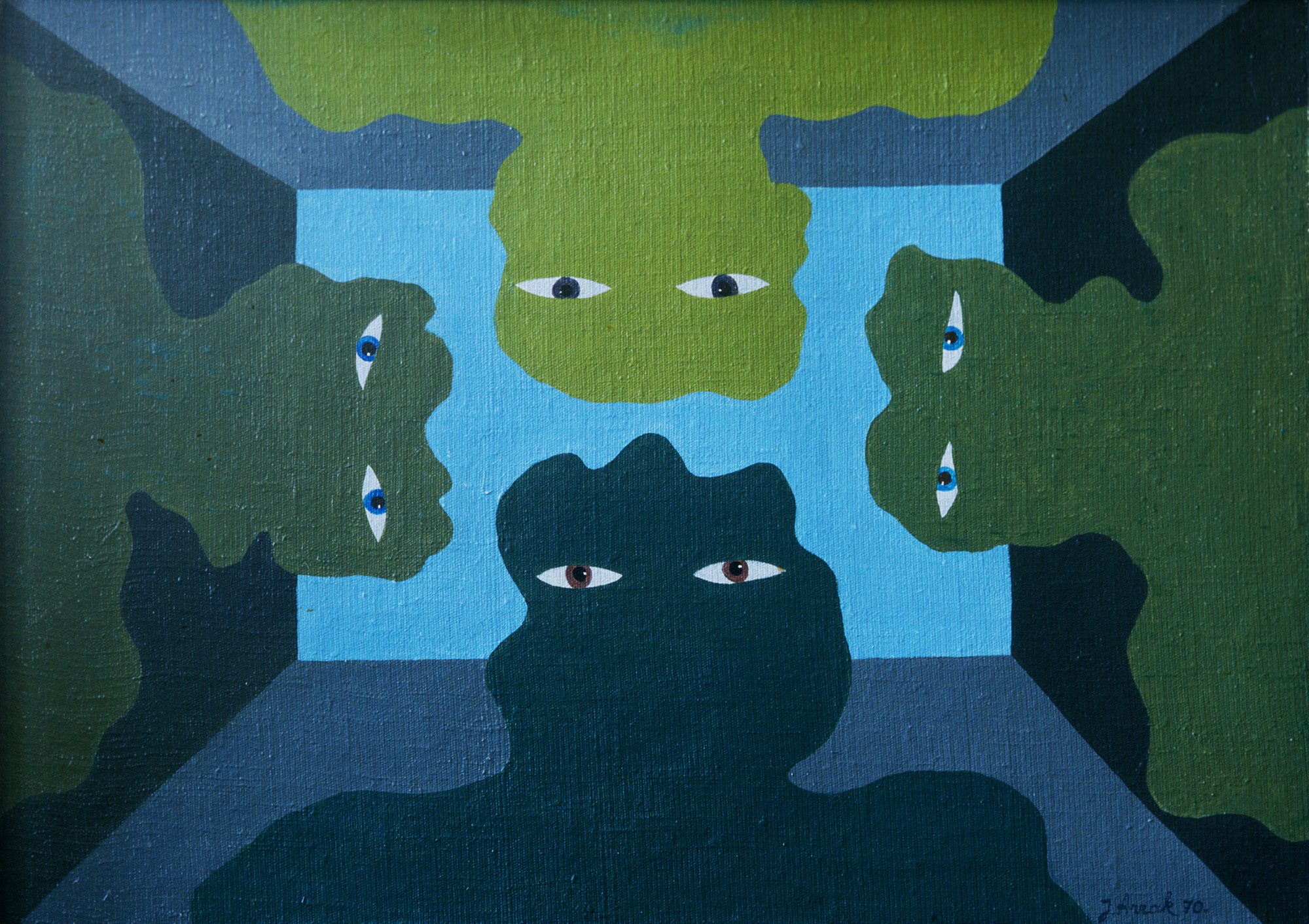
Jüri Arrak
Viewers
1970
Oil on canvas
Private collection of
Andres Eilart
Limitless
Now I will make a big leap in time, to 2021. The half-century has treated Arrak well. His figures have taken on a certain three-dimensionality. Topics have become more complex. Bible stories have now been added to the ancient myths often used in earlier works. The illustrations for the books “The Tales of Panga-Rehe” (Panga-Rehe jutud, 1975) and “Toell the Great” (Suur Tõll, 1982) have brought Arrak’s artistic language into the children’s room, and the allegories of the eighties that he used to proclaim the return of Estonia rang out so loud, like the trumpets of Jericho, that the visual side of our national identity still carries a resonance of the artist’s work. On top of all this, the artist has become one of the most esteemed portraitists since Estonia regained its independence. And all of this is accompanied by the “maivs”.
The evolution of the form does not stop, but enters a process of crystallisation that continues to this day. Arrak explores narrative storytelling, the social mirror effect of portraying groups and the masses, portraiture (in the animal, car and representational genres) and sacred art. The artist is more attracted to what can be done with art than what can be done in art. It seems that there is never a shortage of means of expression. Arrak’s “maiv” does not seem to have a “best before” date. Heights are pursued through thematic concepts and compositional techniques rather than through experiments in form (though the latter occur, if rarely). Even as he creates long series of more classical figures, the artist continually returns to the familiar. “Maivs” can bear even the heaviest of themes: one is reminded of “Killing Officers” (2009, oil), a work created to commemorate the victims of the Katyn massacre.
“Maivs” do not act as substitute figures. They are animated, active characters who, if you look at them in the right light, still seem to be the expression of the modernist impulses that have long possessed Arrak. Perhaps you need to be a chemist to see the memory of liquid carbon in a diamond, but the structure of the atoms does not lie. And the carbon bonds in Arrak’s figurines have not yet been able to find a theme that would break them.
The most recent exhibition by Jüri Arrak took place at Vabaduse Gallery (curated by Reet Varblane).2 Personally, I found it extremely gratifying to see how Arrak’s artistic language had taken on more chamber-like dimensions. The format was smaller, and in the air, there was a funny sense of humility about life. Not in the face of life as some great and important chrestomathic symbol, but in the face of the small, everyday thing that is life’s journey. In the pictures, there was this specific glow, a kind of gentle vulnerability and openness. As if the Bible was making way for God. Arrak had just turned 85. It was a bit scary actually…
At the same time, the exhibition was very impressive. To step back from large and eternal themes to smaller ones, and to do so successfully, deserves recognition on the level of both art and character. Arrak did not get bogged down in the monumental, together with the “maiv”, only to then seem out of place in a more homely atmosphere. Instead, he has taken tiny things and, with a tenderness to his gaze, has painted them into timelessness. Except for one work.
“Gaze” (2021, oil) depicts a “maiv” in a straight-on view, staring at the viewer with light blue eyes and a slightly frozen smile. The figure covers almost the whole of the square-shaped canvas, and it is not clear whether its body is modelled more palely to stimulate the figure’s physicality or to cast light coming from outside the painting. The upper arc of a “maiv’s” eyes is shaped concretely and the lower one blurred, making the issue of light even more problematic. If it has a body shape, it shows a certain complacent fatigue. When it comes to the falling of light, it’s that splash of it in front of the “maiv” that makes the eyes go wide.
A slightly opened mouth will not let the decision go one way or the other: it could be stretched into a broad, contented smile, or could open up to the sublime light that covers it. Anyway, it is gentle. Intense yet gentle. A gaze does not lie. Walter Benjamin’s description of Paul Klee’s “Angelus Novus” (1920) comes to mind. An angel whose gentle gaze sees the past piteously. But the “maiv” is not carried by wings. It is intensely present; it doesn’t even fit on the canvas. The future keeps turning into the present, playing itself out in ways that are almost impossible to look away from. The “maiv” is set in a moment where the “here and now” has just become itself but has not yet sunk into eternity. The gaze that looks at life is the horizon for the “maiv”. And the gaze – it is limitless.
1 NB! To anyone who thinks that I am accusing the artist of betrayal, I would like to remind you of the need for empathy in multifaceted and expressive art.
2 Jüri Arrak’s solo exhibition “The Gaze” at Vabaduse Gallery (22. X–10. XI 2021).
Aleksander Metsamärt is an art historian, curator and film critic, and since 2020 he has been a master’s student in art history at the Estonian Academy of Arts. Recently he curated (with co-curator Tõnis Tatar), at the Mikkel Museum, a branch of The Art Museum of Estonia, the exhibition “Young Jüri Arrak: Storms and Forms” (18. IX 2021–13. II 2022).