16. X 2021–30. I 2022
Tartu Art Museum
Curator: Indrek Grigor
On a rainy autumn evening, three art exhibitions opened in the Leaning House of the Tartu Art Museum: an exhibition of Vano Allsalu’s paintings, “World in the Head”; a group exhibition, “Estonian Energies. The Power of Practice”, curated by Indrek Grigor; and “(self)opinion”, based on the collection of the museum, curated by Julia Polujanenkova. The opening even attracted people from Tallinn, who mixed with the locals, and the three exhibitions merged into one big vernissage, despite the opening speeches for each having been held separately. The following story is dedicated to the Estonian Energies, the group of four old men (Jüri Ojaver, Jaan Paavle, Paul Rodgers and Jaan Toomik), one of whom is now deceased (Paavle, 1940–2010), while the others may no longer be in the best of health. Hence the urgency of what I have to say – let us speak now so that we don’t have to praise in retrospect!
Toomik, Paavle, Rodgers and Ojaver formed their group more than twenty years ago1 in the hope of receiving exhibition support from a certain local electricity producer. It was not to be. They received no money, but at least they took the name, which is better than nothing. The name stuck, and even turned out to be culturally appropriate, as it carried with it associations of masculinity, virility, perhaps even macho nationalism, with its promise to climb the pole to fix the blackout, no matter the weather, just so the needlework indoors does not get neglected through absence of light.
The brand name Estonian Energy represents a masculine engineering culture, industrialism and heavy industry, and an infrastructure that is important to strategic security, on which the well-being of the entire country depends. It is clear that this is an important national responsibility that cannot be entrusted to mama’s boys, humanitarians, artists, softies, minorities, NGOs, activists, the third sector, the poor, women, feminists, children, immigrants, the Mulks, certainly not the Chinese and the Russians, liberals, planet savers, tree huggers, practitioners of traditional culture and other peasants. The brand name Estonian Energy represents state-sanctioned paranoia and phobia, the fear of anomaly and of diversity, and certainly a non plus ultra control network, one that reduces the entire population to a single frequency. Estonian Energy also represented a strong, top-down statesman-like grip on the protection of the country’s welfare, which one might naturally expect from – yes, you guessed it! – the hand of a manly man.
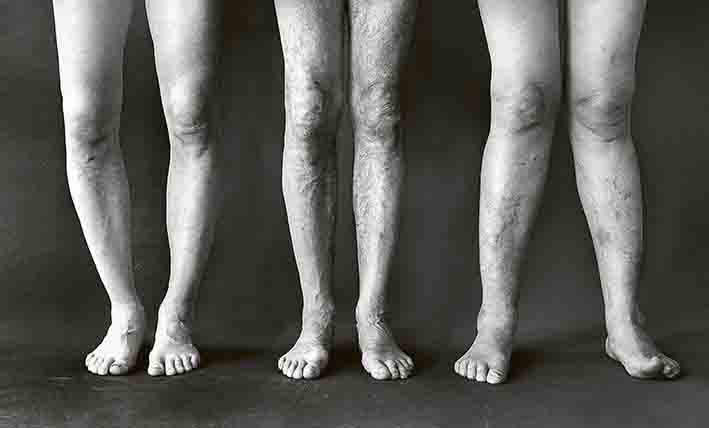
Jaan Toomik’s, Paul Rodgers’ and Jüri Ojaver’s legs
A black and white photograph staged for an exhibition poster
Photographer Mark Raidpere
It should be noted that the fabulous four, the wonderful quartet under discussion, does not really measure up to the hijacked name. One may doubt the sincerity behind the quartet’s desire to offer an artistic Song of Songs in praise of the power plants and the oil shale that burns in the oven. Moreover, they seem to be deliberately sabotaging the horizon of social expectations, which demands that they become “real men”, such as energetic and competent statesmen, perhaps. One of our quartet is already in the Underworld, two are beyond retirement age, and the fourth has entered his seventies; but none of them has become a “real man”. Why?
The point is that they are more interested in the cultural image of masculinity – and of making fun of it – and such a focus does not oblige them to commit to “manly acts”. This they do, nonetheless, through a certain social compulsion, under which all four have grown old. The Soviet Union craved nationally-minded men, as did the idea of Estonia’s re-independence, and, when that was accomplished, so too did the early capitalist mindset of the 1990s. Competitiveness, self-assertion, social Darwinism – these have all been the social norm in their lifetime, justifying the damage done to some, the outright drowning of others, and the incessant screams of those caught between the gears of life. These four have grown up in the midst of social cruelty yet have refused to adopt the militant role-play that is essential to a successful and beautiful life in this race.
On the contrary, Jaan Paavle, for example, chose poetic shamanism instead, or perhaps it chose him; it’s hard to say. In any case, he could still be characterised as someone walking on the verge of death, philosophising and writing poetry about the so-called love-death, in which the state of becoming dust and that of attaining ecstasy reach out to each other tenderly. In this exhibition too, we see Paavle dancing in a trance-like state in his videos. We see and hear the dirty jokes accompanying the pig slaughter, and with his help we also see a male member “having sex with nature”. And finally, we also see his painting, on display for the first and probably last time on the ceiling, which inevitably makes one think that in order to see Paavle, we should for a while now have been obliged to throw our heads back. There is energy in all of this, but it is living for decline, dealing with death and dissolution.
The most modest of the four artists is Paul Rodgers. His morbidness is muted and it is not clear whether that is a general English2 characteristic or a specific personal trait. His works have always been refined, in comparison with the others even classically restrained, with the compositions elaborated and the materials finished. All the same, within these apparently peaceful and formally beautiful installations, an ominous dread is perpetually present. Some kind of micro-violence always comes into play, and with it the danger of getting lost on the path to survival.
A dedication to Rodgers’ long-gone father forms part of his display in this exhibition. Rodgers’ father was a dowser, and used a willow twig to find underground water veins. He left an indelible impression on the young Paul, and this resurfaces from the deeper layers of childhood memory to arrive here, in the exhibition. Or is it the old Paul Rodgers, who now dives back into his childhood through the intervening layers of his adult’s memory? It doesn’t matter: the spirit of the deceased father is here, in the Leaning House in Tartu, and that is what counts. He appears to his aged son as Darth Vader, a cruel knight in a black coat in the middle of a forest of willow twigs. And there is the father-son Oedipal relationship, a classic male disease; but Rodgers is already on the other side of good and evil. He has already suffered from all the age-related illnesses, including the father-killing complex, and is now drawing the line. The twig forest and Rodgers’ father are present at the exhibition in an aestheticised form, behind which is a small family tale.
Rodgers has more stories, but none of the works on show here tell them explicitly. Rather, they do so by hint and suggestion, that things in the picture are wrong, that someone or something is in the wrong place at the wrong time, someone’s paw is trapped and the consequences are irreversible. Volumes of books make up part of a beaver’s dam-building material: why not? We see this engineering achievement in a large nature photo. There is no doubt that nature takes its toll on the books. It is OK to ask: but what can books, apart from cellulose and printing ink, really give a person? Apparently nothing much, beneath the surface of the water. Rodgers portrays this transition, the slow but inevitable liquefaction of meaningful lines: he does not dramatise it, but rather sees it as a natural course of events. The silent melancholy of decline? The lugubrious chords of decadence? Perhaps.
Jüri Ojaver has somehow stolen all the attention this time, acquired the exclusive right to stand in the limelight at this exhibition. At times, it seems that others are orbiting his noisy performance as more reticent satellites. Ojaver is an artist of puns, a maestro of epigrams, but not in the sense of personal eloquence. As a rule, his words belong to someone else, but he notices their inappropriate connotations and of these he makes comical visual generalisations and paraphrases. Words are given form in his works as unnecessary pieces of furniture, and as door mats, carpets that are at times embarrassing if not impossible to use, replete as they are with absurdity and humour, and often awkward conflicts of meanings. How does one step on a carpet with a strange message, “No sexing!”? Or how to approach the statement “The bus comes at eleven, death a little later”? Go figure.
From there, between the meanings, the haystack of ambivalences, we usually find Ojaver, with a trickster smile on his face. And those linguistic short circuits do not seem to end; new works keep appearing. Giant tin ties throw somersaults without dignity in the middle of the hall, ambulatory medical equipment shakes in disco fever amidst them, under the title “The Virus Dies Last” (2021). Nothing is sacred to Ojaver. He is not afraid of dark humour either. Even the video of a lifeguard burying the people he has rescued in the sand proves Ojaver’s courage in leaving good taste behind, as he steps into the playground of simple-minded pranks.
From there, on the other side of good taste, Ojaver often mocks, with mild humour, institutional art ratings and the rank of People’s Artists. There is no ridicule or denigration here. Rather, it’s like the depiction of a French monarch by a foreigner from afar, as something curious and exotic – a literary technique deployed in the socially critical satires of Montesquieu and Voltaire. Ojaver has chosen the Woody and Barky perspective: in the summer of 2021, for example, we saw him perform on the streets of Pärnu as an ordinary tree-stump mushroom, oyster fungus, if I’m not mistaken. These roles give Ojaver the freedom of a folk artist or a fool, and enable him to talk about things in the manner of a child, without the fear of the monarch’s wrath or that of the people. This is his comfort zone, out of which he cannot be pulled. This is his way of skipping so-called manhood and moving from childhood directly to retirement, still accompanied by jokes and laughter, the grotesque overthrowing established power relations.
Jaan Toomik sums up the theme of the exhibition. His new paintings and videos are most closely aligned with those of Jaan Paavle, although also with the paintings of Vano Allsalu, his former comrade-in-arms, who is showing downstairs. There is an expressive and wild rush in the brushstrokes of both artists, including a deliberate dirtiness, reminiscent of the reckless and disturbing aesthetics of the 1980s German neo-expressionist Neue Wilde. The figures are torn and twisted, their eyes wide with horror, their bodies pulled apart in the vortices of cosmic tension fields. After doom, after the apocalypse, we shall all look like that, bleeding, as life slowly leaves our bodies, as if on the butcher’s hook.
Toomik has always painted scenes from the cosmic slaughterhouse, but in his recent paintings the radicalism of his youth has come back to life. The pictures are not painted meticulously, with another sinister scene sketched alla prima and left on the canvas to acknowledge the energy surge that has passed. In their videos, both Paavle and Toomik are looking for a way out for sexual energy in some kind of natural philosophical merging with black soil and rituals of death. The prosaic unity of sex and death develops into a recurrent motif and it seems that if not death then fatigue, life fatigue, has the last word.
“Winter Wrestling” (2021), one of Toomik’s latest video works, shows two fat old men jostling naked in the snow. One nelson follows the other, the hip-tossed falls into the parterre but wriggles out of the grip, and they go against each other again, each of them measuring the strength of the other man. The snow has already been trampled, fatigue and slowness are gaining ground, and soon we see the old men catching their breath on a tree log, jackets on, for a moment, against the cold. And then it continues! True, there is no excitement in this endless battle, never mind beauty. The body touching the snow develops a corpse-like blue complexion, its male member shrunken in the cold air only exacerbating the atmosphere of a final show.
We won’t be seeing them again, that seems certain. They won’t be recovering from this scuffle. Winter wrestling, apparently the name of this new sport, does not boost the morale of the spectators, it does not make the grandstands roar, but it does subdue them into a vita brevis melancholia. The old men have obviously forgotten to stop fighting, a wrestling mat instead of snow is not even tempting any more, and they don’t really know where else to go. They don’t know what else to with themselves. The power of habit is great, and so they go chest to chest with each other again, until all dignity, heroism and hope for a final solution are lost. There is no land for old men, no place to sit down and die in dignity.
1 In 1999, the four men presented the joint exhibition “Estonian Energy” at the Rotermann Salt Storage in Tallinn. After that, eight joint exhibitions took place in the period between 2001 and 2013, but all abroad. – Ed.
2 Paul Rodgers came to Estonia on a British Council scholarship in order to develop an exchange with other artists, and the first man he met when he arrived in Tallinn was Jüri Ojaver. Ojaver and Toomik met in England at a residency organised by Rodgers in Norwich. Jaan Paavle joined through his acquaintance with Toomik. Rodgers and Toomik also began co-curating international exhibitions in Estonia, the most famous of which were the summer art festivals called “GooseFlesh” (2001, 2002) and “PigSkin” (2009, 2010). – Ed.
Johannes Saar is an art historian, critic and educator with a PhD in media and communication from the University of Tartu.