“Love …”
2017, 78 ‘
Director: Sandra Jõgeva
Producer: Igor Ruus / Laterna OÜ
Age limit: K16
“Sandra Jõgeva’s debut “Love… ” tells the story of Veronika, a talented 27 to 29-year-old art student with a nice family background who has decided to drop everything. Veronika is four months pregnant and drinking for a third month in a row. Her beloved Fred is a former criminal whom she once stabbed during a drinking episode sending her temporarily to prison. They spend their days together with other drunks with whom they share a similar pointless view of life, not seeing any reason to prove themselves in any way.”
This film is fitting to write about in an art quarterly for several reasons. Firstly, one of the screenwriters and the director Sandra Jõgeva in mostly known in Estonia as an artist, at least from her previous reincarnations.
At the back doorstep of the art world with a documentary
Changing course in our precarity-ridden socio-economic circumstances is not a rare thing to do, especially if we consider the identity crisis in the field of contemporary culture generally, and so it is not surprising that Jõgeva has recently been more engaged with television and films. Having started as a promising expressive painter, and later rocked in the field of conceptual pop within several artist groups (Pink Punk, Avangard), Jõgeva has now moved away from the visual arts, with only the exception perhaps of the fragile link to her stand-up tragedies, which could be categorized as performance art.
Documentary is also one of the most common forms of contemporary art. Almost all the artists, who have not yet succumbed to the sweet road of decorative arts and who are trying to communicate a social or political message, make documentaries. In that sense, Jõgeva should not be seen as totally expelled from the art world yet.
At the same time, it would be quite difficult to integrate “Love…” into the art scene. First of all, it is too long to be shown at exhibitions. Even the most sadistic camera-based artists and curators do not dare to show films over 40 minutes in exhibition spaces. Secondly, this film is too good. Artist’s documentaries should be rather poor: with agitated hazy camerawork, unedited with interviews and texts that bore you to death, terrible sound and an artistically subjective structure (i.e. dragging and incomprehensible).
Hard-handed with her baby
Alas, the film by Jõgeva and Ruus is too good for this, making it also suitable for cinema and television. If anything could be reproached from the technical side, it is perhaps the occasional lapses in sound quality, some parts of the monologues and dialogues might be slightly difficult to understand. However, considering the delicacy of the subject, it is also forgivable. It would have been impossible to add microphones to every eccentric violent drunk, and the scrupulous officers in the courtroom. Such a solution would have probably brought about a loss of authenticity, and a large part of the scenes might not have taken place at all had the presence of the crew been overly intense. Luckily, it is always possible to add subtitles to these scenes.
A work of art acquires its quality from the energy put into it. This can be manifest in time, money, effort, joy or whatever. In the case of this film, the importance of time, in the sense of a long shooting period, becomes significant. It allowed the main characters to go through quite a lot during this period. There was even hope that they would develop as individuals. This hope was not fulfilled, which is of course not the fault of the filmmakers, but rather the concern of the characters themselves.
Having a lot of material may become problematic: the filmmakers may be tempted to pile things, and not give up on anything as every scene seems brilliant. The editors of the film Kristiina Davidjants and Riina Paldis show their iron resolve here, making a clever and well-organized selection from the material. Most of the scenes from the lives of the glamorous lowlifes are certainly only pieces of a larger story, which probably continues in the same juicy way. Yet, only the best, only the scenes forming a meaningful whole with those before and after them have made it to the selection.
Becoming a trolley-bus driver in six months!
In addition to the background of the director there is another reason to write about this film in an art quarterly. The main character is also part of the art world, having recently obtained a BA from the fine arts department of the Estonian Academy of Arts (EAA). Indeed, she manages to finish her degree with playful ease, despite periods of heavy drinking and imprisonment. One might be tempted to make conclusions based on this about the level of education at the institution.
Watching the scenes in the film concerning the academy, I remembered the time when I used to take part myself in the preparatory courses at ERKI (State Art Institute of the Estonian SSR, and predecessor to EAA – Ed.) in the 1980s. Of course, the choice of the colours in the shops and the students’ options for exhibiting their work (e.g. student presentations took place in St. Nicholas’ Church Museum instead of the art school halls) have shown some progress since then. In general though everything has remained the same. The tasks and the ways of solving them (usually at the last minute) have not changed. The professors used to be stricter, but now everyone has to be treated with tolerance. The current BA level seems to be a combination of the former preparatory courses and kindergarten.
It does not even surprise me so much that the talented, albeit self-destructive girl, managed to pass all the creative tasks. However, the curriculum of an establishment of higher education also involves theory and general courses, and so how she saw her way through all the essays, exams and tests while also being subject to miscarriages, rehab, judicial processes, fights and stabbings presents a great mystery to the viewer.
The questionable quality of the three-year bachelor’s degree does not concern of course only the Estonian Academy of Arts, the whole of Europe has taken this course together with the Bologna accords. Three years might be enough to learn skilled work – you learn the skills of machine management for example – and afterwards add a master’s degree in business management, if you want to rule the roost. In the current case though, it makes one wonder who needs this mass of artists educated only for three years? Indeed, many of them will continue their studies. Many of them are also aspiring and keep learning by themselves. Nonetheless there still remains a large group of “half-artists”, which society has nothing to offer and who also struggle to find their place in life.
In the case of the film’s main character Veronika it would be unwise though to blame the art academy. Blaming someone or something in the case of psychological and behavioural disorders (of which Veronika seems to have plenty: alcoholism, bulimia, aggressiveness, narcissism, nymphomania, psychopathy, being a delinquent mother, etc.) seems a dangerous road anyhow. People are influenced by many different factors. Veronika mentions in the film that she had hoped to arrive into a palace on entering the Estonian Academy of Arts, but instead she ended up in a toilet; at the same time, she also talks badly about her father, accusing him of “brainwashing” her. Considering what’s shown on the screen though, her father seems a relatively normal person.
No one is flawless, but at least he does not seem to be a maniac or a criminal, and what’s most important, he is still there for her. This already shows quite a lot. Veronika’s extreme decline is mainly the result of her own choices. Blaming the parents, education system or society is uncalled for. The film does not do that either, the viewers are left to make their own conclusions.
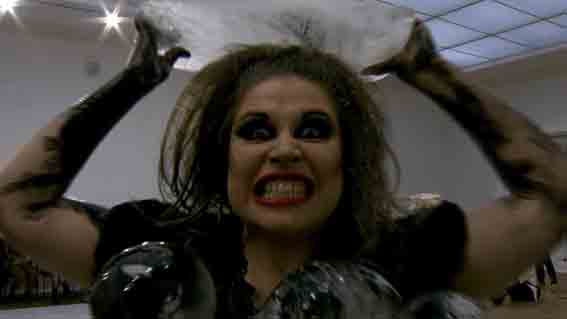
“Love …”, still frame
2017, 78 ‘
Director: Sandra Jõgeva
Producer: Igor Ruus / Laterna OÜ
Age limit: K16
Harmonious composition with a glamorous downfall
Veronika’s life is made up of all the scenes we are usually accustomed to seeing in crime documentaries or reality TV shows with scandalous aims. Of course, we all have our weak points and secrets, but this kind of concentration of trouble is rare. This kind of material would be good for a “yellow” film where the characters are relieved of the last of their dignity. However, the authors of the film have not taken that road.
Based on the film, Veronika’s life seems to be an endless pattern expanding in every direction, decorated with cheap glamour, but underneath consisting of inevitable destruction. There must have been even more juicy details and gloomy scenes but not all of it has been used to maintain a more neutral representation.
It is not very easy to put together the exact sequence of events, but this is not important anyway. It does not actually matter which year she had her baby or was in jail. The important thing is that it all seems to repeat itself taking a more horrible turn each time. None of the setbacks in their personal lives, let alone the social pressure, seem to be sufficient for them to make viable changes in their lifestyles.
There are indeed some moments, even days, when they try to stay sober, but sooner or later their will breaks and the downfall continues at an even faster pace. The film is akin to a medieval tapestry, where hideous scenes take place alongside sweet ones, side by side in a respectable composition, without any hierarchy and judgement. This is just how it is, it is a divine creation, a divine predestination, where each character obediently fulfils their role, and it seems that all of this could even have some kind of a more distant, noble purpose. Probably it will be reached, however, in some future dimension because in the present context it is even hard to find a moral in this film.
Job offer from the Ministry of Health?
Could “Love…” be used as a tool in the fight against alcoholism, regarding the current efforts of the new Estonian Government together with the Minister of Health and Labour? Probably not.
Veronika’s case is so extreme that the vast majority of the population, including those who have a drinking problem, cannot relate to these characters. A housewife who consumes a couple of bottles of wine during the evening does not stab her husband or abandon her children. A lowlife boozer swallowing cheap beer in turn with aftershave does not wear perfect make-up or snake print boots. An art student who drinks a few beers more than they should is not usually accompanied by outcast drunkards and criminals.
In that sense Veronika is more an exception than a cautionary example. And this film is more like a work of art than a social documentary or an anti-alcohol campaign. Yet, in its delicate and modest form it is also telling us something about our current society.
Mari Kartau is an art critic, curator and artist, she works for the weekly Maaleht.