30. III–16. IV 2016
Noorus Gallery
Nooruse Gallery, run by the Tartu Art College, has begun a new series of exhibitions, which, as it says in the press release, “aims to present current-day sculpture from Estonia and abroad”. Eike Eplik and Berit Talpsepp-Jaanisoo’s joint exhibition is an excellent choice to kick off the series in a number of ways. Firstly, both artists, compared to their course mates Jevgeny Zolotko, Jass Kaselaan and Art Allmägi, have received far less attention than they deserve. Secondly, their exhibition is appropriate considering in the current wave of competent and original women artists in Tartu (think of Laura Põld and Eva Mustonen’s exhibition at the Tartu Art Museum). Thirdly, this is clearly a step forward in the gallery’s exhibition policy, which until now has focused on current students at the art school, and less on graduates and establishing artists.
Awareness of materials and tradition
The exhibition space was divided into two almost equal parts with many interesting opportunities for dialogue, but which despite this were like independent micro-exhibitions and did not rely on each other. Even the exhibition poster and press release presented the artists separately, and drew no greater similarity between them than the fact that, “their sculptures of the last few years can be characterised as a conceptualised physical presence and sensitive intellectual connection with the evolution of the genre of sculpture”, in other words contemporary artists who are aware of material and tradition.
The first part of the exhibition space was devoted to Eike Eplik’s work, which comprised three mask-like reliefs, a group of various coloured stumps, a horse’s head and an observation tower with mole hill-like mounds. For many years Eplik has combined materials from nature (branches, stuffed animals and the like), either clearly or hinting at a fairy tale narrative. The collection this time was not as integrated as her solo exhibitions “Väike oks” (Little Twig, 2011) and “Tüdruk, kes kõike armastas” (The Little Girl Who Loved Everything, 2012) at Y-Gallery, but it dealt with the same question: how to make us notice the transient, which we would not notice otherwise. It is gratifying to see how Eplik managed to make a dried up stump, strange distorted masks, opened skulls and mole hills, interesting – in other words everything that we might annoyingly trip over in the landscape, soil our shoes on or even, and why not, instil horror in us.
Eplik typically looks from a distance, but still maintains a compassionate position from which her intimate relationship with the landscape and the motifs she uses shines through. One could claim that for Eplik art is a way of connecting with the environment and making sense of it in a personal way. Whereas in Talpsepp-Jaanisoo’s case it is apparent that she is interacting with tradition and canon, asking how to engage with traditional themes, but at the same time using contemporary technological solutions. In the exhibition there are two figurative sculptures “Surev ori” (Dying Slave, 2016) and “Sfinks” (Sphinx, 2015–2016) made using the artist’s own special technique, which look like a pixelated surface, and therefore, postinternet art. The figure is accompanied by three photographs of men and women in the landscape.
Alice in Wonderland?
It took some time before I realised why Talpsepp–Jaanisoo’s sculptures seemed so foreign, one might even say exotic, in the Estonian context. A large number of Estonian sculptors primarily work with space and make installations and most avoid representing the human figure. Talpsepp-Jaanisoo’s work seems to have more in common with antique sculpture than local sculptural practice today. She is interested in depicting human anatomy in the manner of a classical nude, but the symbolic and allegoric meaning seems to be just as important. Hence, the two figures in the exhibition are prime examples of the artist’s focus. “Surev ori” is a remake of the classical ideal of male beauty using contemporary means and “Sfinks”, a feminist statement by Talpsepp-Jaanisoo, as an artist and a woman. Instead of a lion’s body for the sphinx she has chosen a rabbit’s body, which according to her symbolises a lonely and melancholy animal, but which also has the feminine strength and wisdom attributed to the sphinx.
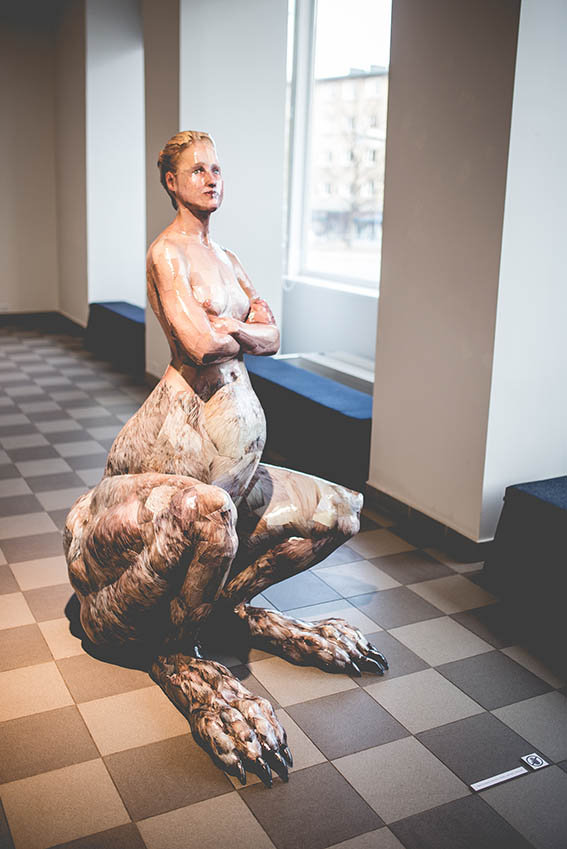
Berit Talpsepp-Jaanisoo
The Sphinx
2015–2016
CNC milling, steel, styrox, photogaphs, 184x70x80 cm
Exhibition view at Noorus Gallery
Courtesy of the artist
Photo by Jevgeny Zolotko
It is interesting how the photographs and sculptures refer to one another and seem to create a common landscape. “Surev ori” is positioned on a stony surface, as are the people in the photographs, emphasising connection and continuation, but because the statue is surrounded by people climbing around in the landscape and the absurd monkey’s head that lies behind the slave’s knee, there is none of the drama and seriousness of classical works. The Sphinx is like a self-ironic commentary, and thoughts move towards the comic March Hare rather then feminine strength and reason.
If we try to verbalise what the first two artists in the series of exhibitions, Eplik and Talpsepp-Jaanisoo, are telling us about sculpture generally, we see that these are two very different artists, working with very different subjects, and who are highlighting a number of issues in contemporary art. In Eplik’s case this is dominated by an intuitive and implied personal mythology, which can be read through the materials and her empathetic approach. In Talpsepp-Jaanisoo’s case it is dominated by an analytical and playful approach to tradition, whose aim is the reworking and rethinking of existing cultural heritage. Both strategies are necessary.
Triin Tulgiste works as project manager at Kumu Art Museum.